
Views: 222 Author: Leah Publish Time: 2025-12-01 Origin: Site


Content Menu
● Understanding Automatic Knives
● What Is an Automatic OTF Knife?
● Internal Mechanism Comparison
● Deployment Speed and User Feel
● Safety Features and Blade Control
● Durability and Maintenance in Outdoor Use
● Blade Styles and Edge Options
● Ergonomics and Carry Options
● Legal and Regulatory Overview
● Use Cases for Automatic OTF Knife
● Use Cases for Side‑Opening Switchblades
● OEM and Branding Perspective
● How to Choose for Your Customers
● FAQ
>> 1) Is an Automatic OTF Knife just another type of switchblade?
>> 2) Which is more durable for outdoor use, an Automatic OTF Knife or a side‑opening switchblade?
>> 3) Is an Automatic OTF Knife safer than a side‑opening switchblade?
>> 4) Are Automatic OTF Knife models legal to carry in most countries?
Automatic OTF knives and traditional switchblade knives are both automatic blades, but they differ in mechanism, handling, durability, and ideal applications for end users and OEM brands. An Automatic OTF Knife launches the blade straight out of the front of the handle, while a classic switchblade usually opens from the side like a folding knife.[1][5]
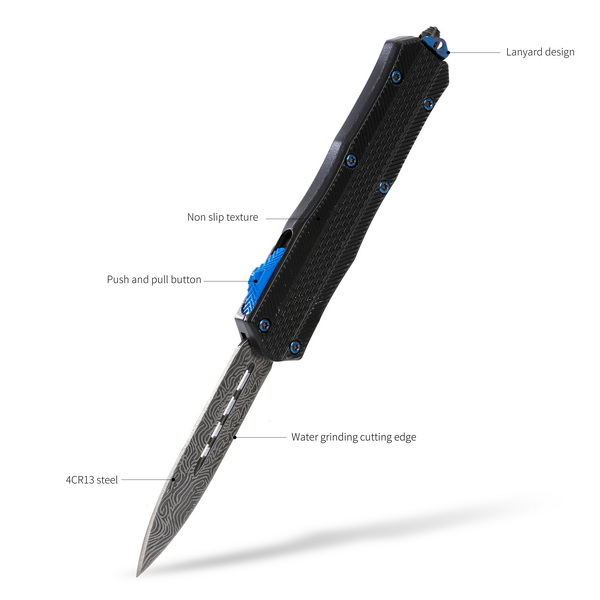
Automatic knives are blades that open with stored spring energy rather than purely manual force. When a user presses a button, slide, or lever, the spring releases and drives the blade into the open position. Both a traditional side‑opening switchblade and an Automatic OTF Knife fall within this automatic category, but their internal structures and user experiences are not the same.[3][5][6]
Automatic knives are often confused with assisted‑opening and gravity knives, yet the resting position and how the blade actually starts moving are different. In assisted models, the blade is naturally closed and needs manual pressure before the spring helps complete the movement. In automatic knives such as an Automatic OTF Knife, the spring is held back by a lock and releases as soon as the control is activated without pushing directly on the blade.[1][3]
An Automatic OTF Knife (Out‑The‑Front knife) is a type of switchblade where the blade travels in a straight line out of a slot at the front of the handle. The blade remains completely enclosed inside the handle when retracted, then shoots forward along internal rails when the user actuates a button or slide.[5][1]
Most modern Automatic OTF Knife models are either single‑action or double‑action. A single‑action OTF uses spring power to extend the blade but must be retracted manually, while a double‑action Automatic OTF Knife allows both extension and retraction through the same control. Double‑action designs offer faster, fully one‑handed operation, which is especially attractive for tactical, rescue, and outdoor tasks.[5][1]
The term "switchblade" is commonly used for any automatic knife that opens with a button or similar control, and in many legal and technical contexts it includes OTF knives. However, in everyday conversation "switchblade" usually refers to side‑opening automatic knives, also called out‑the‑side (OTS) automatics.[6][3][5]
In a typical side‑opening switchblade, the blade pivots out of the handle like a normal folding knife, driven by a spring that is pre‑loaded when the knife is closed. When the user presses the button, the lock releases the spring, causing the blade to swing rapidly into the open and locked position. This simpler rotating motion makes side‑opening switchblades mechanically straightforward compared to many Automatic OTF Knife systems.[3][6]
The main structural difference between an Automatic OTF Knife and a side‑opening switchblade is the path of the blade. In an Automatic OTF Knife, the blade slides forward and back along an internal track, guided by rails and driven by one or more springs. In a side‑opening switchblade, the blade rotates around a hinge or pivot, actuated by a coil or leaf spring anchored inside the handle.[6][1][3][5]
Single‑action Automatic OTF Knife designs deploy very quickly using strong springs, but the user must manually pull the blade back into the handle, often by drawing it to a reset position on the track. Double‑action Automatic OTF Knife mechanisms are more complex, with additional parts that allow the same slide or button to both engage and retract the blade under spring tension. This extra complexity can slightly increase wear over time compared with simpler single‑action or side‑opening designs.[1][5]
Both an Automatic OTF Knife and a side‑opening switchblade offer extremely fast deployment, but the feel is distinct. An Automatic OTF Knife sends the blade straight forward, giving a direct, linear motion that many users find natural for precision thrusting, puncturing packaging, or quickly reaching a target with the tip. The handle stays centered behind the blade during deployment, maintaining a full grip from the moment the slide is pushed until the blade locks.[8][5][1]
Side‑opening switchblades provide a more familiar swinging motion similar to a traditional folding knife, which can feel better for slicing tasks and general cutting. The blade arcs out and away from the handle, and the thumb usually rests near the pivot or button. For users already experienced with standard folders, this makes the transition to a side‑opening automatic simple and intuitive.[8][3][5][6]
Safety is a critical aspect of both designs. Many quality Automatic OTF Knife models include internal safeties or "fail‑safe" mechanisms that disconnect the blade from the spring drive if the tip meets resistance mid‑deployment. In such cases, the blade does not fully lock and can be reset by pulling it back, preventing serious damage or accidental injury.[5][1]
Side‑opening switchblades usually rely on button locks, liner locks, or similar systems to hold the blade open and closed. Some models feature recessed or guarded buttons to minimize accidental activation, while others may have sliding safeties that must be disengaged before the button works. In both Automatic OTF Knife and side‑opening designs, responsible handling and safe storage are essential to avoid unintentional deployment.[3][6][8][5]
Because an Automatic OTF Knife has moving parts, internal tracks, and multiple small components, it can be more sensitive to dirt, sand, and pocket lint than a basic side‑opening switchblade. Outdoor users often need to clean the interior channel of an Automatic OTF Knife more frequently, using compressed air, light lubrication, and periodic disassembly when the design allows.[8][1][5]
Side‑opening switchblades tend to have simpler structures focused on the pivot, spring, and lock. These parts are generally easier to flush and lubricate, and there is usually less chance of debris blocking the deployment path. However, high‑quality Automatic OTF Knife products from reputable OEM factories can still perform very reliably outdoors if users follow cleaning and maintenance guidelines.[3][5][8]
Both Automatic OTF Knife products and side‑opening switchblades are available with multiple blade shapes and edge configurations to suit different buyers and use environments. Common edges include straight (plain), serrated, and partially serrated, each offering distinct cutting characteristics. Straight edges are easy to sharpen and leave a clean cut, while serrated edges excel at cutting fibrous materials such as rope and webbing.[1]
Automatic OTF Knife blades are often offered in single‑edge and double‑edge formats. A single‑edge Automatic OTF Knife blade provides a stronger point and more safety in general utility tasks, while a double‑edge configuration can be favored in self‑defense or tactical roles because both sides of the blade are sharpened. Side‑opening switchblades share similar blade choices, but many brands lean toward traditional profiles such as clip‑point or spear‑point for a classic look.[5][1]
The handle of an Automatic OTF Knife is usually symmetrical and rectangular to accommodate the internal track and springs, giving a modern, tactical appearance. This symmetry allows the user to maintain a stable grip during deployment and retraction, especially in double‑action designs where the thumb rides a spine‑mounted slide. Many Automatic OTF Knife models include deep‑carry clips and textured scales that improve retention in wet or gloved conditions.[8][1][5]
Side‑opening switchblades frequently mimic conventional folding knife ergonomics, including ergonomic curves, finger choils, and scales shaped to fit the hand. They may be slimmer than some Automatic OTF Knife handles, which appeals to everyday carry users who prioritize low profile and pocket comfort. For OEM clients, grip shape, clip style, and handle texture are key areas where brand identity can be built around either mechanism.[5][8]
From a legal perspective, many jurisdictions treat the Automatic OTF Knife and the side‑opening switchblade under the same general "automatic knife" or "switchblade" category. Regulations often focus on whether the blade opens with a button or similar actuator rather than the exact direction of deployment. However, specific rules vary widely by country, state, and even municipality, including restrictions on blade length, carry method, or commercial sales.[6][3][5]
In some regions, Automatic OTF Knife models may attract more attention because of their tactical appearance and media portrayals, even when the law technically groups them with other switchblades. Brands, wholesalers, and importers must confirm local laws for each target market before launching an Automatic OTF Knife or side‑opening automatic series, especially when shipping across borders or marketing for everyday carry.[8][5]
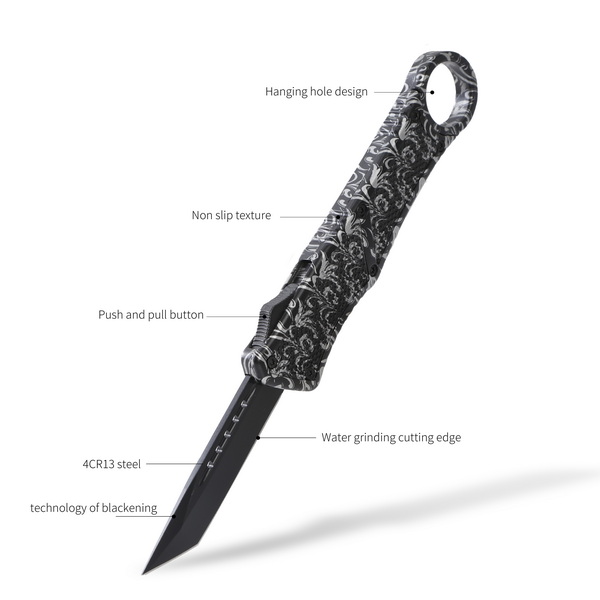
An Automatic OTF Knife excels wherever fast, one‑handed, linear deployment and precise tip control are important. Common applications include:[5][8]
- Tactical and law‑enforcement roles where quick access and compact carry are essential.[5]
- Emergency rescue tasks such as cutting seat belts, webbing, and clothing when minutes matter and one hand may already be occupied.[1][5]
- Outdoor and survival situations where the user wants a modern, robust automatic blade with strong piercing performance.[5]
Because the Automatic OTF Knife design keeps the blade fully contained within the handle when retracted, many users appreciate its safety during carry and storage. Dual‑action Automatic OTF Knife models add speed and convenience by allowing the user to extend and retract the blade without changing grip, which is a strong selling point in premium OEM lines.[1][5]
Side‑opening switchblades are broadly chosen by users who prefer familiar handling and traditional folding knife aesthetics. Popular use scenarios include:[8][5]
- Everyday carry for users in regions where automatic knives are legal and classic styling is valued.[5]
- General utility tasks where a robust pivot and strong lockup provide confidence in cutting, slicing, and opening packages.[6][3]
- Collectible and heritage knives that highlight iconic switchblade silhouettes and historical designs.[5]
Because side‑opening switchblades share ergonomics with manual folders, they can be easier for new automatic knife users to adopt. Their simpler construction can also translate into lower cost compared with intricate Automatic OTF Knife mechanisms, which is useful for brands targeting entry‑level or mid‑price market segments.[3][8][5]
For overseas brands, wholesalers, and manufacturers, the choice between an Automatic OTF Knife and a side‑opening switchblade is both a technical and marketing decision. An Automatic OTF Knife series can position a brand as modern, tactical, and innovative, emphasizing advanced mechanisms, dual‑action deployment, and high‑tech aesthetics. By contrast, a side‑opening automatic collection may highlight heritage, classic lines, and affordable reliability.[8][5]
A professional OEM factory can tailor Automatic OTF Knife projects according to the buyer's target market, including customized handle materials, blade steels, finishes, and safety features. The same applies to side‑opening switchblade OEM programs, where brands may request traditional or contemporary profiles, different spring strengths, and local‑law‑compliant blade lengths. Combining both an Automatic OTF Knife line and a side‑opening automatic line enables a complete portfolio that serves tactical, EDC, and collector niches worldwide.[1][8][5]
When deciding whether to prioritize an Automatic OTF Knife or a side‑opening switchblade, consider:
- Target user profile: Tactical professionals and enthusiasts often gravitate toward Automatic OTF Knife designs, while mainstream EDC users may favor side‑openers.[8][5]
- Price positioning: The more complex mechanism of an Automatic OTF Knife often fits mid‑to‑high price tiers, whereas simpler side‑opening designs can dominate entry‑level and mid‑range.[1][5]
- Local laws: Some jurisdictions heavily restrict or prohibit automatic knives, so verifying whether an Automatic OTF Knife can be imported or sold is essential before committing to production.[3][5]
By aligning mechanism choice, design language, and legal compatibility, brands can build coherent product families that highlight the strengths of both Automatic OTF Knife products and classic switchblades.
Both the Automatic OTF Knife and the side‑opening switchblade are powerful automatic knife platforms, but they excel in different ways. The Automatic OTF Knife offers straight‑line deployment, modern styling, and excellent tip control, making it ideal for tactical, rescue, and advanced outdoor roles where one‑handed operation is critical. Side‑opening switchblades provide familiar ergonomics, simpler construction, and classic appeal, fitting everyday carry, utility work, and heritage‑style collections. For brands and OEM partners, integrating an Automatic OTF Knife series alongside side‑opening automatics enables a complete product strategy that satisfies diverse customers and legal environments in global markets.[3][1][8][5]
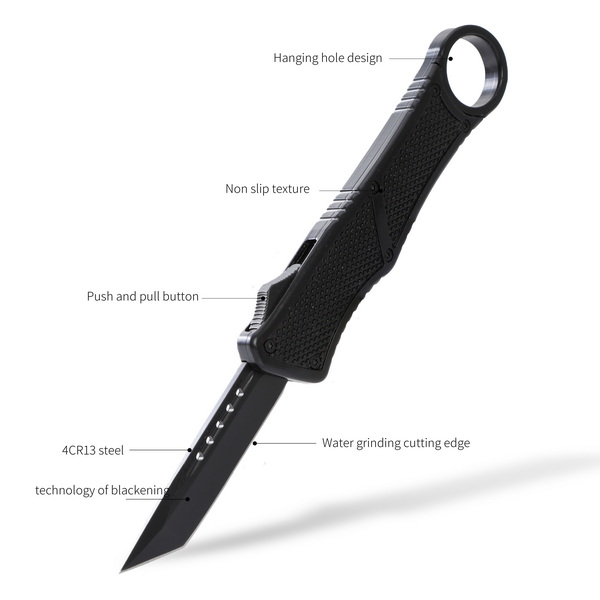
Yes. An Automatic OTF Knife is a specific kind of switchblade where the blade deploys straight out of the front of the handle instead of swinging from the side. In common language they are often discussed separately, but legally they are usually treated under the wider automatic or switchblade category.[6][3][1]
A high‑quality Automatic OTF Knife is very capable outdoors, but its sliding track and internal parts can collect more dust, sand, and lint, so it needs more frequent cleaning. Side‑opening switchblades have simpler pivots and may feel more robust long‑term with less maintenance, especially in very dirty environments.[3][1][8][5]
Both designs can be safe when properly made and used. Many Automatic OTF Knife mechanisms include a feature that prevents full lockup if the tip hits an obstacle during deployment, reducing the chance of serious accidents. Side‑opening switchblades typically rely on guarded buttons and locks to avoid accidental activation, so safe handling habits are important for both types.[6][1][3][5]
No. Laws governing automatic knives vary widely, and in many places both Automatic OTF Knife products and side‑opening switchblades face strong restrictions or outright bans. Before purchasing, importing, or carrying an Automatic OTF Knife, users and brands must check the specific regulations in each country or state they operate in.[3][8][5]
If your brand targets tactical users, collectors of advanced mechanisms, or premium price segments, an Automatic OTF Knife series can create a strong high‑tech identity. If you focus on everyday carry, classic styling, and broader price coverage, side‑opening switchblades may be the better starting point, with Automatic OTF Knife models added later as a flagship or premium upgrade.[8][5]
[1](https://tacknivesusa.com/what-is-an-otf-knife-and-how-is-it-different-from-other-switchblades/)
[2](https://www.vipertecknives.com/blogs/news/switchblade-vs-otf-knives-key-differences-and-which-to-choose)
[3](https://knife-depot.com/pages/switchblade-vs-assisted-opening-knives)
[4](https://www.youtube.com/watch?v=-yOd5kC3Mak)
[5](https://www.tektoknives.com/blogs/news/understanding-different-types-of-switchblades)
[6](https://swordsswords.com/blog/difference-between-switchblades-and-other-automatic-opening-knives/)
[7](https://www.youtube.com/shorts/tkAZI82jmu4)
[8](https://www.58hrcknives.com/otf-pocket-knife-vs-switchblade-understanding-the-key-differences.html)
[9](https://www.reddit.com/r/knives/comments/122n27w/honest_question_why_carry_an_auto_when_other/)


