
Views: 222 Author: Leah Publish Time: 2025-12-02 Origin: Site


Content Menu
● What Is an Automatic OTF Knife?
● Why Authenticity and Quality Matter
● Start With Trusted Sales Channels
● Check Branding, Logos, and Markings Carefully
● Analyze Product Descriptions and Specifications
● Use Price as a Risk Indicator
● Inspect Images and Request Additional Visual Proof
● Evaluate Mechanism Action and Lock‑Up
● Assess Blade Steel and Heat Treatment
● Check Handle Materials, Hardware, and Fit
● Packaging, Documentation, and Warranty Signals
● Use Reviews and Community Knowledge
● Legal and Safety Considerations Before Buying
● Working With Reliable OEM Manufacturers
● Step‑By‑Step Checklist for Buyers
● Maintenance as a Long‑Term Quality Test
● FAQ
>> 1) How can I quickly tell if an Automatic OTF Knife is fake?
>> 2) Is some blade play normal in an Automatic OTF Knife?
>> 3) What should I look for in a high‑quality Automatic OTF Knife blade?
>> 4) Why should brands work with established OEM factories for Automatic OTF Knife production?
>> 5) How often should I maintain my Automatic OTF Knife?
Automatic OTF Knife buyers today face a market filled with both premium products and low‑quality clones, making verification more important than ever. Whether you are a brand owner, wholesaler, or individual user, learning how to verify authenticity and quality will protect your safety, your money, and your reputation.[3][7]
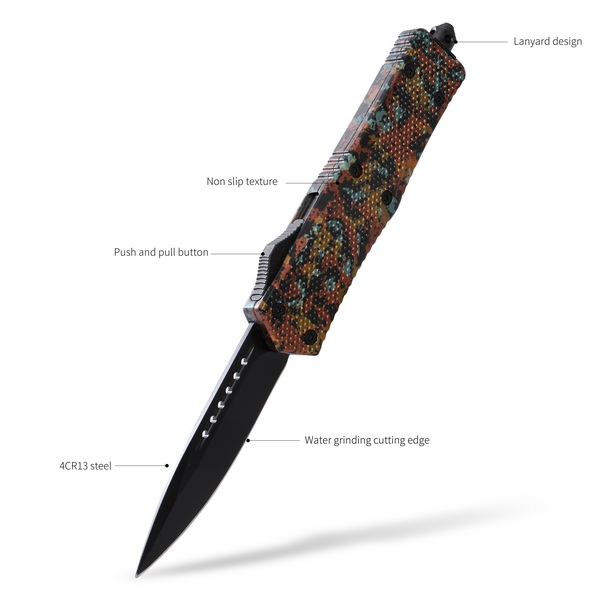
An Automatic OTF Knife (out‑the‑front knife) is an automatic knife whose blade travels in a straight line out of the front of the handle when activated by a button or slider. Many modern designs use a spring‑driven mechanism for both deployment and retraction (dual‑action), which demands precise machining and reliable internal components.[7][11]
Because the Automatic OTF Knife relies on tight tolerances inside a narrow handle channel, any error in design, materials, or assembly can cause misfires or lock‑up failure. This is why counterfeit or poorly made versions are not only disappointing but can also be unsafe during real use.[4][11][12][3]
Authentic Automatic OTF Knife models from reputable brands or OEM factories are built with controlled blade steel, consistent heat treatment, and tested internal mechanisms, resulting in predictable deployment and long‑term durability. Counterfeits often copy the external silhouette but use inferior steels, weak springs, and inconsistent hardware, which leads to faster wear, failure to deploy, and poor cutting performance.[13][3][4][7]
For international brands, wholesalers, and importers, authentic, high‑quality Automatic OTF Knife products also protect trademark value and reduce warranty claims and returns. A single batch of low‑grade clones with your logo can damage a market you have spent years building.[14][15][7]
The first filter for any Automatic OTF Knife purchase is the sales channel. Premium manufacturers emphasize that customers should buy only from listed authorized dealers or reputable online retailers that specialize in knives and outdoor gear.[1][3][7]
For private‑label brands and wholesalers, working directly with verified OEM factories in established knife‑making regions, such as Yangjiang in China, is one of the safest ways to control quality. Industry sources list Yangjiang Ruizhen Industry and Trade Co., Ltd. as an experienced OEM supplier of Automatic OTF Knife products for overseas markets, offering stable production and customization capability.[15][14]
Authentic Automatic OTF Knife products typically feature consistent, precise logos and markings on the blade, clip, or handle. Buyers should look at the font, spacing, positioning, and clarity of laser etching or engraving, then compare those details with official images or documentation from the brand.[5][1]
Counterfeits often reveal themselves through slightly distorted logos, thicker or rougher laser marks, shifted placement, or missing model numbers and serial codes. On many collectible knives, real models have clearly defined serial numbers that can be checked against the brand's records, while fake Automatic OTF Knife copies either skip them or use random, repeated sequences.[9][10][1][5]
A serious Automatic OTF Knife listing usually provides a full specification sheet, including blade steel, blade length, handle material, hardness range, mechanism type, and weight. When the description is vague, only says "high quality steel", or makes unrealistic promises such as "never needs sharpening", this is a warning sign.[3][5][7]
Before confirming an order, compare the listed specifications for the Automatic OTF Knife with those published on the official brand or OEM website. Any mismatch in steel type, dimensions, or mechanism description can indicate that the seller is offering a different product from what is claimed.[5][7]
Price alone cannot prove authenticity, but it is a strong indicator when combined with other factors. Genuine Automatic OTF Knife models that use quality material and complex mechanisms have a certain minimum production cost, so retail prices usually stay within a relatively stable range in each market segment.[7][13][3]
If you find an Automatic OTF Knife that appears identical to a known premium model but is sold at a fraction of the usual price, treat it with caution. For large orders, brands and wholesalers can compare quotes from reputable OEM factories, such as qualified Yangjiang manufacturers, with unusually cheap offers from unknown suppliers to identify suspicious gaps.[14][15][3][7]
High‑quality, multi‑angle photographs provide vital clues about an Automatic OTF Knife's authenticity. Look for clear, high‑resolution images showing the blade grind, edge lines, handle texture, pivot screws, clip, and mechanism button or slider.[11][3][7]
If only one or two generic stock photos appear in a listing, serious buyers should request extra images or a short demonstration video of that exact Automatic OTF Knife. Ask the seller to show close‑ups of branding, serial numbers, packaging, and any unique design elements so you can compare them with reference materials.[3][5][7]
The action of an Automatic OTF Knife is one of the most direct tests of quality. On a good knife, the blade deploys quickly and consistently when the button or slider is activated, locks firmly in place, and retracts smoothly when commanded, with a crisp feel and predictable resistance.[12][11][7]
A poor Automatic OTF Knife often shows several issues: failure to fully deploy, weak lock‑up, heavy grinding during travel, or random misfires when pointed upward or downward. Some blade play is normal in many dual‑action OTF designs, but excessive lateral or vertical movement suggests poor internal tolerances or worn parts.[16][17][4][11]
The blade is the working heart of any Automatic OTF Knife, so steel choice and heat treatment strongly affect real performance. Quality models use steels whose properties are well understood, providing a balance of hardness, toughness, corrosion resistance, and sharpenability appropriate for the intended application.[13][7]
Many counterfeits copy premium steel markings on the blade but use cheaper alloys that do not match the claimed performance. Brands and wholesalers can ask OEM suppliers for information such as typical hardness values, internal steel certificates, or basic cutting test results for the Automatic OTF Knife series they are ordering.[2][6][15][13]
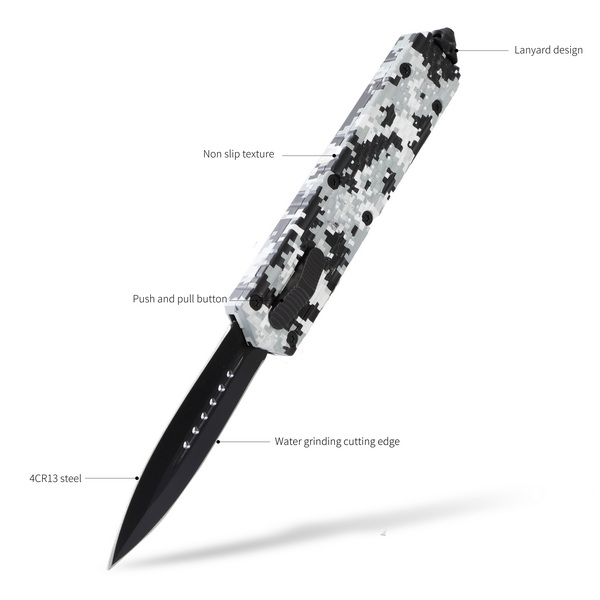
A high‑quality Automatic OTF Knife handle typically uses aluminum alloys, stainless steel, titanium, or reinforced composite materials, combined with precision‑machined scales and consistent surface finishing. Examine the junctions where handle halves meet, around the pivot area, and near the mechanism track to see if there are gaps, misalignment, or sharp unfinished edges.[11][12][13]
Pay attention to pocket clips, screws, and decorative hardware as well. On a genuine Automatic OTF Knife, screws seat cleanly and hardware often carries brand‑specific shapes or finishes; on clones, screws may be mismatched, stripped, or roughly finished, and the clip printing may look faded or off‑center.[6][1][9][5]
Packaging is another important indicator of whether an Automatic OTF Knife is genuine. Trusted brands invest in consistent box designs, labels, inserts, and protective materials, and many include user manuals, warranty cards, and care instructions.[17][4][7]
Counterfeit sellers rarely match this level of detail. If your Automatic OTF Knife arrives in a plain, unbranded box or with obviously low‑quality printing and no documentation, it is wise to contact the brand or OEM factory to confirm whether the product is legitimate.[1][4][5]
Customer reviews and enthusiast communities provide real‑world feedback on how a particular Automatic OTF Knife performs over time. Look for reviews that discuss deployment smoothness, edge retention, comfort in hand, and the effectiveness of any warranty or service claims.[18][7][3]
Knife forums, social media groups, and dedicated sub‑communities often share comparison photos and user experiences for specific brands and even OEM manufacturers. For brand owners, monitoring this feedback helps evaluate whether an Automatic OTF Knife OEM partner is meeting expectations batch after batch.[9][15][18][14]
Before buying or importing an Automatic OTF Knife, always confirm the legal status in your jurisdiction, because automatic knives are heavily regulated or prohibited in some countries, states, or cities. Retailers often require age verification (such as 18 or 21 years) and may restrict shipping to specific regions.[19][20][7]
Safe use is equally important. When handling an Automatic OTF Knife, always keep the blade pointed in a safe direction, avoid activating it in crowded spaces, and never attempt risky modifications or disassembly beyond the manufacturer's recommendations.[16][17]
For overseas brands and wholesalers, selecting the right OEM factory is one of the most powerful ways to control authenticity and quality from the source. Leading OEM suppliers invest in CNC machining, quality inspection at multiple stages, and structured testing of Automatic OTF Knife mechanisms before shipment.[21][15][14]
Yangjiang, China, is recognized as a major knife manufacturing hub, and industry listings highlight companies such as Yangjiang Ruizhen Industry and Trade Co., Ltd. among the top Automatic OTF Knife manufacturers in the region. Partnering with such OEM producers allows brands to create customized Automatic OTF Knife lines with consistent materials, branding, and performance, reducing the risk of unapproved copies.[15][21][14]
A clear checklist helps both individual and bulk buyers evaluate each Automatic OTF Knife purchase more systematically.[7][3]
For each knife or batch:
- Verify the seller or factory
Confirm that the retailer is listed as an authorized dealer, or that the OEM factory has a documented history in Automatic OTF Knife production and export.[1][14]
- Match the model and specs
Compare the listed model name, blade length, steel type, and mechanism description with official information from the brand or OEM.[5][7]
- Inspect logos and serials
Check fonts, positioning, and serial numbers for accuracy; if possible, validate serials through the manufacturer's support channel.[1][5]
- Evaluate mechanism performance
Test deployment and retraction multiple times, in different orientations, to confirm that the Automatic OTF Knife works reliably without unusual noise or failures.[11][16]
- Examine fit, finish, and hardware
Look for clean grinds, even coatings, tight hardware, and quality handle materials that match the description.[13][11]
- Confirm packaging and documentation
Ensure the knife arrives with proper packaging, instructions, and any expected warranty or authenticity materials.[4][7]
- Check price realism
Compare pricing with similar Automatic OTF Knife products and be wary of offers that are far below the normal market range.[3][7]
How an Automatic OTF Knife behaves over time is also a strong quality indicator. A well‑made knife will respond positively to regular maintenance—light cleaning, careful lubrication of internal tracks, and routine sharpening—by regaining smooth action and sharpness without unusual wear.[22][17][16]
In contrast, a low‑quality or counterfeit Automatic OTF Knife may develop severe blade play, corrosion, or chronic deployment issues even with careful maintenance. If problems appear soon after purchase under normal use, this is a sign that materials, heat treatment, or assembly did not meet proper standards.[23][16][13]
Verifying authenticity and quality in Automatic OTF Knife purchases is a multi‑step process that starts with choosing trustworthy sellers or OEM factories and continues through careful inspection of branding, specifications, mechanism performance, and long‑term behavior. By combining realistic price expectations with detailed visual checks, documentation review, community feedback, and ongoing maintenance observations, buyers and brands can confidently avoid counterfeits and low‑grade products and focus on reliable Automatic OTF Knife models that perform safely and consistently in real use.[14][7][1][3]
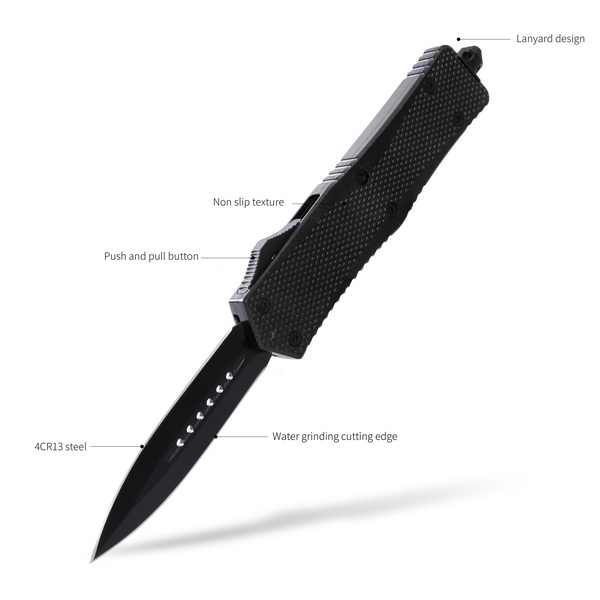
A quick method is to compare the knife's logos, serial numbers, and specifications with the brand's official information and to confirm that the seller is authorized. Large gaps in price, rough laser markings, and poor packaging are strong warning signs that the Automatic OTF Knife might be counterfeit.[4][1][3]
Yes, a small amount of blade play is common in many dual‑action Automatic OTF Knife designs because of the internal track structure. However, if the blade feels excessively loose or unstable, especially when locked open, it may indicate poor quality or worn internal parts.[17][4][11]
Look for clearly stated steel type, appropriate hardness range, clean grind lines, and an even finish that matches the manufacturer's description. Avoid knives with unknown or suspicious steel markings, or those that dull, chip, or rust quickly despite proper care.[2][6][7][13]
Established OEM factories, especially in well‑known knife regions such as Yangjiang, offer advanced machining, structured quality control, and experience in exporting Automatic OTF Knife products. This helps brands maintain consistent quality, protect their designs, and reduce problems with returns and complaints.[21][15][14]
The frequency of maintenance depends on how often and how hard the Automatic OTF Knife is used, but light cleaning and lubrication after heavy use or exposure to dirt and moisture are generally recommended. Periodic inspection of the mechanism and edge, followed by sharpening when needed, will keep a quality Automatic OTF Knife performing well for a long time.[22][23][16]
[1](https://microtechknives.com/blogs/news/counterfeit-microtech%C2%AE-knives-tips-on-identifying)
[2](https://www.youtube.com/watch?v=Sv5J4_amTpI)
[3](https://swordsswords.com/blog/how-to-spot-genuine-automatic-knives-for-sale-online/)
[4](https://eknives.com/blog/ensure-authenticity-microtech-knives)
[5](https://unholyblades.com/blogs/news/knife-authentication-guide-spot-fake-knives)
[6](https://www.youtube.com/watch?v=_5cr6WTa8Q4)
[7](https://knife-depot.com/blogs/sharpened-values/otf-knives-explained-the-complete-guide)
[8](https://www.youtube.com/watch?v=lVh6mGA81X0)
[9](https://www.reddit.com/r/microtech/comments/1ea7ilv/any_general_methods_for_distinguishing/)
[10](https://support.benchmade.com/hc/en-us/articles/15181458965659-Model-Number-Identification)
[11](https://www.bladehq.com/blog/how-to-choose-an-otf-knife)
[12](https://bladeops.com/blog/otf-knife-buyers-guide-what-to-look-for-in-your-next-otf-knife/)
[13](https://eknives.com/blog/how-can-you-tell-if-an-automatic-knife-is-durable-and-highquality/)
[14](https://www.58hrcknives.com/top-automatic-otf-knife-manufacturers-and-suppliers-in-america.html)
[15](https://www.58hrcknives.com/top-10-automatic-otf-knife-manufacturers-in-china.html)
[16](https://bladeops.com/blog/otf-knife-care-101-maximize-the-life-of-your-knife/)
[17](https://ravencresttactical.com/otf-knife-maintenance-keeping-your-blade-in-prime-condition/)
[18](https://www.facebook.com/groups/STLEDC/posts/7230695260368946/)
[19](https://www.reddit.com/r/knives/comments/xulxca/automatic_knife_purchase_questions_what_is/)
[20](https://www.tektoknives.com/blogs/news/a-buyers-guide-to-automatic-knives)
[21](https://www.58hrcknives.com)
[22](https://ravencresttactical.com/otf-knife-maintenance-a-guide-to-keeping-your-tactical-tool-razor-sharp/)
[23](https://tacknivesusa.com/how-to-maintain-your-otf-knife-guide/)


