
Views: 222 Author: Leah Publish Time: 2025-11-04 Origin: Site


Content Menu
● What is a Tactical OTF Knife?
>> Rapid Deployment and Retractability
>> Compact and Lightweight Design
● How Do Tactical OTF Knives Work?
● Tactical OTF Knives in Practice
>> Comparison With Traditional Knives
● Legal Landscape: Tactical OTF Knives Worldwide
>> Europe
>> Compliance and Best Practices
● Safety and Responsible Ownership
● FAQ
>> 1. Are Tactical OTF Knives legal in the United States?
>> 2. Is it legal to import or sell Tactical OTF Knives internationally?
>> 3. What are the main safety features of Tactical OTF Knives?
>> 4. Can Tactical OTF Knives be used for rescue or emergency purposes?
>> 5. What should buyers consider before purchasing a Tactical OTF Knife?
Tactical OTF (Out-the-Front) knives have revolutionized the way professionals and enthusiasts approach rapid blade deployment in tactical situations. These knives feature sophisticated engineering and unique deployment mechanisms, making them invaluable for emergency responders, law enforcement, military personnel, and outdoor adventurers. In this comprehensive guide, discover the key features, safety considerations, legal regulations, technical innovations, and best practices for tactical OTF knives across global markets, with special attention to compliance and responsible ownership.[1][4][5][10][11][12][13][14][15][16][17]
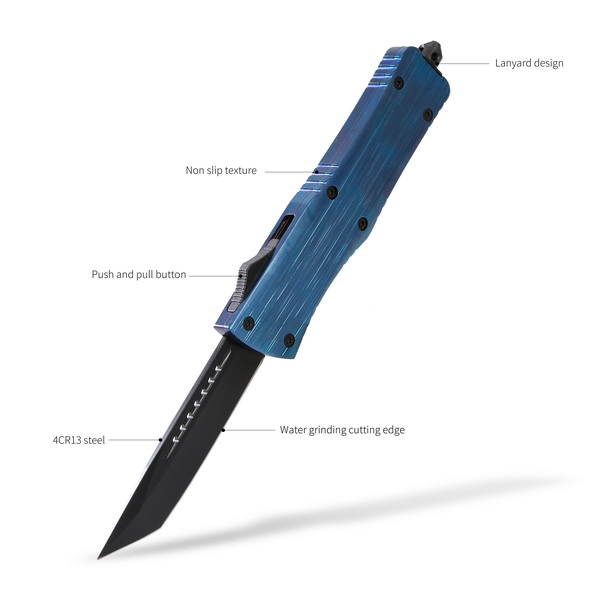
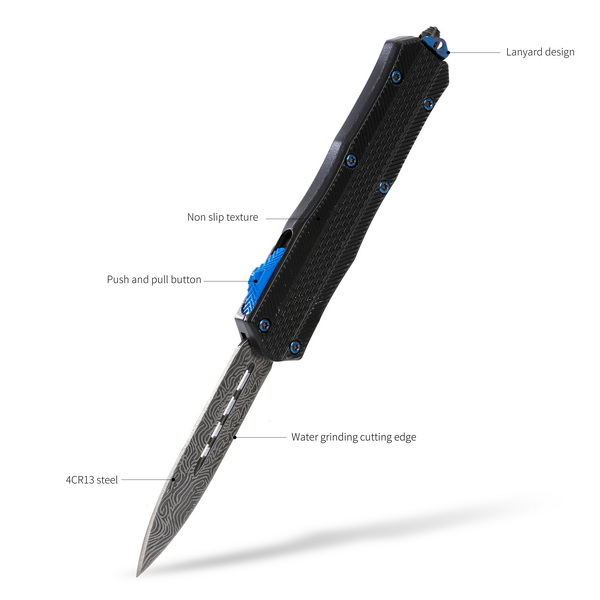
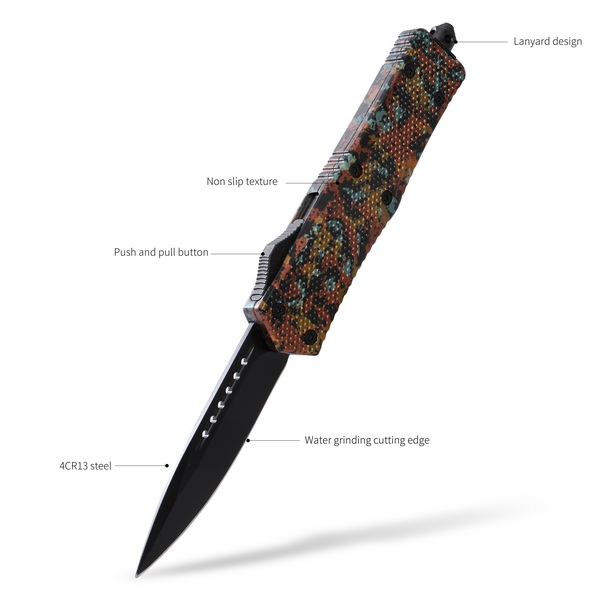
Tactical OTF Knives deploy their blades straight out from the handle by sliding a button or switch, offering unmatched speed and efficiency. There are two main categories:[2][4][5]
- Single-Action OTF Knives: Blade ejects with a button; manual retraction is necessary.
- Double-Action OTF Knives: Both deployment and retraction are accomplished automatically via the same control, boosting safety and speed.[4][6]
Highly prized for their precision, reliability, and ergonomic design, these knives are engineered for high-pressure environments where quick access and control are paramount.[5][1]
- Immediate Blade Access: One-handed operation allows for lightning-fast deployment, a crucial benefit in emergencies, rescue operations, or field tasks where every second matters.[5]
- Quick Retraction: Double-action OTF knives offer seamless transition between tools without sacrificing safety or efficiency.[5]
- Slim Profile: Easily slips into pockets, vests, or gear setups, drastically reducing bulk compared to fixed blades.[2]
- Lightweight Materials: Handles made from aircraft-grade aluminum or zinc alloy balance strength and portability.[6][8][9]
- Sturdy Locking Mechanisms: Prevent accidental retraction or deployment during use.[4][5]
- Safety Switches: Most Tactical OTF Knives include fail-safe systems that halt blade deployment if obstructed, protecting users from accidental injury.[18][2]
- Blade Lockout: After an obstruction, resetting the blade ensures continued safe function.[2]
- Emergency Features: Some models incorporate glass breakers and seatbelt cutters for rescue scenarios.[10][2]
- Replaceable Blades: Utility OTF knives allow for easy blade swap via standardized mechanisms, promoting longevity and adaptability.[6]
- Blade Steel: Premium options such as D2, CPM S30V, or 440C stainless steel, offering outstanding edge retention and corrosion resistance.[3][8][1]
- Handle Material: Aircraft-grade aluminum, zinc alloy, carbon fiber for ultra-light yet durable construction.[8][9][6]
- Blade Length: Varies from compact 2-inch models (often legally restricted) up to 4 inches for professional use.[4]
- Locking System: Mechanical, ball-bearing, or friction locks provide secure blade fixation for demanding tasks.[4]
- Activation: Ambidextrous sliding or push-button systems ensure rapid, reliable deployment and retraction.[9][2]
- Weight: Usually between 3-7 ounces, balancing tactical efficiency and user comfort.[9][6]
Understanding the mechanics of Tactical OTF Knives reveals why these tools command such respect among professionals:
- Spring Mechanism: A potent spring stores energy with every blade retraction, primed for instant action upon button release.[4]
- Blade Carrier & Track System: Precision-milled channels guide the blade for smooth, controlled movement, avoiding misalignment or "blade play".[4]
- Lock & Safety: The blade locks firmly in position when deployed, ensuring reliable operation under stress. Safety switches or levers prevent unwanted deployment.[5]
- Resetting: Should an obstruction halt deployment, the user can reset the blade by pulling it back into its locked position.[2]
- Law Enforcement/Military: Provides immediate access for cutting, rescue, and defensive maneuvers without impeding other tasks.[1][10][5]
- First Responders: Used to sever seatbelts, clothing, or other obstacles quickly and efficiently.
- Outdoor Enthusiasts: Perfect for hiking, camping, and field use, where versatile gear is crucial.[11]
| Type | Deployment | Safety Mechanism | Size/Bulk | Speed |
| Tactical OTF Knife | One-handed | Secure lock | Slim, pocket-friendly | Instant |
| Folding Knife | Two-handed | Safety locking | Bulkier, less compact | Moderate |
| Fixed Blade | No mechanism | Sheath required | Bulky, not concealable | Immediate |
Tactical OTF Knives fall under federal Switchblade laws, but state statutes govern ownership, carry, and commercial sale. Most states permit tactical OTF knives with blade length and carry restrictions, but some (e.g., New York, California, Delaware) ban or tightly restrict them. Local ordinances may further limit public carry, especially near schools and sensitive public spaces.[12][13][19][20]
German regulations allow single-edged OTF knives under 8.5 cm, while the UK bans all automatic knives outright. France, Italy, Belgium, and other EU countries impose varying restrictions, often focused on blade length and opening mechanisms.[14][17][21][22]
Australian law categorically bans importation and ownership of automatic knives, including Tactical OTF Knives, except under special permits. Chinese markets consider them restricted weapons, requiring state authorization for importing, wholesaling, or retailing.[15][16][17][23][24][25]
- Know Your Market: Always verify legal requirements and restrictions before manufacturing, importing, or selling Tactical OTF Knives in a given country or region.[16][17][23][24][25]
- Conform to Blade Limits: Design, produce, or market knives that meet local blade length and mechanism guidelines.
- Proper Labeling: Attach clear warnings and compliance notes for end-users and retailers.
- Training & Documentation: Provide comprehensive use and safety instructions with each knife.
Operating a Tactical OTF Knife demands respect for local laws and careful handling:
- Secure Handling: Double-check blade lockout before carrying or using. Use safety switches diligently.[26][18][2]
- Storage: Store in a secure sheath or pouch, away from children's reach.
- Legal Use: Never carry into prohibited zones (schools, government properties, airports) or use for unlawful purposes.
- Maintenance: Regular cleaning and careful inspection safeguard against mechanical failures.
Tactical OTF Knives are distinguished by their rapid deployment, robust technical design, and reliability in the field, making them indispensable for professional, outdoor, and tactical users. Yet, their legality remains a dynamic challenge, subject to intricate federal, state, and international laws that every manufacturer, brand, and end-user must understand. Continuous education, responsible ownership, and commitment to safety are vital for long-term success and compliance. Always stay informed, seek relevant permits, and follow best practices to leverage the full power of Tactical OTF Knives—legally and safely.[13][17][23][12][14][16][1][5]
No, their legality depends on state law. Some states allow them conditionally, while others impose outright bans.[12][13]
Not in every country—many, including Australia and the UK, prohibit import and possession without special permits.[17][23][15][16]
Safety switches, locking mechanisms, and blade lockouts prevent accidental deployment or injury.[18][2][4]
Yes, many include seatbelt cutters, glass breakers, and rapid deployment for first-responder scenarios.[10][11][2]
Check blade length restrictions, ensure compliance with local laws, and review warranty and safety documentation before buying.[23][16][6][2]
[1](https://bladeops.com/blog/the-advantages-and-disadvantages-of-otf-knives-in-tactical-settings/)
[2](https://ravencresttactical.com/product-category/otf-knives/)
[3](https://www.benchmade.com/products/5370fe-shootout-otf)
[4](https://knife-depot.com/blogs/sharpened-values/otf-knives-explained-the-complete-guide)
[5](https://bladeops.com/blog/pros-and-cons-of-otf-knives-for-tactical-operations/)
[6](https://cobratecknives.com/product/special-purpose/utility-knives/otf-utility-knife/)
[7](https://uppercuttactical.com/blogs/news/how-does-an-otf-knife-work)
[8](https://kratetactical.com/shop/carbon-fiber-otf/)
[9](https://conquesttactical.com/knife-specifications/)
[10](https://ravencresttactical.com/otf-tactical-knives-advantages-and-uses/)
[11](https://www.tacticalsportinggoods.com/blogs/news/understanding-otf-knives-a-comprehensive-guide-to-their-features-and-uses)
[12](https://uppercuttactical.com/blogs/news/are-otf-knives-legal-state-laws-on-otf-knives)
[13](https://www.vipertecknives.com/blogs/all-tactical/the-legal-landscape-of-automatic-knives-what-you-need-to-know)
[14](https://knyfe.de/en/2024/10/26/otf-messer-alles-zur-rechtslage-in-deutschland/)
[15](https://www.tosahwi.com/blogs/what-size-knife-is-legal-to-carry-in-australia-a-comprehensive-guide-to-knife-laws)
[16](https://www.abf.gov.au/entering-and-leaving-australia/can-you-bring-it-in/categories/weapons)
[17](https://steelriverknives.com/world-wide-switchblade-laws/)
[18](https://tacknivesusa.com/safety-suggestions-for-otf-knives/)
[19](https://sanityjewelry.com/blogs/news/otf-knife-state-laws-legality-explained-by-sanity-jewelry)
[20](https://microtechknives.com/blogs/news/microtech-enthusiasts-know-your-laws)
[21](https://www.bladeforums.com/threads/european-knife-law-guide.1777846/)
[22](https://blademag.com/knife-collecting/tips-for-traveling-with-knives-in-europe)
[23](https://www.aussieknives.com/blog/what-types-of-knives-cant-you-import-into-australia-without-a-permit/)
[24](https://sakparts.com/blogs/everything-about-victorinox-swiss-army-knife/what-are-the-restrictions-on-carrying-a-victorinox-swiss-army-knife-in-australia)
[25](https://www.aussieknives.com/knife-and-sword-laws-in-australia/)
[26](https://nobliecustomknives.com/what-is-an-otf-knife-and-how-does-an-otf-knife-work/)


