
Views: 222 Author: Leah Publish Time: 2025-11-29 Origin: Site


Content Menu
● What Is an Automatic OTF Knife?
● Why Blade Shape Matters in Automatic OTF Knives
● Common Blade Types in Automatic OTF Knives
● Drop Point Blades: The All‑Rounder
● Clip Point Blades: Precision and Piercing
● Tanto Blades: Maximum Tip Strength
● Spear Point and Dagger Blades: Thrust‑Focused Performance
● Sheepsfoot and Rescue Blades: Safety First
● Trailing Point and Other Slicing Profiles
● Edge Types: Straight, Serrated, and Combo
● Single‑Edge vs Double‑Edge on Automatic OTF Knives
● Action Types: Single‑Action vs Double‑Action
● Steel, Grind, and Performance in Automatic OTF Knives
● Matching Blade Types to Real‑World Uses
>> Everyday Carry and Office Use
>> Tactical, Duty, and Self‑Defense
>> Rescue, EMS, and Industrial Environments
>> Outdoor, Hunting, and Field Use
● Safety Practices for Automatic OTF Knives
● Maintenance and Reliability Tips
● How to Choose the Right Automatic OTF Knife for You
● FAQ
>> 1. Is an Automatic OTF Knife good for everyday carry?
>> 2. Which blade shape is strongest for an Automatic OTF Knife?
>> 3. Should I choose a single‑edge or double‑edge Automatic OTF Knife?
>> 4. Are serrated edges useful on Automatic OTF Knives?
>> 5. How do I keep my Automatic OTF Knife reliable?
Choosing the right blade shape is the key to getting the most from any Automatic OTF Knife, whether you are an EDC user, a tactical professional, or an outdoor enthusiast. Different blade types change how your Automatic OTF Knife cuts, pierces, and carries, so understanding them helps you match performance to your real‑world tasks and local laws.[2][6][11][12]
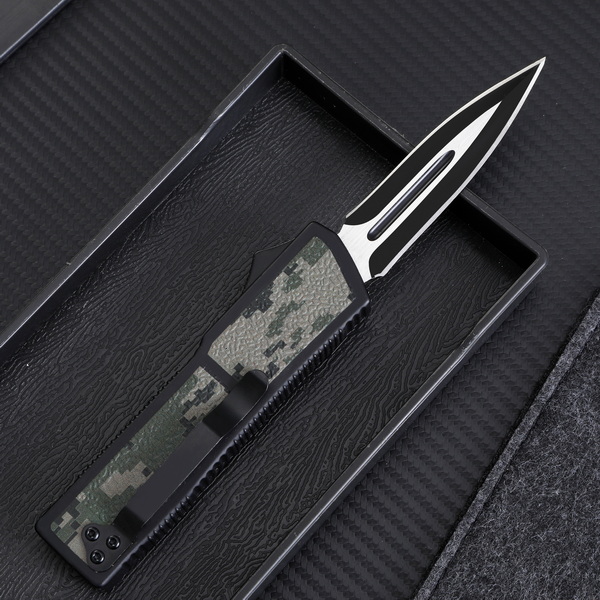
An Automatic OTF Knife (Out‑The‑Front knife) uses a spring‑driven internal mechanism to launch the blade straight out of the front of the handle at the push of a button or slider. Many modern Automatic OTF Knives use double‑action systems, so the same control both deploys and retracts the blade quickly and conveniently.[6][11][13]
Automatic OTF Knives keep the blade fully enclosed inside the handle when retracted, giving a slim closed profile compared to many side‑folding automatic knives. This design allows safe use of single‑edge or double‑edge blades and provides very fast, linear access that many users prefer for self‑defense and duty carry.[14][15][6]
Although the firing mechanism gets the attention, the blade profile is what determines how an Automatic OTF Knife actually performs day to day. Blade geometry controls tip strength, slicing efficiency, penetration ability, and even how easy the knife is to sharpen in the field.[11][12][2]
For Automatic OTF Knives, blade shape is especially important because the handle and deployment style already limit blade length, so the profile must work efficiently within a shorter edge. Choosing correctly lets you turn a compact Automatic OTF Knife into a specialized tool for EDC, rescue, or tactical work instead of a simple gadget.[2][6][11]
Most Automatic OTF Knives are offered in a group of proven blade shapes that balance strength, cutting performance, and manufacturability. The most common are:[12][16]
- Drop point
- Clip point
- Tanto
- Spear point / dagger
- Sheepsfoot / rescue
- Trailing point (less common in OTF but still important)
Each style gives a different mix of tip durability, belly length, and control, which directly affects what your Automatic OTF Knife does best.[11][12]
A drop point blade has a spine that gently slopes downward toward the tip, creating a strong, controllable point with plenty of belly for slicing. On an Automatic OTF Knife, this makes the drop point a superb general‑purpose profile for EDC cutting, light outdoor work, and even basic utility on job sites.[16][12][2][11]
Because the point is not too thin, drop point Automatic OTF Knives handle tasks like opening boxes, cutting rope, or light prying better than many needle‑fine shapes. At the same time, the curved belly makes draw cuts smoother, which is helpful when cutting packaging, food, or webbing in everyday scenarios.[12][11]
Drop point blades also tend to look less aggressive than dagger or tanto profiles, which can make a drop point Automatic OTF Knife more acceptable in office or mixed public environments. Manufacturers often choose drop point blades for budget and mid‑range Automatic OTF Knives because the profile offers broad appeal with simple, reliable geometry.[1][5][2][11]
Clip point blades remove a concave or straight "clip" from the spine near the tip, leaving a narrower, sharper point ideal for controlled piercing and detail work. On an Automatic OTF Knife, this means quicker penetration and fine tip control for tasks like package opening, light carving, or detailed cutting in tight spaces.[16][2][12]
The downside is that the thinner tip of a clip point Automatic OTF Knife can be more vulnerable to breakage under heavy lateral stress. However, many users appreciate the sweeping belly and sharp point because it combines slicing ability with good penetration for everyday use and even light game processing.[12][16]
In compact Automatic OTF Knives with shorter blades, the clip point profile helps maintain a fine, usable tip without sacrificing too much cutting length. This combination makes clip point Automatic OTF Knives attractive for users who want an EDC with a little more precision and style.[5]
Tanto blades feature an angular transition between the primary edge and a secondary edge near the tip, keeping the spine thick almost all the way forward. This geometry creates an extremely strong tip that resists breaking, which is why tanto Automatic OTF Knives are popular in tactical and hard‑use environments.[11][16][12]
The reinforced point excels in piercing harder materials and standing up to abuse, but the straight edges give a different slicing feel compared to curved bellies. Sharpening a tanto Automatic OTF Knife also takes more skill because of the secondary edge and angle change, which must be maintained to keep the characteristic "corner."[11][12]
Many high‑end Automatic OTF Knives aimed at law‑enforcement and military buyers feature tanto blades in premium steels such as MagnaCut or M390 to mix extreme tip toughness with strong edge retention. For users who regularly cut through heavy webbing, plastic, or heavier materials, a tanto Automatic OTF Knife can provide additional confidence and durability.[1][5]
A spear point blade is symmetrically ground with the tip centered along the blade's axis, and when double‑edged it closely resembles a dagger optimized for thrusting. Automatic OTF Knives can safely use spear point and dagger blades because the handle fully encloses the edges until deployment, reducing carry risk.[6][16][12][11]
Double‑edge spear point Automatic OTF Knives are highly effective for dedicated self‑defense because they provide cutting and penetration regardless of orientation. However, they often have less belly for slicing tasks and may face stricter legal restrictions in some regions compared to single‑edge blades, which buyers must check before carrying.[6][12][11]
Premium OTF models from well‑known brands often pair a dagger blade with double‑action mechanisms and robust aluminum or G‑10 handles, targeting tactical users and enthusiasts who value fast thrusting performance. These spear point Automatic OTF Knives usually focus more on combat or duty roles than general utility.[10][5][1]
Sheepsfoot blades have a straight or gently curved cutting edge and a spine that drops sharply to a blunt or nearly blunt tip. On an Automatic OTF Knife, this design is excellent for controlled slicing while reducing the risk of accidental punctures, which is why many rescue and EMS tools use it.[17][12][11]
A sheepsfoot Automatic OTF Knife excels at cutting seatbelts, bandages, and other materials close to the body, where piercing could be dangerous. The straight edge also makes contact along its entire length during push cuts, which is helpful for clean, controlled slicing in emergency and industrial environments.[18][19][12][11]
Some Automatic OTF Knives combine sheepsfoot or wharncliffe‑style blades with partially serrated edges to offer both aggressive cutting of fibrous materials and controlled tip behavior. This setup is attractive for rescue workers, sailors, and technical professionals who need a safety‑oriented Automatic OTF Knife that still cuts quickly under pressure.[5][18]
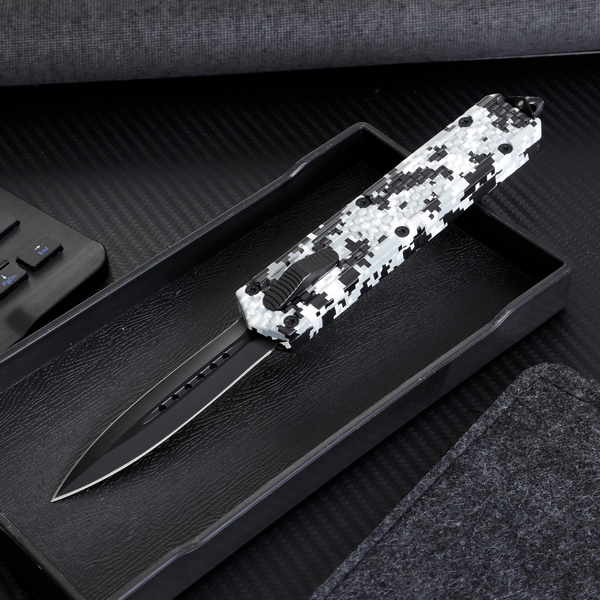
Trailing point blades have a spine that sweeps upward behind the tip, creating a long, pronounced belly optimized for slicing and skinning. In Automatic OTF Knives this profile is less common but can provide exceptional slicing performance for hunting and food prep when it does appear.[12][11]
Because the tip rides higher, a trailing point Automatic OTF Knife favors long draw cuts over heavy piercing, so it suits users who prioritize clean, efficient slicing. However, the elevated and thinner tip is easier to damage with rough use, making it a more specialized rather than all‑purpose choice for OTF platforms.[11][12]
Some manufacturers also offer wharncliffe blades, which resemble a straight‑edged sheepsfoot with a sharper, more controlled tip for precise cuts. When combined with an Automatic OTF Knife, a wharncliffe blade gives superb edge‑to‑surface contact along the entire edge, making it potent for utility cutting and fine work.[5]
Edge style matters as much as blade shape for how an Automatic OTF Knife behaves on different materials. The three common configurations are:[20][16]
- Straight edge – Best all‑round choice for clean cuts, easy maintenance, and precise control in most EDC Automatic OTF Knife applications.[20][16]
- Partially serrated (combo edge) – Combines a plain edge section with serrations, giving one Automatic OTF Knife both clean slicing and aggressive sawing capability.[16][20]
- Fully serrated – Excels at cutting fibrous materials like rope and webbing but is harder to sharpen and less versatile for general tasks on an Automatic OTF Knife.[20][16]
For most everyday carry Automatic OTF Knives, a straight or partially serrated edge on a drop point, clip point, or tanto blade delivers a useful mix of slicing and cutting power. Users in rescue or marine environments may prefer more serrations because they bite into wet rope and straps faster, which complements the quick deployment of an Automatic OTF Knife.[19][18][16][20]
Automatic OTF Knives typically come in single‑edge or double‑edge configurations, especially with spear point and dagger‑style blades.[6][20]
Single‑edge Automatic OTF Knives are usually safer and more versatile for general cutting because you can press on the unsharpened spine for control. They are generally easier to sharpen and often better accepted under local knife regulations, making them ideal for utility and EDC use.[7][2]
Double‑edge Automatic OTF Knives are sharp on both sides for cutting in either direction, which can be valuable in high‑stress self‑defense situations. The trade‑off is reduced safety when gripping the blade, more complex sharpening, and potential legal issues in many regions, so they are typically chosen by experienced users.[7][10][6]
Although blade shape is the focus, the type of mechanism in your Automatic OTF Knife affects how easily you can use that blade in real situations. There are two main action types:[1][5]
- Single‑action Automatic OTF Knife – Spring powers deployment only; you manually retract the blade afterward, usually by pulling a handle or charging bar.[1][5]
- Double‑action Automatic OTF Knife – The same button or slider both deploys and retracts the blade using internal springs.[1][6]
Single‑action Automatic OTF Knives often hit harder because the entire spring force is dedicated to opening, which some tactical users prefer. Double‑action Automatic OTF Knives prioritize convenience and speed for EDC, rescue, and general use, allowing quick repeated deployment regardless of blade shape.[5][6][1]
Blade steel and grind style influence how any Automatic OTF Knife performs and how long it holds an edge. Popular steels for modern OTF knives include CPM S30V, Elmax, MagnaCut, and 154CM, which balance hardness, corrosion resistance, and toughness.[5][1]
A high flat grind on a drop point or clip point Automatic OTF Knife improves slicing, especially in shorter blades. In contrast, thicker grinds on tanto or dagger blades favor durability and thrusting, aligning with tactical roles where an Automatic OTF Knife might encounter harder materials.[1][5]
The choice of grind and steel should match the blade type and user demands: a rescue‑oriented sheepsfoot Automatic OTF Knife may prioritize corrosion resistance and toughness, while a high‑end tanto Automatic OTF Knife might emphasize edge retention and strength.[5][1]
Different users benefit from different blade shapes on their Automatic OTF Knife depending on environment and common tasks.[2][11]
For daily carry in urban or office settings, users usually need clean cutting of packaging, plastic straps, zip ties, and light materials. A drop point or clip point Automatic OTF Knife with a straight edge and single‑edge configuration is typically the most practical and low‑profile choice.[7][2][11]
In these environments, a non‑aggressive blade shape and neutral finish make it easier to use an Automatic OTF Knife without drawing unwanted attention. A slim handle and moderate blade length around 3 to 3.5 inches also help keep the Automatic OTF Knife comfortable in the pocket.[2][11][1][5]
Law‑enforcement, security, and self‑defense users often prioritize fast deployment, penetration, and reliable cutting under stress. Tanto or double‑edge spear point Automatic OTF Knives are popular in this category, sometimes with partial serrations to handle heavy clothing and webbing.[16][20][6][11]
Here, the ability to deploy an Automatic OTF Knife instantly with either hand and cut in multiple directions can be vital. Strong locking mechanisms, premium steels, and robust handles become more important than minimal weight or discreet appearance.[9][6][1][5]
Rescue workers need to cut near skin and inside vehicles without accidental stabbing. A sheepsfoot or modified sheepsfoot Automatic OTF Knife with a partially serrated edge on the straight section works well for seatbelts and harnesses while controlling the tip.[18][19]
In industrial or marine settings, corrosion resistance and grip texture also matter for a rescue‑style Automatic OTF Knife. Bright handle colors can make these tools easier to find in low‑light or chaotic conditions, complementing the immediate access of an Automatic OTF Knife.[19][18]
Outdoor users often need to slice rope, food, and sometimes game, where belly length is valuable. Drop point and trailing point Automatic OTF Knives with straight or combo edges are excellent here, balancing slicing ability with reasonable tip strength.[12][11]
Field users may prefer steels with strong corrosion resistance and toughness, paired with easy‑to‑clean handles, because dirt and moisture can enter the mechanism of an Automatic OTF Knife. Choosing the right sheath or pocket clip orientation also helps keep the automatic mechanism and blade shape ready when needed outdoors.[11][1][5]
An Automatic OTF Knife performs best when used and maintained correctly, regardless of blade type. Safe handling starts with keeping fingers, clothing, and other objects away from the blade path during deployment and retraction.[18][19]
Many Automatic OTF Knives are designed to "derail" and stop if the blade meets resistance during deployment, reducing the chance of penetrating an object inadvertently. Even with this safety feature, users should treat every Automatic OTF Knife as a live tool and avoid pointing it at themselves or others during operation.[21][19][18]
Engaging and disengaging any safety switches, locking sliders, or secondary controls according to manufacturer instructions further reduces the chance of accidental firing. Training with an inert or inexpensive Automatic OTF Knife can help users become comfortable with the motion and blade path before carrying a higher‑end model.[19][18]
Regular maintenance keeps your chosen blade type and Automatic OTF Knife mechanism working as intended. Dust, lint, and grit can accumulate inside the handle and track, especially on knives carried daily in pockets.[18][19]
Basic care for an Automatic OTF Knife includes blowing out debris, wiping the blade with a light oil or rust inhibitor, and occasionally flushing the internal mechanism with suitable cleaner if recommended by the maker. Many brands advise against complete disassembly by the user because incorrect reassembly can compromise safety or void warranties, particularly on Automatic OTF Knives.[13][19][18]
Users should deploy and retract their Automatic OTF Knife a few times after cleaning to distribute lubricant evenly along the track and locking surfaces. Sharpening should follow the original bevel angles of each blade type so that a tanto, drop point, clip point, or sheepsfoot Automatic OTF Knife keeps its intended geometry and performance.[13][19][12][11]
Choosing the ideal blade type in an Automatic OTF Knife starts with honest evaluation of your primary use cases. Ask whether you most often cut packaging and light materials, face tactical or defensive scenarios, perform rescue work, or spend more time outdoors and in the field.[2][11]
From there, match your needs to blade geometry:
- Drop point or clip point for balanced EDC Automatic OTF Knife performance.
- Tanto or double‑edge spear point for tactical Automatic OTF Knife roles.
- Sheepsfoot or wharncliffe for rescue‑oriented Automatic OTF Knife use.
- Trailing point or high‑belly profiles for slicing‑focused Automatic OTF Knife applications.[12][11]
Finally, consider edge type, steel choice, and action style to fine‑tune your Automatic OTF Knife configuration. The right combination ensures the mechanism, blade shape, and material work together, giving you a reliable tool that feels natural in hand and suits your daily environment.[2][1][5]
The ideal blade type for an Automatic OTF Knife depends on how and where you use it, not just on style or trend. Drop point and clip point blades shine for everyday carry, tanto and double‑edge spear points excel in tactical roles, while sheepsfoot, wharncliffe, and trailing point blades serve specialized rescue and slicing tasks. By understanding how each blade shape, edge type, and action style affects strength, slicing ability, and control, you can configure an Automatic OTF Knife that truly fits your hand, your environment, and your work.[16][2][11][12]
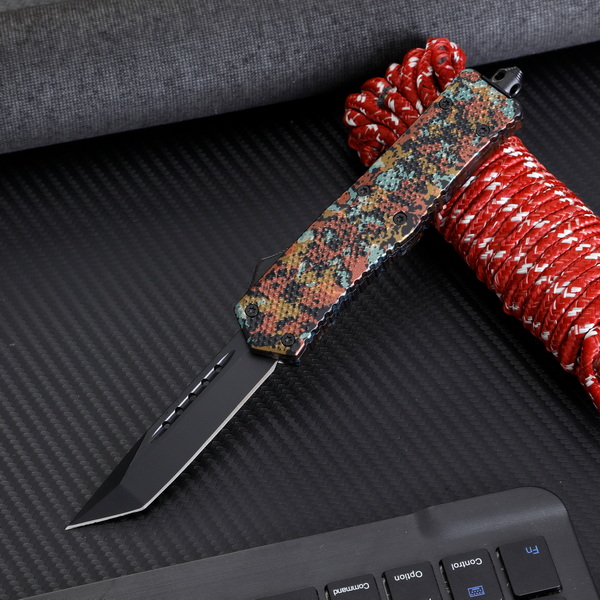
Yes, many users carry an Automatic OTF Knife daily because the linear deployment is fast, the handle is compact, and single‑edge drop point or clip point blades handle common cutting tasks well.[6][2]
For tip strength, tanto blades are typically the strongest because the spine remains thick almost to the point, while drop points also offer a good balance of strength and control. Spear point and dagger profiles focus more on penetration than pure durability on an Automatic OTF Knife.[16][11][12]
Single‑edge Automatic OTF Knives are usually safer, easier to control, and more practical for utility since you can press on the spine. Double‑edge versions are better for dedicated self‑defense but can be harder to handle and may face more legal limits in many jurisdictions.[7][6][2]
Yes, partially or fully serrated Automatic OTF Knife blades cut rope, webbing, and other fibrous materials more aggressively than plain edges. However, serrations are more difficult to sharpen, so straight or combo edges are often preferred for mixed use on an Automatic OTF Knife.[20][16]
Keep the blade path clear when deploying, avoid using the knife as a pry bar, and clean and lubricate the internal mechanism on a regular schedule. Always follow manufacturer instructions for disassembly, and deploy the blade before opening the handle to avoid uncontrolled spring release inside an Automatic OTF Knife.[13][19][18]
[1](https://knifeinformer.com/the-best-otf-knife-for-your-money/)
[2](https://www.bladehq.com/blog/how-to-choose-an-otf-knife)
[3](https://www.youtube.com/watch?v=mk0jqi3VmUg)
[4](https://www.fieldandstream.com/outdoor-gear/hunting/knives/best-automatic-knives)
[5](https://hiconsumption.com/gear/best-otf-knives/)
[6](https://uppercuttactical.com/blogs/news/types-of-switchblades-differences-and-benefits-of-each)
[7](https://tacknivesusa.com/the-ultimate-otf-knife-buying-guide/)
[8](https://www.tektoknives.com/blogs/news/a-buyers-guide-to-automatic-knives)
[9](https://www.vipertecknives.com/blogs/news/switchblade-vs-otf-knives-key-differences-and-which-to-choose)
[10](https://www.bladeforums.com/threads/microtech-otf-best-blade-style.1806059/)
[11](https://knife-depot.com/blogs/sharpened-values/otf-knives-explained-the-complete-guide)
[12](https://knife-depot.com/pages/knife-blade-shapes)
[13](https://www.tektoknives.com/blogs/news/tekto-how-to-reset-an-automatic-otf-knife)
[14](https://swordsswords.com/blog/different-styles-and-mechanisms-of-automatic-knives/)
[15](https://www.tektoknives.com/blogs/news/understanding-different-types-of-switchblades)
[16](https://ravencresttactical.com/otf-knife-buyers-guide/)
[17](https://swordsswords.com/blog/a-comprehensive-guide-to-automatic-knife-use/)
[18](https://eknives.com/blog/4-key-secrets-otf-knives-safety/)
[19](https://tacknivesusa.com/safety-suggestions-for-otf-knives/)
[20](https://tacknivesusa.com/otf-knife-and-spring-design-key-elements-to-identify-when-deciding-to-buy/)
[21](https://www.reddit.com/r/knives/comments/16dz9ee/i_rarely_see_safety_feature_on_otf_anybody/)


