
Views: 222 Author: Leah Publish Time: 2025-10-11 Origin: Site


Content Menu
● What Is a Heavy-Duty OTF Knife?
● What Defines an Automatic Knife?
>> Blade Deployment and Retraction
>> Mechanism Complexity and Durability
● Typical Use Cases for Heavy-Duty OTF Knives
● Why Choose a Heavy-Duty OTF Knife?
● Frequently Asked Questions (FAQs)
>> 1. What does OTF stand for in knives?
>> 2. Are heavy-duty OTF knives legal to carry?
>> 3. Can automatic knives be single or double-action?
>> 4. Which knife is better for tactical use?
>> 5. What materials make a heavy-duty OTF knife durable?
When it comes to high-performance outdoor knives, two categories often come into discussion: the Heavy-Duty OTF (Out-The-Front) Knife and the Automatic Knife. Both are engineered for rapid deployment and reliability but cater to differing needs and preferences. Understanding the distinctions between these two types of knives helps consumers, outdoor enthusiasts, and professionals choose the right tool for their specific applications. This article delves deep into the mechanics, functionality, use cases, and benefits of heavy-duty OTF knives compared to Automatic Knives, clarifying key differences to empower better decisions.
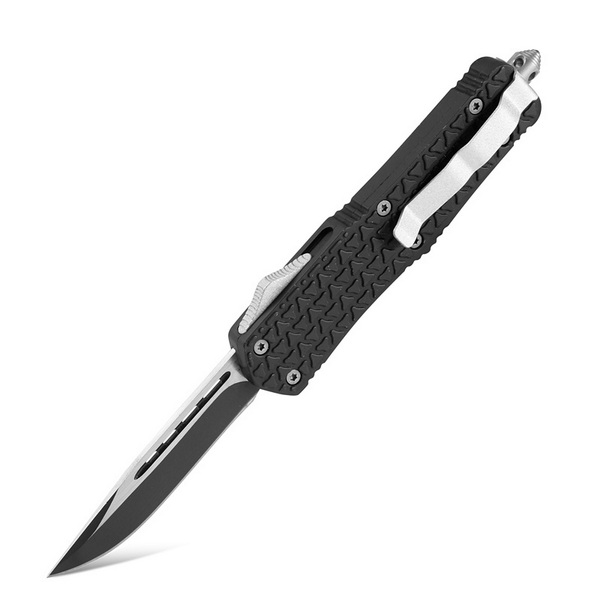
A Heavy-Duty OTF Knife is a type of automatic knife where the blade extends and retracts directly through a hole in the handle's front end. Unlike most knives that pivot open from the side, OTF knives feature a blade that slides forward and backward along the handle axis. This design allows for quick one-handed operation, making them especially practical for tactical, outdoor, and emergency situations.
The "heavy-duty" designation highlights that the knife is built for demanding conditions. These knives typically feature robust construction materials like high-grade stainless steel or titanium for both the blade and the handle. The mechanism inside is reinforced to withstand frequent use, rough handling, and adverse environmental factors. Heavy-Duty OTF knives often incorporate double-action mechanisms, meaning the blade can be both deployed and retracted smoothly with the same thumb slide or button.
An Automatic Knife, broadly speaking, refers to any knife with a spring-loaded mechanism that automatically opens the blade once activated. The term commonly refers to switchblades, which open through a button or lever on the knife handle. Most automatic knives open by pivoting the blade out from the handle side, unlike OTF knives.
Automatic knives vary widely in styles, from side-opening switchblades used in everyday carry to specialized tactical models. They are appreciated for rapid blade deployment and the ability to be quickly deployed with one hand, which is useful for self-defense, rescue, or work-related tasks.
- Heavy-Duty OTF Knives: The blade slides straight out of the handle tip via a sliding mechanism. Double-action models enable smooth extension and retraction by moving a slider or button. This unique linear deployment keeps the blade protected inside the handle when retracted, minimizing snagging.
- Automatic Knives: The blade pivots out from the side of the handle, locked into place once open. Depending on the knife, retraction may involve manual closing since many automatic knives are single-action (blade deploys automatically but closes manually).
- OTF knives, especially heavy-duty types, contain complex internal mechanisms for blade movement and locking, requiring precise engineering for reliable performance.
- Automatic knives often have simpler pivot and spring mechanisms, which can be easier to maintain but sometimes compromise the smoothness of deployment compared to OTF knives.
- Heavy-Duty OTF Knives typically include mechanisms to prevent accidental blade release, using sliders that require deliberate action.
- Many automatic knives have safety switches or locks, but the variety of designs means some can be easier or harder to accidentally activate.
Heavy-Duty OTF knives are favored in tactical fields, law enforcement, and outdoor survival due to their robust build and rapid deployment capability. Their linear blade action is optimal for cutting tasks that require precision and reliability under stress. Outdoor enthusiasts appreciate the compact and protected design, which avoids blade exposure when not in use.
- Tactical Operations: Fast and smooth deployment critical in emergencies.
- Survival Situations: Robust blade materials withstand tough conditions.
- Rescue Work: Quick access to the blade can save lives in trapped scenarios.
Automatic knives are versatile tools found in everyday carry collections and specialized professional contexts.
- Self-Defense: Rapid blade deployment helps in defensive situations.
- Utility Tasks: Quick blade access useful for opening packages or cutting ropes.
- Collectors: Many automatic knives are valued for their design and heritage.
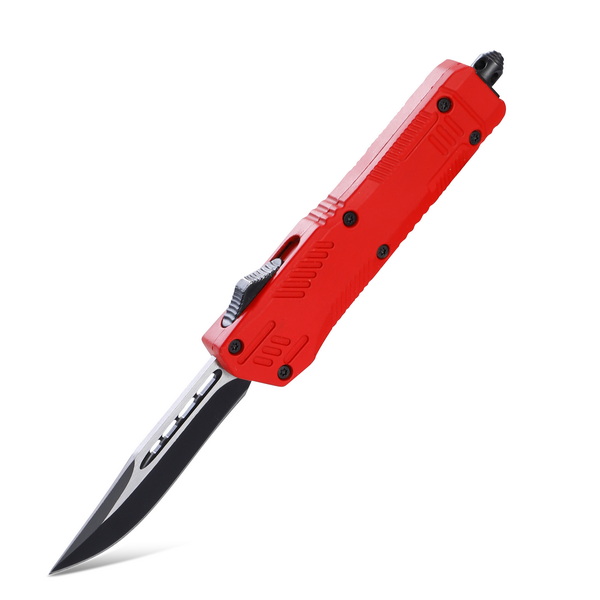
Both Heavy-Duty OTF and Automatic Knives utilize high-grade materials but the focus on "heavy-duty" OTFs often leans towards premium stainless steels or even exotic metals to ensure the knife endures harsh conditions without dulling or breaking. Handles may be crafted from durable composites, aluminum, or titanium for strength and light weight.
Automatic knives may vary more widely from budget models to premium knives, making material quality less consistent. However, reputable brands emphasize durable materials across their product lines.
Heavy-Duty OTF knives typically have a streamlined, often longer and narrower profile due to the sliding blade mechanism. This makes them highly pocketable without blade exposure risk. Automatic knives can be bulkier due to pivot spaces but offer varied sizes depending on style and purpose.
Laws around carrying and owning automatic and OTF knives vary globally and can affect availability and usage.
- Some jurisdictions heavily restrict or ban OTF knives because of blade deployment speed and mechanism.
- Automatic knives face similar legal regulations but these depend on blade length, deployment method, and local laws.
It is crucial for buyers, especially OEM clients targeting global markets, to understand these legal nuances before sourcing or distributing.
| Feature | Heavy-Duty OTF Knife | Automatic Knife |
| Blade Deployment | Linear/front sliding blade | Side pivoting blade |
| Mechanism | Complex double-action possible | Often single-action or double-action |
| Durability Focus | Built for heavy use | Varies, some built for daily carry |
| Safety | Slider with safety mechanism | Safety switch/lock optional |
| Typical Use Cases | Tactical, survival, rescue | Self-defense, utility, collection |
| Material Quality | Premium metals and composites | Varies widely |
| Profile | Long and narrow, pocketable | Varies, can be bulkier |
| Legal Restrictions | Strict in many regions | Also regulated, varies widely |
When strength, reliability, and rapid linear blade access matter, Heavy-Duty OTF Knives outperform many automatic knives. Their robust build and double-action mechanisms provide precise, quick control in demanding environments. For OEM manufacturers and distributors, offering these knives positions them well into tactical, outdoor, and rescue markets that value performance and durability.
Choosing between a Heavy-Duty OTF Knife and an Automatic Knife boils down to deployment style, intended use, and user preference. Heavy-Duty OTF knives offer superior linear blade deployment with strong build quality designed for intense use cases. Automatic knives provide diverse styles, often easier mechanisms, and broad utility appeal. Both categories have passionate user bases and clear advantages in different scenarios.
Manufacturers like Yangjiang Ruizhen Industry and Trade Co., Ltd. offering OEM services can tailor heavy-duty OTF or automatic knife production to meet brand specifications and customer demands globally, making informed design choices that align with market needs, legal considerations, and user expectations.
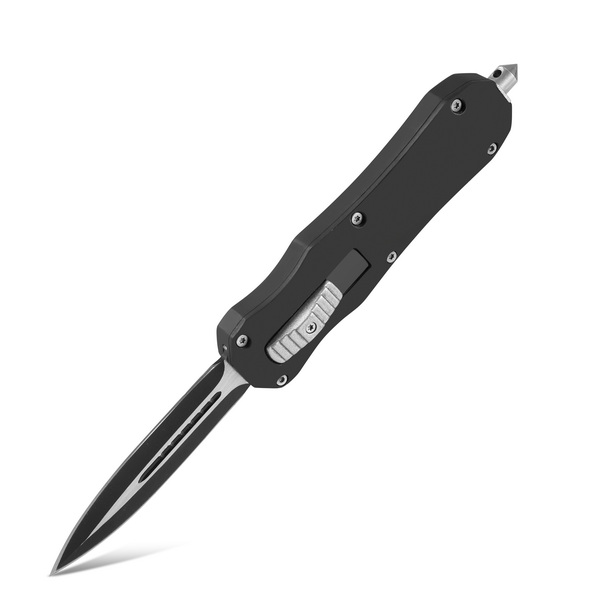
OTF stands for "Out-The-Front," referring to a knife blade that slides straight out from the front of the handle rather than pivoting out sideways.[1]
Legal status varies by country and state. Many regions have restrictions on carrying OTF knives due to their rapid deployment capabilities, so it's important to check local laws before carrying one.[1]
Yes, automatic knives can be single-action (blade opens automatically, closes manually) or double-action (blade both deploys and retracts automatically) depending on the design.[2]
Heavy-Duty OTF knives are generally preferred for tactical applications due to their rapid, smooth, and reliable linear blade action combined with robust construction.[3][1]
High-quality stainless steel, titanium, reinforced composites, and precision engineering of the mechanism contribute to the durability of heavy-duty OTF knives.[1]
[1](https://hiconsumption.com/gear/best-otf-knives/)
[2](https://en.wikipedia.org/wiki/Switchblade)
[3](https://bladeops.com/blog/pros-and-cons-of-otf-knives-for-tactical-operations/)


