
Views: 222 Author: Leah Publish Time: 2025-11-13 Origin: Site


Content Menu
● Understanding the OTF Pocket Knife
● Core Qualities of a Reliable Manufacturer
>> Precision Engineering and Manufacturing Standards
>> Advanced Quality Control and Certification
>> Compliance and Export Support
>> Infrastructure and Industry Standing
● The Manufacturing Process: Technical Insights
>> Assembly and Final Inspection
● Red Flags: What to Avoid in OTF Pocket Knife Manufacturing
● Maintenance Tips for Brands and Buyers
● OEM Partnership: Balancing Innovation and Quality
● Choosing Your OTF Pocket Knife Manufacturer: Actionable Steps
● FAQ
>> 1. What is an OTF pocket knife?
>> 2. Which materials ensure maximum durability in OTF knives?
>> 3. How do manufacturers guarantee quality in production?
>> 4. Why is OEM partnership important for brands?
>> 5. How should OEM buyers verify a manufacturer's credibility?
Identifying a trustworthy OTF (Out-the-Front) pocket knife manufacturer is essential for overseas brands, wholesalers, and production companies seeking robust products tailored to their specifications. A reputable partner can elevate your product line and reputation while minimizing risks. This expanded guide provides an in-depth view into theOTF pocket knife industry, blending rigorous factory selection criteria and technical details with market insights and actionable OEM advice.
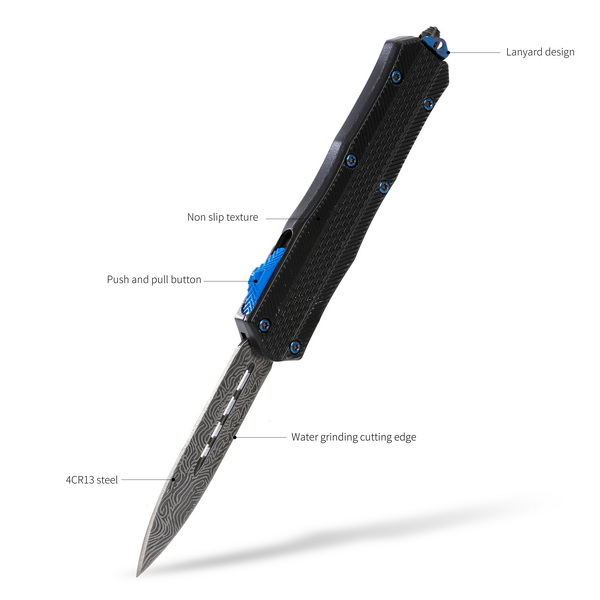
OTF pocket knives feature blades that deploy and retract linearly from the handle, controlled by a switch or button. This design enables rapid, one-handed operation, making them preferred tools in tactical, outdoor, and emergency settings. The unique mechanism and compact form factor distinguish OTF pocket knives from traditional folding knives.[11]
OTF knives are assets for professionals and enthusiasts, combining precision engineering, innovative designs, and high-tech materials for optimal performance. Handle shapes, blade profiles, and locking mechanisms vary widely; every part is manufactured to tight tolerances, as even minor discrepancies can compromise function.[1][3]
The heart of a quality OTF pocket knife lies in precision. Handles are often crafted from aluminum or titanium bar stock, milled to exact tolerances using advanced CNC machinery. Blade steels such as S35VN, M390, MagnaCut, and Elmax are favored for superior hardness, edge retention, and resistance to corrosion. Manufacturing steps include deburring, tumbling, and media finishing, ensuring both operational smoothness and a refined aesthetic.[5][1]
Component tolerances are measured in thousandths of an inch—often tighter than the thickness of a sheet of paper. Individual parts, like triggers and springs, are made from stainless steel to resist wear and corrosion. Each batch undergoes multi-stage quality checks, including functional testing for blade deployment speed, lock strength, and mechanical reliability.[6][1]
A reliable OTF pocket knife manufacturer will have strict quality assurance protocols, employing skilled staff and state-of-the-art machinery. ISO or similar certifications and compliance with international knife regulations are strong indicators of legitimacy. Lifetime or extended warranties, coupled with responsive after-sales service, further bolster buyer confidence.[12][13][14][11]
Frequent QC steps include:
- Blade deployment and retraction cycling
- Locking mechanism endurance testing
- Material authentication and hardness validation
- Dimensional checks of machined parts[1][6]
Manufacturers offering flexible OEM (Original Equipment Manufacturer) and ODM (Original Design Manufacturer) models help brands distinguish themselves in the market. OEM arrangements allow customized blades, handles, engravings, and packaging, enabling exclusivity and full brand control. ODM options offer proven designs with minor modifications for faster, cost-effective launches.[11][12]
A capable OEM partner supports bespoke requirements such as:
- Special blade shapes (drop-point, tanto, dagger)
- Custom handle materials (carbon fiber, G10, anodized aluminum)
- Personalized markings, logos, and packaging artwork
- Batch sample runs before mass production
International knife laws can vary widely regarding blade length, automatic deployment, and locking features. Reliable manufacturers are well-versed in these regulations, providing necessary export certifications and guiding clients on compliance for their target markets. Assistance includes documentation, customs clearance, and adaptation to changing laws.[12][11]
Trusted factories maintain modern workshops, experienced technicians, and clean operational environments. Customer testimonials and repeated business are strong indicators; an open-door policy for audits and factory tours signals transparency. Top manufacturers often feature in knife trade shows, receive industry awards, and cultivate a reputation for consistency and innovation.[13][14]
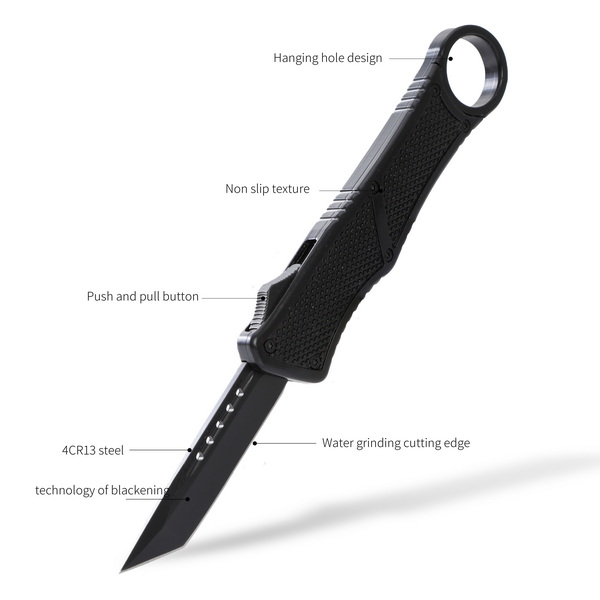
Premium OTF knife makers start with sturdy bar stock aluminum or titanium. Bar stock is deburred before CNC milling, which performs several precise operations to create handle tracks and cutouts essential for blade motion. Tolerances are meticulously observed—mistakes in milling or deburring can undermine the entire product.[1]
After machining, handles are smoothed in a media tumbler and inspected for dimensional accuracy, fit, and finish before assembly.
Blades are cut from quality steel sheets, oversized by a precise margin. Each process (grinding, heat-treating, sharpening) progressively moves blades closer to final tolerances. Multiple blade shapes (tanto, dagger, leaf, sheepfoot) are offered for tactical and aesthetic preferences.[3][1]
Finishing may include stonewashing, DLC coating, and laser engraving. Premium OTF manufacturers sharpen blades by hand for superior edge quality.[1]
All OTF internals, including springs, locking tabs, and trigger assemblies, are cut and milled from stainless steel. These parts are essential for reliable activation and safety. The complexity of the stacked tolerances in OTF knives means even small errors can cause jams or misfires, so only top factories invest in extensive testing.[2][1]
Once blades, handles, and internals are ready, each knife is assembled and undergoes:
- Functional cycle tests
- Lock integrity checks
- Aesthetic and dimensional inspections
Leading brands such as Microtech and Benchmade are known for meticulous hand-assembly, further elevating quality standards.[6]
- Unusually low pricing may hint at compromised materials or shoddy craftsmanship.[14][11]
- Lack of OEM/ODM experience or refusal to offer customizations exposes brands to generic knockoffs.[11][12]
- No evidence of relevant certifications, transparent process documentation, or positive customer testimonials is a serious concern.[14][11]
- Poor after-sales service, unclear warranty terms, or refusal to support export compliance can cause operational and legal headaches.[14][11]
To maximize the lifespan and reliability of OTF pocket knives:
- Clean and lubricate the blade slot and trigger regularly, using brake cleaner or compressed air.[15][16]
- Use blade-specific lubricants to prevent wear on mechanisms.[16][17]
- Check for debris and perform functional cycle tests before wholesale shipment or retail.[18][19]
- Store knives in a dry environment to avoid corrosion, especially on stainless steel internals.[1]
Collaborating with an experienced manufacturer leverages technical expertise and market insight. Whether launching a new product or refining an existing line, communication between your technical teams and factory engineers is critical. Sample testing, iterative design, and transparent feedback channels form the foundation for successful long-term partnerships.[4]
1. Vet factory credentials: Inspect documentation, certifications, and audit reports.
2. Demand sample runs: Test functional and aesthetic aspects rigorously.
3. Review testimonials: Seek evidence of satisfied brand partners and positive forum reviews.
4. Tour facilities (physically or virtually): Assess equipment, staff expertise, cleanliness, and process control.
5. Test prototypes thoroughly: Measure deployment/retraction speeds, lock strengths, and responses to stress.
6. Ensure responsive support: Clarify communication channels and guarantee transparent after-sales service.
7. Confirm export support: Require legal compliance, documentation aid, and guidance on international knife laws.
Finding a reliable OTF pocket knife manufacturer is an investment in your brand's reputation, risk management, and customer satisfaction. The best factories excel in engineering precision, quality assurance, and flexible OEM services. By carefully evaluating supplier credentials, manufacturing capabilities, and compliance expertise, you can confidently select a partner who delivers high-performance OTF pocket knives tailored to your specifications—strengthening your market position and supporting long-term growth.[3][4][5][13][6][12][11][14][1]
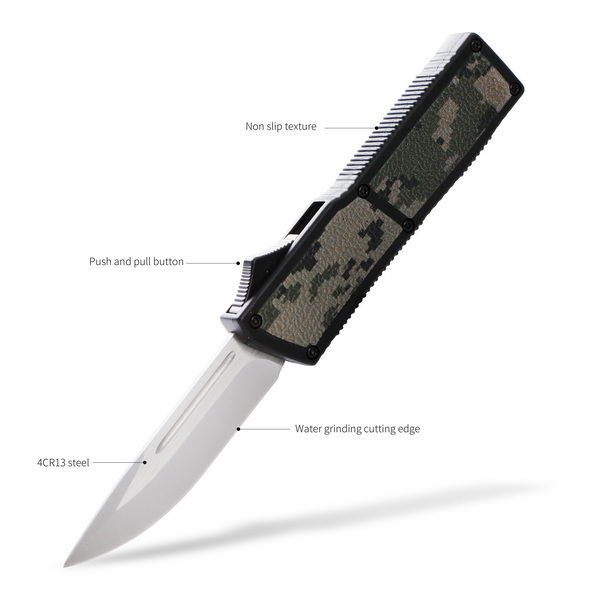
- It is a knife with a blade that slides out the front of the handle via a mechanical mechanism, offering rapid deployment and safe retraction.[2][11]
- Premium knife makers use high-grade steel (S35VN, M390) for blades and aircraft aluminum or titanium for handles, along with stainless steel springs for strong, corrosion-resistant internals.[5][3][1]
- By using CNC machining, multi-stage quality inspections, precise assembly processes, and endurance cycle testing, reliable manufacturers maintain strict standards.[6][11][1]
- It enables unique customization, better brand control, and tailored solutions, ensuring exclusive designs and differentiation in competitive markets.[12][11]
- Ensure documentation (certificates, audits), test multiple samples, visit production facilities, and confirm ongoing export compliance support for your target region.[11][12][1]
[1](https://www.youtube.com/watch?v=EwG2oytZCl8)
[2](https://patents.google.com/patent/US20070175045A1/en)
[3](https://takcom.com/the-precision-engineering-that-goes-into-a-premium-otf-knife/)
[4](https://www.58hrcknives.com/how-ruizhen-balances-innovation-and-quality-in-tactical-otf-knife-design.html)
[5](https://bladeops.com/blog/the-history-of-otf-knives-from-military-tool-to-everyday-essential/)
[6](https://smkw.com/knife-101-microtech)
[7](https://www.youtube.com/watch?v=lojT2LuLPxY)
[8](https://www.tacticalsportinggoods.com/blogs/news/understanding-otf-knives-a-comprehensive-guide-to-their-features-and-uses)
[9](https://swordsswords.com/blog/what-makes-otf-automatic-double-action-knives-so-popular-among-collectors/)
[10](https://pvk.com/our-blog?p=the-shrike-otf-knife)
[11](https://www.58hrcknives.com/oem-vs-odm-what-you-should-know-when-sourcing-otf-knives.html)
[12](https://www.58hrcknives.com/what-to-expect-from-a-top-manufacturer-of-custom-otf-knives.html)
[13](https://cobratecknives.com/product/special-purpose/utility-knives/otf-utility-knife/)
[14](https://tacknivesusa.com)
[15](https://www.youtube.com/shorts/b3tL5c46gx4)
[16](https://www.youtube.com/watch?v=15ayGK5h2L0)
[17](https://microtechknives.com/blogs/news/microtech-otf-maintenance-cleaning-and-caring-tips-for-your-edc)
[18](https://uppercuttactical.com/blogs/news/otf-knife-maintenance-clean-lube-fix-misfires)
[19](https://bladeops.com/blog/otf-knife-care-101-maximize-the-life-of-your-knife/)


