
Views: 222 Author: Leah Publish Time: 2025-11-09 Origin: Site


Content Menu
● What Are Tactical OTF Knives?
>> Specialized Tactical Variants
● Technical Specifications: What Retailers Must Know
>> Mechanism and Locking System
● Performance Benchmarks for Retailers
● Manufacturing Best Practices
>> Legal Compliance and Regulations
● Product Selection Strategies
● Care, Maintenance, and Longevity
● Branding and Private Label Opportunities
● Common Pitfalls and Mistakes to Avoid
● FAQ
>> 1. What is the primary advantage of tactical OTF knives compared to other knife types?
>> 2. Which blade steels are most suitable for tactical OTF knives?
>> 3. What are the common legal concerns with tactical OTF knives?
>> 4. What maintenance do tactical OTF knives require?
>> 5. How can retailers ensure quality when working with OEM manufacturers?
The tactical knife industry is rapidly evolving, and Out-The-Front (OTF) knives have become a staple for first responders, military operators, outdoor adventurers, and knife enthusiasts. For retailers looking to source Tactical OTF Knives, understanding the full landscape—including technical specs, manufacturing partners, branding possibilities, and regulatory risks—is essential. Partnerships with advanced OEM factories, especially those in China, now allow international brands and wholesalers to create high-performance, customizable products tailored to professional markets.
This article explores every crucial aspect of sourcing tactical OTF knives for retail, including in-depth details about construction, mechanism, material selection, compliance, quality assurance, and shipment—all optimized for wholesale buyers and brand builders.
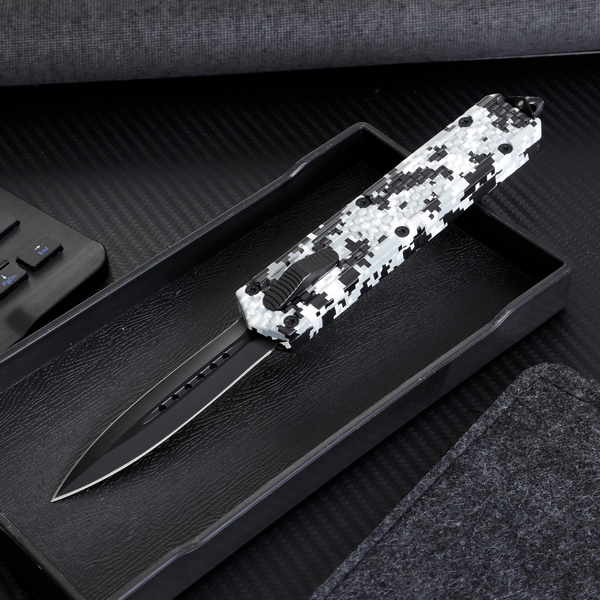
Tactical OTF knives are a category of automatic knives in which the blade deploys linearly from the handle via a thumb slider or button. This deployment method offers exceptional speed, allowing for convenient one-handed opening and closing—a trait that gives tactical OTF knives a unique edge over conventional folders.[2][11]
Core attributes of tactical OTF knives:
- Swift automatic deployment and retraction
- Mechanisms for single-action or double-action operation
- Compact and discreet carry profiles
- Tough materials, typically stainless steels and lightweight alloys
- Enhanced safety features for real-world tactical scenarios
Tactical OTF knives are designed with rapid response and utility in mind, making them favored tools for military units, law enforcement, and wilderness professionals.[5][11]
Double-action mechanisms allow the blade to both deploy and retract with each push or pull of the actuator, simplifying repeated use in the field. These are the most popular configuration for tactical applications because they combine speed with reliability.[10][2]
Single-action models deploy with a button or slider but must be manually retracted. They provide increased simplicity and may be easier to maintain, but lack the rapid reset capabilities prized in tactical environments.[2]
Many manufacturers develop niche products aimed at unique market segments:
- Glass-breaker or rescue tips
- Non-reflective or rubberized handles for covert operations
- Premium blade coatings (black oxide, titanium nitride)
- Custom engraved or branded designs for retailers and collectors
- Serrated or hybrid edge options for versatility[12][5]
Selecting the right blade steel directly impacts edge retention, corrosion resistance, ease of maintenance, and overall utility. Modern tactical OTF knives utilize:
- Premium Steels: CPM S30V, S35VN, M390, Elmax, 20CV — these offer exceptional durability, edge holding, and stain resistance but can be harder to sharpen without professional tools.[4][9][2]
- Standard Steels: 440c, 154CM, AUS-8, D2 — widely used for their ease of sharpening, balanced toughness, and corrosion resistance; suited to most tactical applications and more budget-friendly lines.[6][4][5][2]
Blade profiles commonly found include drop point (general use), spear point (puncture tasks), and tanto (extra tip strength).
OTF knife handles are engineered from robust metals and advanced composites to withstand heavy field use:
- Aviation aluminum (6061-T6): Lightweight, corrosion-resistant, CNC-machined for exacting tolerances; often seen in premium models.[1][7][2]
- G10 fiberglass laminate: Used for its outstanding grip and resilience, ideal for wet environments.
- Zinc alloy: Offers solid structure and can be rubberized for non-slip handling.[5]
- Textured polymer: Suitable for weight reduction and customization.
Handle ergonomics include pocket clips (often reversible), glass breakers, thumb grooves, and inlays for superior grip and safety.[7][5]
A central feature of tactical OTF knives is their robust sliding deployment system, powered by a high-tension coil spring, and secured by an internal track and lock assembly:
- Double-action slides: Offer dual, smooth actions for blade deployment and retraction.
- Single-action buttons: Mechanically simpler, generally stronger but slower for repeated use.
- Precision CNC machining: Ensures tight tolerances, reliable actuation, and minimal blade play—critical for operational safety.[1]
Locking integrity must be tested: High-end OTF knives minimize blade movement within the track, but some degree of play is inherent to their design and should be balanced against ease of action and safety.[2]
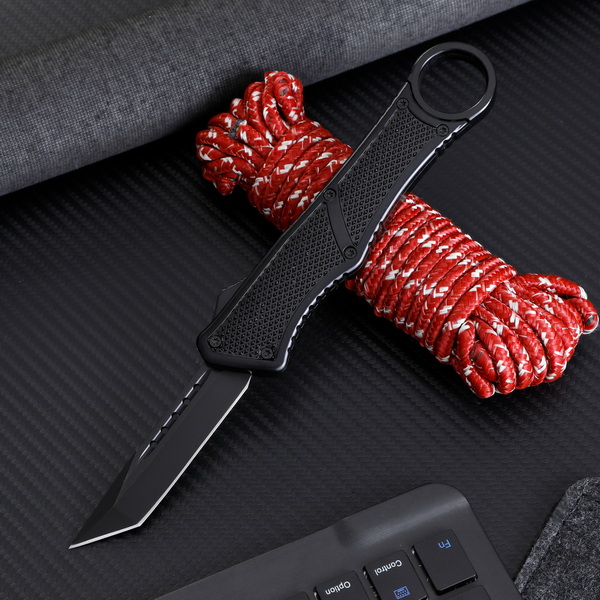
Understanding and testing the following criteria can help ensure your tactical OTF knives will perform up to market demands:
- Deployment speed and reliability: Rapid and consistent blade action is mission-critical.
- Blade stability and lock-up: Check for minimal movement when the blade is extended; test across multiple units.
- Edge grind and finish: A uniform sharpened edge, quality coatings, and tip geometry mean better performance and customer appeal.
- Ergonomics and carry options: Comfortable handling and functional pocket clips drive user satisfaction.
- Durability of mechanism and spring: Internal components should resist wear even after hundreds or thousands of cycles.[4][2]
Partnering with a reputable OEM manufacturer brings several advantages:
- Access to advanced materials and technology (premium steels, CNC machining, modern coatings)
- Custom branding and design capabilities (engraving, handle colors, blade etchings)
- Compliance with international export and knife laws
- Quality assurance through batch testing, warranty, and traceability
- Scalable production to meet growth demands and special orders[8]
For wholesalers and retailers, stringent QC should cover:
- Consistency of mechanical action across production batches
- Material certificates for blade and handle alloys
- Visual and functional inspection of locking and safety systems
- Assessment of finishing, branding marks, and packaging quality
- Documentation for compliance and warranty coverage[8][1]
Automatic knives—including tactical OTF knives—face varied legal restrictions around the globe:
- Many countries and states limit blade length (typically 3–4 inches for EDC compliance) or ban automatic knives entirely.
- Shipping and import/export rules require proper paperwork, accurate labeling, and sometimes restricted courier services.
- Retailers must inform buyers about local regulations and maintain records regarding shipment and compliance.[10][4]
Consult reliable wholesale partners and legal specialists to ensure that every tactical OTF knife product meets destination market standards.
Choosing which tactical OTF knives to stock or private label depends on:
- Target market: Law enforcement agencies, military units, survivalists, EDC fans, collectors
- Price point: High-end tactical knives for professionals vs. entry-level models for general retail
- Feature set: Enhanced safety, grip style, deployment reliability, blade options, and additional functions (glass breaker, seatbelt cutter).[6][5][2]
Recommended products by category:
- Premium: Microtech Ultratech (M390/Elmax), Benchmade Infidel (D2), Hogue Counterstrike (S30V)
- Mid-range: Smith & Wesson M&P OTF (AUS-8), RavenCrest Tactical (440c)
- Budget: SOS Knives OTF (D2), Boker Plus OTF (standard steels)
Retailers should educate buyers on maintaining tactical OTF knives:
- Clean debris from the blade track and mechanism after field use
- Use a light oil on moving parts for smoother deployment
- Sharpen blades using whetstones or diamond stones; most OTF knives use a 20–25 degree angle per side[4]
- Avoid prying or heavy-duty tasks that exceed the knife's design (fixed blades may be preferable for these purposes)[2]
High-quality knives should last for years, but mechanism wear can occur if abused or improperly maintained.
Strong partnerships with OEMs enable retailers to elevate tactical OTF knife offerings:
- Bespoke designs, logos, and packaging to build brand loyalty
- Custom handle colors, blade finishes, and edge profiles
- Control over production volume, quality standards, and after-sales support
Major knife brands—including Guardian Tactical, Microtech, and Hogue—have built industry reputations by offering exclusive OEM models tailored to specific user demands.[9][13]
- Feature compelling photography and videos displaying deployment, blade detail, and safety features
- Collaborate with tactical gear influencers for reviews and live demonstrations
- Highlight unique selling points—reliability, speed, innovation, and safety
- Publish comprehensive buyer's guides and FAQs to clarify product choices and legal status
- Neglecting compliance checks, which can cause seized shipments and legal troubles
- Overlooking batch consistency and quality inspection, risking brand reputation
- Focusing only on price at the expense of mechanical reliability and material quality
- Underestimating the importance of customer education on knife handling and care
Sourcing tactical OTF knives for OEM retail or wholesale operations demands close attention to blade material, mechanism integrity, handle construction, and compliance with international knife laws. Retailers who embrace manufacturing best practices, partner with established OEMs, and educate their customers with quality marketing content will earn trust and market share in this dynamic segment. Tactical OTF knives offer unique opportunities for professional and enthusiast customers, provided products meet rigorous standards of performance, safety, and reliability.
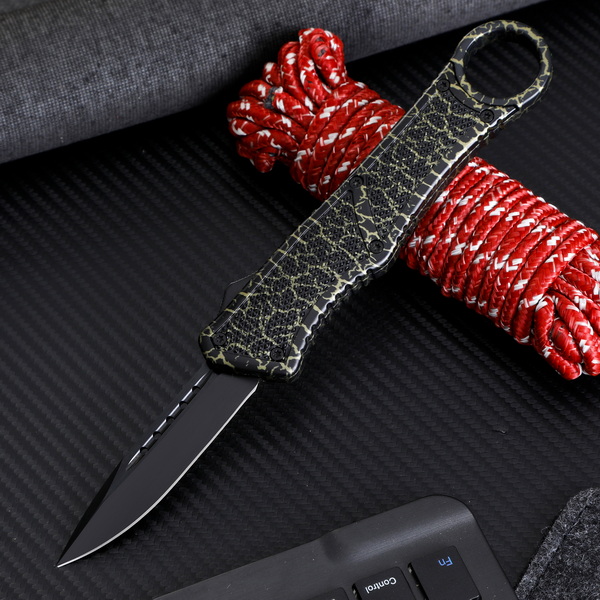
Tactical OTF knives offer rapid, one-handed deployment and retraction, making them ideal for emergency situations and high-pressure professional environments.[11][2]
Premium steels such as S35VN, M390, and Elmax are preferred for their edge retention and corrosion resistance; mid-range steels like AUS-8 and D2 are good choices for cost-effective reliability.[9][2]
Many jurisdictions restrict automatic knife sales based on blade length, mechanism type, and carry regulations. Retailers must ensure compliance before importing or reselling tactical OTF knives.[10][4]
Regular cleaning and light lubrication of the deployment mechanism, proper blade sharpening (20–25 degrees per side), and avoiding heavy-duty prying significantly extend the knife's lifespan.[4]
Batch inspections for deployment integrity, locking stability, material certification, and finish consistency should be mandatory. Working with reputable OEM partners secures reliability and compliance.[1][8]
[1](https://cobratecknives.com/product/special-purpose/utility-knives/otf-utility-knife/)
[2](https://bladeops.com/blog/the-advantages-and-disadvantages-of-otf-knives-in-tactical-settings/)
[3](https://www.benchmade.com/products/5370fe-shootout-otf)
[4](https://knife-depot.com/blogs/sharpened-values/otf-knives-explained-the-complete-guide)
[5](https://ravencresttactical.com/product-category/otf-knives/)
[6](https://store.smith-wesson.com/tactical/knives/smith-wesson-swotf9b-assist-opening-otf/SWOTF9B.html)
[7](https://www.tektoknives.com/products/a5-spry)
[8](https://www.58hrcknives.com/what-to-expect-from-a-top-manufacturer-of-custom-otf-knives.html)
[9](https://eknives.com/blog/brands-we-trust-guardian-tactical-recon-otf-knives/)
[10](https://www.sogknives.com/pentagon-otf-black/)
[11](https://bladeops.com/blog/pros-and-cons-of-otf-knives-for-tactical-operations/)
[12](https://www.trueswords.com/Armed-Force-Tactical-Non-Reflective-Automatic-OTF--51801/51801.html)
[13](https://microtechknives.com/collections/otfs)


