
Views: 222 Author: Leah Publish Time: 2025-11-14 Origin: Site


Content Menu
● Understanding OTF Pocket Knives
>> Price Point
● Assisted Opening Knife: Definition and Operation
>> What is an Assisted Opening Knife?
● Assisted Opening Knife: Pros
● Assisted Opening Knife: Cons
>> Deployment Requires Manual Start
● The Difference in Speed and Everyday Use
● Choosing the Right Knife: Scenarios and Application
>> When Is the OTF Pocket Knife Ideal?
>> When to Choose an Assisted Opening Knife
● Summary
● Frequently Asked Questions (FAQ)
>> 1. Are OTF pocket knives legal worldwide?
>> 2. Which knife is better for everyday carry?
>> 3. Do OTF pocket knives require special maintenance?
>> 4. Can assisted opening knives handle heavy-duty tasks?
>> 5. What risks are associated with OTF pocket knives?
As knife technology evolves, end-users from outdoor enthusiasts to tactical professionals face critical decisions regarding their everyday carry gear. Among the most debated options are the OTF pocket knife—renowned for its unique deploying mechanism—and the assisted opening knife, celebrated for its legality and reliability. This article provides an in-depth, comparative overview of these two knife types, examining their construction, practical advantages, drawbacks, maintenance requirements, and real-world applications, so buyers and OEM partners alike can choose the best solution for their global markets.
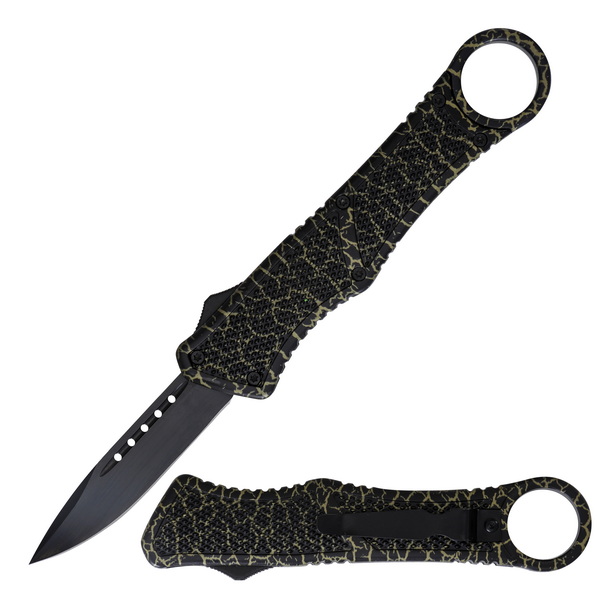
An OTF pocket knife, or “Out the Front” knife, features a blade that deploys linearly from the handle, unlike traditional side-folders. With a button or switch, users can instantly open or retract the blade. Most high-quality OTF pocket knives offer dual-action operation, allowing rapid extension and retraction without manual intervention.[1][10]
This design is especially valuable for rescue, tactical, or emergency scenarios where one-handed use and speed are paramount.[5][1]
Inside an OTF pocket knife, a series of tracks, springs, and locking mechanisms work together to control the blade's motion. When activated, a spring pushes the blade straight out; releasing the switch pulls it back in. The blade locks into place when extended, creating a secure tool ready for fast action.[5]
Engineers must balance weight, spring tension, and material choice to ensure smooth operation and durability. Premium OTF pocket knives require precision manufacturing, making them prized in professional circles and among collectors.[11][5]
OTF pocket knives deploy instantly with a press of a button. This rapid response is crucial in emergencies, such as when cutting through seatbelts or saving someone from entanglement, where every second counts.[2][1][5]
The ability to both extend and retract the blade with a single switch enhances safety and utility, as users can secure the blade quickly after use—essential for law enforcement, military, or rescue personnel operating under stress.[4][5]
OTF pocket knives tend to be thin and pocket-friendly. They do not require the extra bulk of a sheath and are easily stowed in vests, utility belts, or outdoor gear, making them practical for both casual carry and professional deployment.[5]
Modern OTF pocket knives feature advanced locking systems, ensuring the blade stays extended during use and retracts safely. This prevents accidental disengagement and increases user confidence, even in demanding environments.[4][5]
The linear blade deployment provides fine control and accuracy for detail-oriented tasks, such as medical emergencies or delicate fieldwork.[5]
The intricate mechanisms inside an OTF pocket knife require thorough maintenance. Dust, sand, or lint can interfere with the spring tracks, increasing the risk of failed deployment or blade jams, especially in challenging outdoor conditions.[10][1][11]
Most OTF pocket knives are designed for slicing and emergency use, not heavy-duty cutting or prying. Their mechanism and blade mounting do not support tasks that demand significant force, such as chopping or batoning wood.[12][5]
Precision engineering and premium materials add to the cost of quality OTF pocket knives. While entry-level models exist, users seeking high reliability and performance should expect higher prices compared to folding or assisted opening knives.[5]
Many regions restrict or ban the carry and sale of automatic OTF pocket knives because they are classified as switchblades. Users and OEM partners must research and comply with local knife laws before importing, selling, or carrying these products.[13][1]
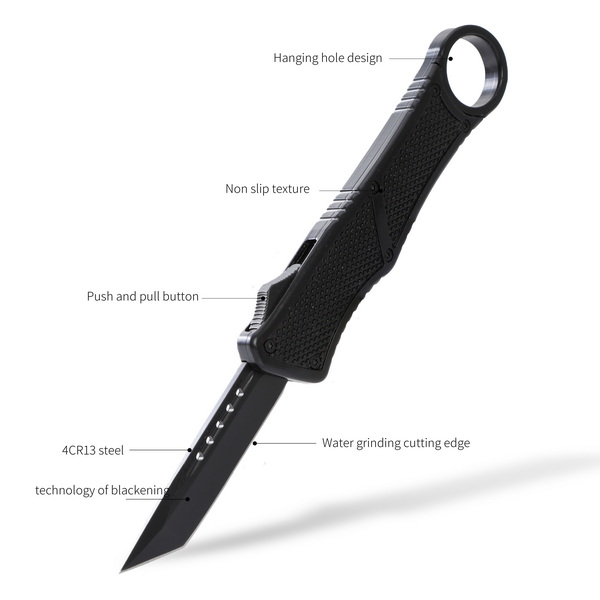
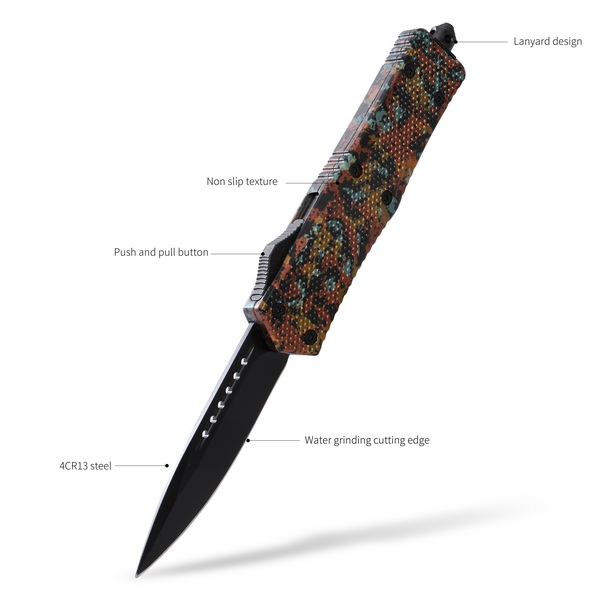
An assisted opening knife uses a spring or torsion bar that engages after a user begins manually pushing the blade open via a thumb stud or lever. Once initiated, the spring mechanism swiftly propels the blade to its fully open and locked position.[1][2][4]
Unlike OTF pocket knives, the blade is always “biased toward closure,” remaining in place until the user applies force. This means the knife will not open unless intentionally triggered—a design feature that enhances legal standing and safety for everyday users.[4]
Assisted opening knives have fewer moving parts compared to OTF counterparts, which makes them easier to maintain and generally more robust for heavy, repeated use tasks.[14]
Once activated, a spring-assisted knife opens rapidly, rivaling the quickness of a manual folder while adding speed over traditional designs. This capability is useful in work environments, outdoor activities, and emergency applications where time and efficiency matter.[2][4]
Assisted opening knives are legal in more regions than OTF automatic knives, since they require an initial manual action for the blade to deploy. This makes them a preferred choice for global OEMs and overseas brands looking to serve broad consumer segments.[1][4]
The simpler mechanism means less susceptibility to mechanical failure, and cleaning or repairs are straightforward. Assisted openers stand up better to dirt, debris, and rugged use in field operations than more delicate OTF mechanisms.[14][4]
With a wide variety of blade shapes, handle designs, and opening methods (flipper tab, thumb stud, etc.), assisted opening knives can be tailored for specific uses—be it utility work, camping, hiking, or tactical operations.[15]
Most assisted opening knives are slim, lightweight, and equipped with pocket clips, making them extremely convenient for daily carry.[14]
Unlike OTF pocket knives, assisted knives require the user to initiate opening, meaning they are marginally slower to deploy in emergency scenarios where mere fractions of a second can make a difference.[2][1]
Closing the blade requires manual intervention, which may be less convenient for those accustomed to dual-action OTF designs or high-frequency professional tasks.[4]
The opening mechanism is less visually striking than OTF automatics, which may matter to collectors or professional end-users seeking specialized gear.[4]
While both OTF pocket knives and assisted opening knives are engineered for rapid deployment, automatic OTF knives are typically faster since the blade is always under spring tension, ready to deploy at a moment's notice. Assisted openers rely on the user to overcome a “bias toward closure” before the spring takes over, meaning their deployment, while swift, requires slightly more effort and is less ideal when the user is injured or encumbered.[2][4]
However, assisted knives shine in everyday utility, work, and outdoor scenarios, combining legality, control, and ergonomic design with reliable one-handed opening.[4]
- Rescue situations: The rapid one-hand deployment of OTF automatics can free someone from entanglement or cut through tough materials in an instant.[5]
- Tactical operations: When gear may snag, space is restricted, or speed is needed, the OTF pocket knife provides optimal performance.[5]
- Professional use: Military, law enforcement, EMT, and first responders may benefit from the instant deployment and secure lockup of OTF knives.[16][5]
- General outdoor use and EDC: Legal acceptance, durability, and simplicity make assisted openers perfect for camping, hiking, fishing, and utility work.[14][4]
- Work environments: Assisted knives are reliable for repeated heavy tasks; companies and OEM partners often select them for varied market regulations.[14]
- Regions with strict knife laws: Assisted opening knives satisfy most global legal requirements, allowing for wider distribution and consumer adoption.[1][4]
Owners must routinely clean and lubricate the internal mechanism, keeping tracks free from debris, dust, and sand. Neglecting maintenance leads to sluggish deployment, jams, and increased risk of malfunction. Regular inspection and light maintenance restore peak performance and extend product life.[10][11]
These knives require only minor upkeep. Occasional cleaning and lubrication of the pivot and torsion bar maintain smooth opening action. Their robust design withstands field abuse and reduces risk of failure in rugged, dirty environments.[14][4]
Automatic OTF pocket knives are heavily regulated and, in some markets, outright banned. In contrast, assisted opening knives enjoy much broader legal status due to their safety mechanisms and required manual input. This makes assisted openers a valuable OEM option where compliance is essential.[1][4]
This article thoroughly explores the distinctions between OTF pocket knives and assisted opening knives, focusing on deployment speed, locking mechanisms, maintenance requirements, and legal implications. For buyers, professionals, and OEM partners, understanding these differences supports informed decision-making and product selection for their target applications and markets.
If the fastest possible, one-handed deployment matters—in tactics, rescue, or emergencies—OTF pocket knives offer unmatched speed. However, assisted opening knives excel in work, utility, and outdoor scenarios, thanks to their reliability, ease of maintenance, and favorable legal status.
No. Many countries and regions restrict or ban automatic OTF knives. Always consult local laws before purchasing, importing, or carrying these knives to avoid legal trouble.[1][4]
For most users, assisted opening knives are more practical due to their legal status, mechanical simplicity, and robust design. OTF pocket knives are ideal for professionals needing instant deployment.[4][5]
Yes. Their complex mechanism needs regular cleaning and lubrication. Assisted openers require less upkeep but still benefit from occasional attention.[11][10][14]
Assisted openers are usually more durable for hard use—cutting, slicing, and repetitive work—while OTF pocket knives excel in fast deployment and precision tasks.[14][4]
Besides legal restrictions, OTF pocket knives' mechanisms can fail if not maintained properly. In critical moments, a jammed blade may pose safety issues. Always keep the knife clean and inspect before high-risk use.[10][11][1]
[1](https://knife-depot.com/pages/switchblade-vs-assisted-opening-knives)
[2](https://artisancutlery.net/blogs/knife-knowledge/spring-assisted-vs-automatic-knife-speed)
[3](https://www.youtube.com/watch?v=FFln79efYWI)
[4](https://www.benchmade.com/blogs/beyond-the-bench/knife-opening-guide)
[5](https://bladeops.com/blog/automatic-knife-vs-manual-folding-knife-which-is-right-for-you/)
[6](https://www.bladeforums.com/threads/automatic-vs-assisted-opening.1361990/)
[7](https://www.reddit.com/r/knifeclub/comments/1bnhoty/whats_the_deal_with_assisted_opening_otf_vs/)
[8](https://www.reddit.com/r/knifeclub/comments/ek0fm8/auto_vs_assisted_not_much_difference_to_me/)
[9](https://www.vipertecknives.com/blogs/all-tactical/switchblade-vs-spring-assist-knife-key-differences-and-which-is-right-for-you)
[10](https://bladeops.com/blog/pros-and-cons-of-otf-knives-for-tactical-operations/)
[11](https://knife-depot.com/blogs/sharpened-values/otf-knives-explained-the-complete-guide)
[12](https://www.58hrcknives.com/heavy-duty-otf-knife-vs-spring-assisted-knife-pros-and-cons.html)
[13](https://blog.knife-depot.com/comparing-auto-vs-assisted-opening-knives/)
[14](https://knifeinformer.com/best-assisted-opening-knives/)
[15](https://kershaw.kaiusa.com/assisted-opening.html)
[16](https://www.tacticalsportinggoods.com/blogs/news/understanding-otf-knives-a-comprehensive-guide-to-their-features-and-uses)


