
Views: 222 Author: Leah Publish Time: 2025-11-05 Origin: Site


Content Menu
● Understanding Tactical OTF Knives
>> What is a Tactical OTF Knife?
>> Single and Double Action OTF Knives
>> Primary Tactical Applications
● Exploring Assisted Open Knives
>> What is an Assisted Open Knife?
>>> Key Features
>> Common Uses
● Tactical OTF Knives: Advantages
>> Secure Lock and Reliable Control
● Tactical OTF Knives: Limitations
>> Price
● Assisted Open Knives: Advantages
● Assisted Open Knives: Drawbacks
>> Potential for Unintended Opening
>> OTF Knives
● Tactical and Everyday Scenarios
>> Law Enforcement and Military
>> Outdoors & Everyday Utility
● Legal and Practical Considerations
● Who Should Choose a Tactical OTF Knife?
● Who Should Choose an Assisted Open Knife?
● FAQ
>> 1. What is the fastest-deploying tactical knife style?
>> 2. Are Tactical OTF Knives legal everywhere?
>> 3. Which knife is better for high-pressure emergencies?
>> 4. How should I maintain a Tactical OTF Knife?
>> 5. Can Assisted Open Knives accidentally open in a pocket?
In the world of tactical gear, choosing the right knife is a critical decision for professionals, enthusiasts, and everyday users. Among the most discussed styles are Tactical OTF (Out-The-Front) Knives and Assisted Open Knives. Each offers distinct advantages for speed, control, reliability, and practicality, making them ideal in specific situations but less so in others.[1][3][5]
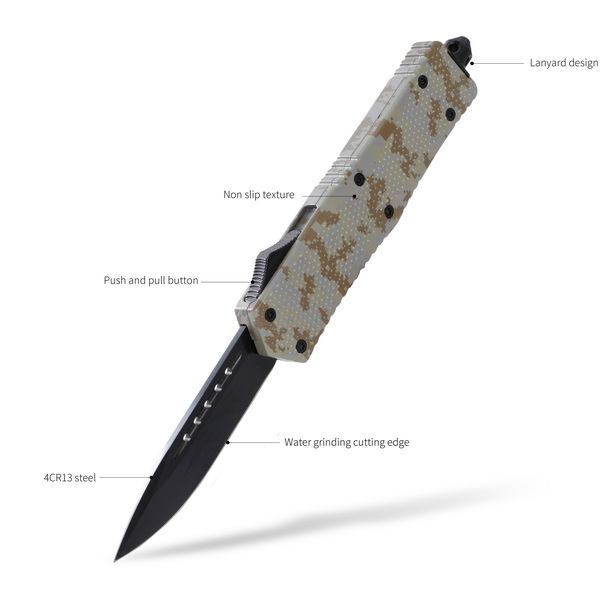
A Tactical OTF Knife operates with a mechanism that allows the blade to extend linearly out of the handle with the press of an actuator. This feature is engineered for rapid, one-handed deployment, which is essential for law enforcement, military, and emergency personnel under high-stress and multi-tasking scenarios.[3][5][1]
- Instant deployment: Fully automatic blade extension with a button or lever.
- True one-handed use: Perfect for situations when your other hand is occupied.
- Compact and easily concealed: Slim profile for quick accessibility.
- Precision action: Controls blade movement and minimizes unnecessary wrist motion.[1]
OTF knives come in single- or double-action versions:
- Single-action: Blade deploys automatically but requires manual retraction.
- Double-action: Both deployment and retraction are automated, streamlining operation in tense situations.[11][1]
- Quick access for emergency rescue
- Cutting restraints or materials in high-pressure events
- Self-defense where intimidation and immediate action matter
- Support roles for medical professionals and outdoor enthusiasts[5][1]
Assisted Open Knives are folding knives with internal springs that help deploy the blade after the user starts the process using a thumb stud, flipper, or alternative actuator. While not fully automatic, they provide fast and reliable blade access with a more conventional and widely accepted mechanism.[2][5]
- Assisted, but not automatic: User initiates deployment, spring completes the movement.[2]
- Suited for one-handed opening: Many designs allow for fast, smooth access.
- Simpler build and lower maintenance: Fewer moving parts compared to OTF knives.
- Broad legality: Generally permitted in most regions, especially compared to OTF models.[12][5]
- Everyday carry (EDC) for utility and safety
- Outdoor activities like camping, hiking, and fishing
- Situations requiring controlled and safe blade use
- General utility roles in professional and personal contexts
The core appeal of Tactical OTF Knives is their ability to deploy a blade with a single press, saving critical time in emergencies. This is essential when your second hand is busy or your reaction must be immediate.[3][1]
OTF knives excel in situations where multitasking is required, such as administering medical aid or operating heavy tools. Their design eliminates unnecessary wrist movement and ensures a secure, deliberate cut.[1]
The slim profile allows Tactical OTF Knives to fit seamlessly on tactical vests, in pockets, or a gear setup. Their straight-out blade means less space is needed for deployment, a critical factor in cramped conditions.[1]
High-quality OTF knives include robust internal locking mechanisms to keep the blade steady, reducing the risk of blade play or accidental retraction during use. Double-action mechanisms further enhance control.[1]
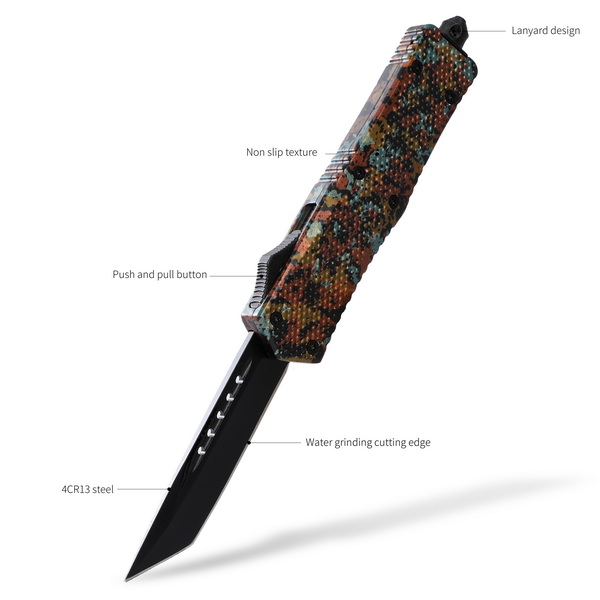
Their intricate design requires diligent maintenance. Debris and dust can compromise the mechanism, increase the risk of spring failure, or slow deployment. Regular cleaning and lubrication are mandatory for reliable function.[5]
Compared to fixed blades or even some folders, the sliding mechanism of OTF knives may not withstand heavy-duty use. Excess force can result in mechanism failure, making them less ideal for rugged applications.[1]
Tactical OTF Knives are often classified as switchblades or automatics. Many regions restrict or ban these knives, so always verify local laws before ownership or carry.[13][5]
Quality OTF knives are typically more expensive due to their complex internal system and high manufacturing standards. Investing in reputable OEM models guarantees performance, but costs can be significant.[13]
While slightly slower to deploy than OTF knives, assisted openers are still quick and intuitive for everyday and emergency scenarios. The controlled opening is especially valued by casual users and professionals alike.[2][5]
Since the spring only assists after user initiation, these knives skirt many legal restrictions that apply to automatics. This makes them suitable for travel, daily carry, and most outdoor locations.[14][5]
With fewer moving parts, assisted open knives are less prone to mechanical failure. Routine cleaning and pivot lubrication are usually sufficient for long-term reliability.[5]
Assisted openers are available across a wide spectrum of designs, materials, and price points. Whether seeking a premium tool or an entry-level utility knife, options abound for every need.[15][12]
A fraction of a second is lost to manually initiating blade deployment. In most real-world cases this is negligible, but in a tactical emergency, the speed advantage of OTF knives is clear.[5]
Most assisted openers still require the user to close the blade manually. This can slow down transitions or increase risk if the user is distracted or under stress.
While perfect for EDC and utility work, these knives rarely satisfy the demanding requirements of tactical professionals, particularly in high-risk environments where speed and intimidation are paramount.[12]
Some designs, if mishandled or lacking appropriate locking mechanisms, may accidentally open in a pocket or bag. Modern safety features minimize this risk, but users should take precautions.[16]
Routine care for Tactical OTF Knives involves disassembling the knife (if allowed by design), removing debris, and lubricating the internal track, spring, and locking mechanisms. Pay particular attention after exposure to sand, mud, or moisture, which can cause jamming or premature wear.[5][1]
Mechanical simplicity makes assisted openers easier to maintain. Cleaning the pivot and blade, ensuring the spring is free of corrosion or failure, and checking locking mechanisms are usually enough for years of dependable service. Users should inspect for blade play and keep the knife free of residue.[15][5]
Rapid deployment can mean the difference between safety and danger. Tactical OTF Knives are preferred when immediate action is non-negotiable—cutting restraints, responding in emergencies, or intimidating threats. However, assisted open knives also hold value for officers needing a reliable and legal backup.[5][1]
OTF knives' ability to cut with precision in close-quarters makes them invaluable when speed and minimal wrist motion matter—rescue situations, medical response, and vehicle extrication. Assisted openers serve support roles, offering easy access and versatile utility.[1]
For regular camping, hiking, fishing, or work, assisted open knives shine for their blend of speed, durability, and legal acceptance. They're ideal for both novice and experienced users in outdoor pursuits.[12][15]
Tactical OTF Knives, as automatics, are subject to legal scrutiny worldwide. Many U.S. states and countries ban their carry, while assisted open knives are widely permitted. It's essential to verify local laws, especially for international travel or work across jurisdictions.[13][5]
- Law enforcement, military, security, and rescue workers requiring instant blade deployment
- Knife collectors seeking high-performance or specialty models
- Emergency responders who value speed above all else[13][1]
- Outdoor enthusiasts and utility workers desiring reliable performance with minimal legal issues
- General EDC users who want versatility and practicality
- Anyone needing a balance of deployment speed, legality, and price[14][15][12]
Tactical OTF Knives deliver unparalleled speed, one-handed operation, and precision for professionals working in high-stress environments. Their strengths, though considerable, are offset by mechanical complexity, maintenance demands, and stringent legal restrictions. By contrast, Assisted Open Knives provide rapid and controlled access for everyday use, broad legal acceptance, and simpler upkeep. The best knife for you depends on your operational needs, environment, and local laws—choose wisely to maximize safety, efficiency, and utility.[15][12][13][5][1]
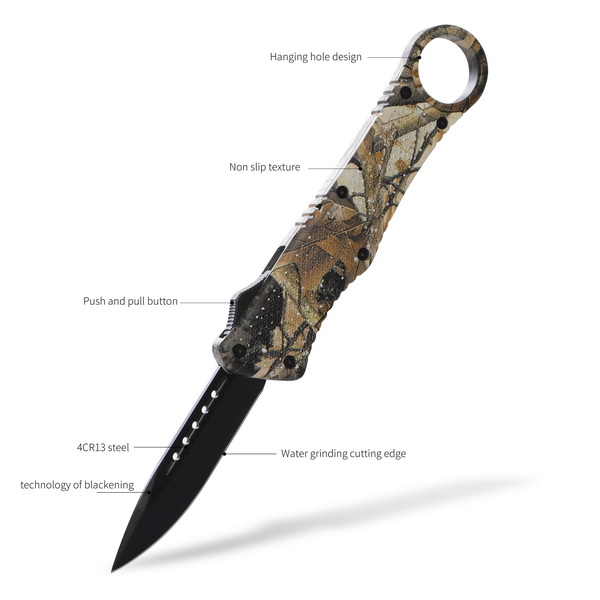
Tactical OTF Knives deploy instantly with a button or slider, while assisted openers require initial manual action before the spring finishes deployment.[5][1]
No, many areas restrict or prohibit automatic knives like OTFs. Always check local regulations to avoid legal issues.[13][5]
OTF knives are preferred for split-second deployment and single-handed use, but assisted open knives offer reliability and legality for most civilian tasks.[12][1][5]
Regular internal cleaning and lubrication are vital to ensure smooth, safe operation. Check mechanisms for dirt, debris, and wear after heavy use.[1][5]
Some models risk accidental opening without proper safety mechanisms, but most modern designs include locks to minimize this issue.[16][14]
[1](https://bladeops.com/blog/pros-and-cons-of-otf-knives-for-tactical-operations/)
[2](https://knife-depot.com/pages/switchblade-vs-assisted-opening-knives)
[3](https://www.benchmade.com/blogs/beyond-the-bench/knife-opening-guide)
[4](https://www.reddit.com/r/knives/comments/122n27w/honest_question_why_carry_an_auto_when_other/)
[5](https://www.58hrcknives.com/otf-knife-vs-spring-assisted-knife-which-is-better.html)
[6](https://www.reddit.com/r/knifeclub/comments/ek0fm8/auto_vs_assisted_not_much_difference_to_me/)
[7](https://www.americanedgeknives.com/blog/automatic-and-assisted-open-knives-practical-or-tactical-/)
[8](https://www.vipertecknives.com/blogs/all-tactical/switchblade-vs-spring-assist-knife-key-differences-and-which-is-right-for-you)
[9](https://www.bladeforums.com/threads/mechanical-difference-between-assisted-openers-and-otf-from-a-legal-perspective.1816022/)
[10](https://www.youtube.com/watch?v=FFln79efYWI)
[11](https://www.youtube.com/watch?v=fjHUrk9RnVg)
[12](https://knifeinformer.com/best-assisted-opening-knives/)
[13](https://crateclub.com/blogs/loadout/are-otf-knives-good-for-self-defense-a-comprehensive-analysis)
[14](https://www.budk.com/Assisted-Opening-Knives-2947?start=36&sz=48)
[15](https://hiconsumption.com/gear/best-assisted-opening-knives/)
[16](https://blog.knife-depot.com/why-do-people-hate-assisted-openers/)


