
Views: 222 Author: Leah Publish Time: 2025-11-13 Origin: Site


Content Menu
● Patents: Foundations of OTF Pocket Knife Innovation
>> Mechanisms That Define OTF Excellence
>>> Three-Point Locking Systems
>>> Precision Liner and Slider Technology
● Patents as Blueprint for Manufacturing and OEM Strategy
>> Patent Mapping and OEM Differentiation
>> Establishing Freedom to Operate (FTO)
● Legal and Commercial Contours
>> Licensing, Partnerships, and Cross-Licensing
● Improving Safety and User Experience Through Patents
>> Mechanism Diversity: Single-Action and Double-Action Designs
>> Robust Materials and Advanced Processes
● Building Defensible Brand Identity
>> Practical Workflow for Patent-Driven OTF Pocket Knife Development
● Avoiding Common Pitfalls: Lessons from Patent History
● Envisioning the Future: OTF Pocket Knife Patents Evolve
● FAQ
>> 1. What kind of patent best protects OTF Pocket Knife mechanisms?
>> 2. Do brands need design patents for OTF Pocket Knives?
>> 3. How can OEMs avoid patent infringement with OTF Pocket Knives?
>> 4. Why are advanced lock designs and three-point mechanisms important in OTF Pocket Knives?
>> 5. Is international legality an issue for OTF Pocket Knife distributors?
Patents are the backbone of innovation for OTF (Out-The-Front) Pocket Knife manufacturing. For global OEM factories and brands, these legal protections enable safe investment in research and development, allow new designs to flourish, and serve as strategic assets for commercial differentiation. This article offers an expansive overview of how patents—from utility to design to processes—continue to shape the technology, function, and aesthetics of modern OTF pocket knife products, supporting successful OEM partnerships and global export.
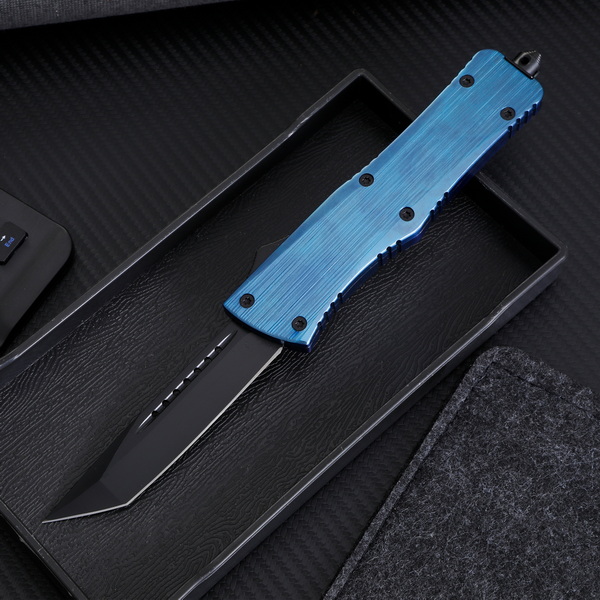
Utility patents are critical in protecting the technical function and deployment mechanisms unique to OTF Pocket Knife architecture. Double-action sliders, robust locking systems, and actuator improvements are typical patent subjects, inhibiting competitors from simply duplicating essential features for 20 years or more. Design patents, meanwhile, safeguard the ornamental aspects—handle profiles, surface engravings, and actuator shapes—supporting brand identity and premium positioning.[10][11][12]
Early OTF Pocket Knife patents, dating back to the 1908 telescoping models and Christiansen's robust deployments in the 1920s, laid the groundwork for modern automatic knives. These innovations addressed safety, reliability, and compactness—factors critical for pocket carry. Spring mechanisms, track engineering, and advanced locking have evolved through patented improvements, giving rise to blades that deploy with consistent force and lock with precise timing.[5]
A breakthrough in safety and strength came from patents detailing three-point interconnections between blade and handle. By securing multiple interface points, these designs prevent misfires—instances where the blade fails to lock open or retract—reducing the risk of accidents for users. Firing and retraction springs provide dynamic movement, while timing mechanisms coordinate blade transitions for optimized reliability.[1][6]
Recent inventions separate the liner-slider-blade mechanism from the handle, making slide action independent of handle materials and design. This allows for more customization, expanded material choices, and minimal blade wobble or play, providing both functional strength and aesthetic flexibility for OTF Pocket Knife brands.[2]
Process patents have carved a niche in the OTF Pocket Knife domain. Advanced metallurgy, injection-molded inserts, and toleranced interfaces ensure quality and repeatability at scale. For OEM operations, adhering to patented manufacturing steps guarantees consistent lock-up and durability across mass-produced OTF Pocket Knife lines.[13][14]
Competitive patent mapping is an OEM's first defense against infringement and enables creative engineering within so-called ‘white spaces'—areas not covered by active patents. Integrating utility and design protection in product development cycles results in distinctive OTF Pocket Knife offerings that command better margins and brand loyalty.[14][10]
A thorough FTO review catalogues every relevant patent by mechanism type—audit trails for sliders, springs, locks, and chassis components. This diligence ensures new designs avoid infringement, differentiating genuine OTF Pocket Knife engineering from mere imitation.[15]
U.S. patents dominate the OTF Pocket Knife landscape, but international brands must navigate global legality regarding automatic knives. Jurisdictions differ in their acceptance, impacting importation, channel strategy, and product packaging for OTF Pocket Knife products.[16]
Expedited market entry often relies on licensing proven mechanisms, especially when time-to-launch is crucial or innovation sits within another party's patents. Cross-licensing arrangements allow OEMs and brands to blend distinctive aesthetics with reliable, field-tested internals for competitive OTF Pocket Knife collections.[14][15]
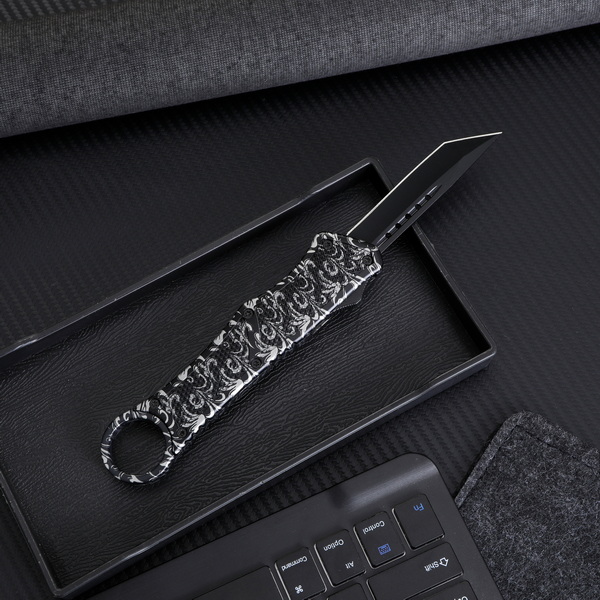
Patents directly address common safety challenges such as ensuring consistent lock-up, preventing accidental deployment, and reducing blade play. Multi-point locking, reinforced triggers, and innovative materials offer tangible improvements users experience daily. Integrated timing prevents misfires in both deployment and retraction—essential for tactical, outdoor, and EDC users of OTF Pocket Knives.[6][1][2]
Single-action OTF Pocket Knives use spring-out blades requiring manual reset, often favored for simplicity and reliability. Double-action knives allow both deployment and retraction via operator controls and spring systems, balancing efficiency and user safety. Contemporary patents detail force curves, anti-bounce technology, and robust slider assemblies.[3][14]
Manufacturing process patents underpin much of the OTF Pocket Knife industry's progress, introducing high-strength steels, ceramic inserts, and advanced coatings that extend wear life. These innovations reduce maintenance, boost lock-up rigidity, and support diverse product portfolios—from tactical units to luxury collectibles.[13]
Design patents create functional value by protecting distinctive features—actuator geometry, handle silhouette, and unique clip designs. These trademarks persist across product generations, supporting OEM and co-branding efforts in the competitive OTF Pocket Knife marketplace.[11][12][10]
- Landscape analysis of key patents in the region and segment.
- Concept down-selection based on freedom-to-operate space.
- Prototyping to validate mechanical function, lock-up, and user ergonomics.
- Timely provisional filings and detailed documentation linking features to patentable functions.[15][14]
- George Schrade's Telescoping Knife (1908): Introduced a spring-released blade, forming the template for OTF mechanisms.[5]
- Christiansen's Enhanced OTF Lock (1923): Improved safety through reliable locking and robust construction.[5]
- Modern Three-Point Lock Systems: Addressed weaknesses by integrating multiple contact points between blade and handle, greatly enhancing operational security.[1][6]
Copying ornamental details from design-patented OTF Pocket Knives or reusing utility-patented locking and actuation systems invites legal challenges. OEMs should prioritize unique exterior styling and mechanism geometry, and seek licenses where innovation depends on patented elements.
Current filings focus on anti-wobble technology, low-friction coating, and ergonomics aimed at users operating in gloves or extreme conditions. Additive manufacturing and hybrid-material solutions push the boundaries of conventional OTF Pocket Knife construction, fueling the next generation of patents and consumer experiences.[13][14]
Patents serve as the engine of innovation for OTF Pocket Knife technology, protecting not only mechanical breakthroughs but also the aesthetics that define brand presence. OEMs and manufacturers who respect and leverage patent frameworks secure competitive advantages, deliver unique value to global partners, and contribute to the evolution of safer, more reliable OTF Pocket Knife products. Successful adoption and compliance with these legal constructs yield both marketplace stability and creative engineering.
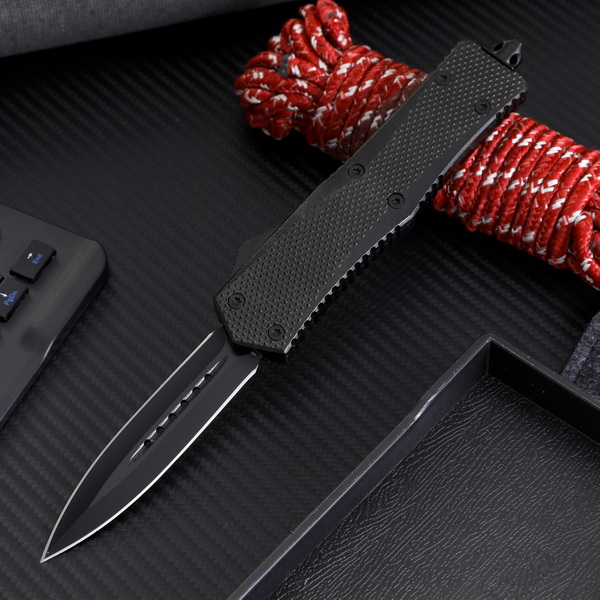
Utility patents defend technical functions such as the slider assembly, spring deployment, and lock-up systems, preventing unauthorized replication for up to two decades.[3][14]
Yes, design patents shield the exterior look—such as actuator and handle shapes—helping build recognizable products and avoid copycat styling.[10][11]
By conducting rigorous freedom-to-operate reviews, mapping competitive claims, and licensing or re-engineering around protected mechanisms, OEMs minimize legal risk.[14][15]
Patented multi-point locks and reinforced triggers drastically reduce operational failures and boost user safety for automatic deployment and retraction.[2][6][1]
Yes, each country has different laws regarding automatic knives, so brands and OEMs must research local policies to maintain compliance.[16]
[1](https://patents.google.com/patent/US20070175045A1/en)
[2](https://patents.justia.com/patent/10981284)
[3](https://patents.google.com/patent/US9498889B1/en)
[4](https://upknife.com/pages/patent-pending)
[5](https://bladeops.com/blog/the-history-of-otf-knives-from-military-tool-to-everyday-essential/)
[6](https://patents.google.com/patent/US7562455B2/en)
[7](https://www.scribd.com/document/730292066/hawlk-otf)
[8](https://patents.justia.com/patent/11207790)
[9](https://www.youtube.com/watch?v=RX6cTzuugpo)
[10](https://patents.justia.com/patent/D945240)
[11](https://patents.justia.com/patent/D1087722)
[12](https://patents.google.com/patent/USD986023S1/en)
[13](https://patents.google.com/patent/US8601907B2/en)
[14](https://patents.justia.com/assignee/microtech-knives-inc)
[15](https://www.akti.org/brand-protection/intellectual-property-101/)
[16](https://steelriverknives.com/world-wide-switchblade-laws/)


