
Views: 222 Author: Leah Publish Time: 2025-11-23 Origin: Site


Content Menu
● Understanding Tactical OTF Knives
● Why South Korea Is Emerging as a Tactical OTF Hub
● Key Strengths of South Korean OTF Knife Producers
>> Advanced Engineering and Tolerances
>> Rigorous Quality Control Systems
● The Role of OEM and ODM for Global Buyers
>> OEM Services for Established Brands
>> ODM and Co-Development Projects
● Manufacturing Process Highlights for OTF Knives
>> Handle and Internal Frame Production
>> Blade Fabrication and Heat Treatment
>> Assembly, Testing, and Final Inspection
● Market Position of South Korean Tactical OTF Producers
>> Comparison with Other Knife-Manufacturing Regions
>> Growth in Personal and Professional Use
● How Overseas Buyers Can Work with South Korean Suppliers
>> Evaluating Potential Partners
>> Key Cooperation Points for OEM/ODM
● Future Trends for Tactical OTF Knives in South Korea
>> Material and Mechanism Innovation
>> Sustainable and Responsible Manufacturing
● FAQ
>> 1. What makes OTF knives different from regular folding knives?
>> 2. Are OTF knives safe to use?
>> 3. Why should brands choose South Korean Tactical OTF Knives Manufacturers and Suppliers?
>> 4. What factors should buyers consider when selecting an OTF knife manufacturer?
>> 5. How is the tactical knife market in South Korea expected to grow?
South Korea is becoming a rising force in the global tactical knife industry, particularly in the field of OTF (Out The Front) knives designed for professional and outdoor applications. tactical OTF knives manufacturers and suppliers in South Korea are increasingly partnering with international brands, wholesalers, and OEM buyers to deliver high-precision, durable, and innovative knife solutions.[9]
Tactical OTF knives are automatic knives in which the blade slides linearly out of the front of the handle rather than pivoting from the side like a traditional folding knife. This design allows rapid one-handed deployment and retraction, making OTF knives highly valued in tactical, military, rescue, and outdoor scenarios where speed and reliability are critical.[5]
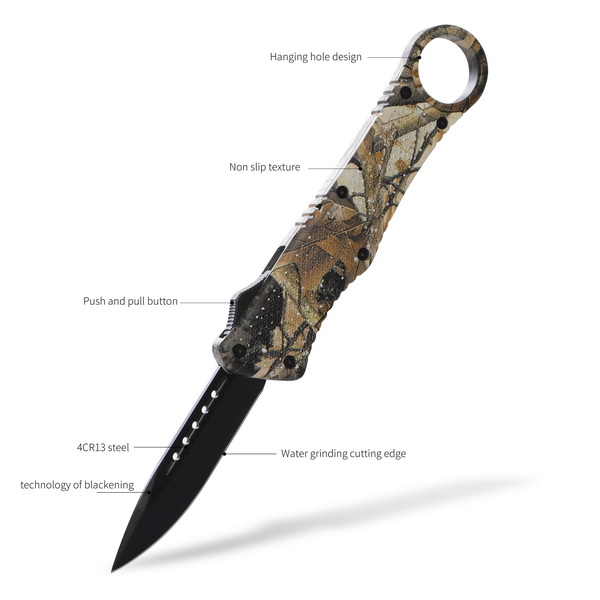
There are two main types of OTF mechanisms: single-action (SA) and double-action (DA). SA OTF knives use a spring to deploy the blade but require manual retraction, whereas DA OTF knives use internal springs for both deployment and retraction via a single switch. For Tactical OTF Knives Manufacturers and Suppliers, mastering both systems opens up wider markets and use cases, from law enforcement and emergency teams to everyday carry (EDC) enthusiasts.[5]
South Korea's manufacturing sector is already well-known for electronics, automotive components, and precision machinery, and the knife industry is increasingly leveraging that same technological base. Tactical OTF Knives Manufacturers and Suppliers in South Korea benefit from advanced CNC machining, high-precision 3D modeling, and rigorous process control, creating knives that rival long-established markets in quality.[4][9]
Manufacturers also adopt integrated OEM systems similar to broader outdoor tool production: from design engineering and simulation to tooling, molding, mass production, and packaging logistics under one quality framework. This integrated approach allows South Korean suppliers to handle complex OTF mechanisms and tight tolerances while ensuring stable lead times and consistent product performance.[1][4]
OTF knives demand extremely tight tolerances in the handle channels, blade geometry, and internal components so the blade can deploy and retract smoothly without wobble or misfires. South Korean Tactical OTF Knives Manufacturers and Suppliers apply high-speed CNC machining and precision inspection methods similar to aerospace or high-end tool industries, controlling dimensions within fractions of a millimeter to guarantee safe, repeatable action.[1][4][5]
These manufacturers also rely on advanced 3D CAD and simulation techniques to verify the feasibility of new OTF designs before investing in molds and fixtures, which reduces development risk for overseas OEM clients. As a result, foreign brands can iterate on blade profiles, handle ergonomics, and internal spring systems quickly while keeping mechanical reliability at the core.[4][1]
Modern tactical OTF knives frequently use premium stainless and tool steels such as S35VN, 20CV, M390, or similar high-carbon alloys that balance edge retention, toughness, and corrosion resistance. South Korean producers adopt comparable steel grades and combine them with durable handle materials like anodized aluminum, titanium, and reinforced composites to deliver lightweight yet robust knives for harsh environments.[6][1]
Surface treatments—such as stonewashing, DLC (diamond-like carbon) coating, or other advanced finishes—further protect blades from abrasion and rust while giving them a professional tactical look favored by military and law-enforcement buyers. For OEM brands, this materials expertise enables a wide range of product tiers, from entry-level tactical models to high-end collectible or professional-grade OTF knives.[3][6][1][4]
To succeed as global Tactical OTF Knives Manufacturers and Suppliers, factories in South Korea implement quality frameworks comparable to other export industries, often including ISO 9001 quality management certification. Quality control covers multiple stages: verification of raw materials, inspection of CNC-machined parts, hardness and edge consistency testing, and full functional checks of the OTF mechanism under repeated deployment cycles.[9][1][4]
Many outdoor-knife and tool producers also subject their products to corrosion tests such as salt-spray exposure and environmental durability checks, reflecting the demands of military and survival markets. This systematic QC approach reduces defect rates for overseas buyers and builds trust with wholesalers and brands who rely on stable repeat orders and low warranty returns.[4][9]
For existing knife brands or distributors with ready-made designs, OEM cooperation with South Korean factories is often the most direct route to market. OEM Tactical OTF Knives Manufacturers and Suppliers reproduce the customer's design using their own tooling, production lines, and QC systems while applying custom logos, markings, and packaging.[3][4]
Because these factories are accustomed to handling multiple international clients, they can adapt to different regulatory requirements, barcoding systems, and private-label packaging without sacrificing production efficiency. For a foreign buyer, this means a faster scale-up from prototype to large-volume shipments with consistent performance across batches.[9][4]
ODM cooperation is ideal for companies that want unique tactical OTF models but do not yet have complete engineering resources. In an ODM relationship, Tactical OTF Knives Manufacturers and Suppliers provide full design support, creating knife concepts, mechanical layouts, and prototypes in collaboration with the client's branding and market requirements.[4]
Using reverse engineering tools, 3D modeling, and prototypes, South Korean ODM partners can help customers differentiate their blades through custom grinds, handle textures, or internal mechanism variations. This reduces both the technical and financial barriers for new entrants who want to sell advanced OTF knives under their own name but lack in-house R&D.[3][4]
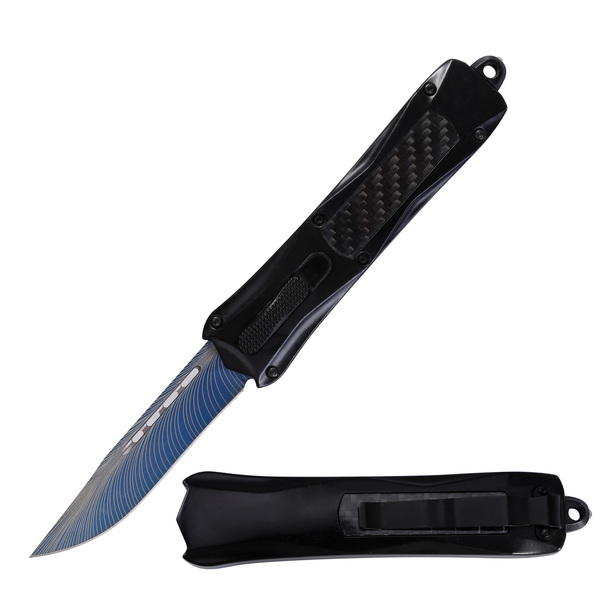
The handle and internal frame of an OTF knife are more complex than in standard folding knives because they must guide and house a reciprocating blade and springs. Typical production begins with bar stock or plate materials that are cut, deburred, and then machined on multi-axis CNC equipment to form internal tracks, cavities, and stop surfaces controlling blade movement.[8][1]
Each handle half is then repeatedly inspected for dimensional accuracy, followed by surface finishing treatments like tumbling to remove sharp edges and provide a uniform appearance. For Tactical OTF Knives Manufacturers and Suppliers, this precision machining and finishing process is crucial to achieving smooth deployment and minimizing play or rattle when the blade is locked open.[8][1]
OTF blades are usually cut from sheets of high-performance steel slightly oversize, then progressively ground and milled to the final dimensions required by the mechanism's tolerances. Heat treatment is carefully controlled to reach target hardness values while retaining toughness; for high-end alloys, this can include multiple tempering stages or cryogenic processing.[6][1]
After rough and finish grinding, blades receive bevel grinding, surface finishing, deep engraving for logos or technical data, and final hand sharpening. Because the OTF mechanism depends on precise mass and balance for proper spring-driven movement, every manufacturing step must be consistent across the entire production batch.[1][5][6]
Once handles, blades, and internal components are completed, assembly teams or automated stations insert springs, sliders, and trigger mechanisms into the handle and fit the blade to the track system. Each knife is then function-tested to ensure reliable deployment, secure lockup, and safe retraction without misfires or incomplete travel.[5][8][1]
Final inspection may also include cosmetic checks for coating defects, alignment issues, or engraving clarity to match brand expectations. For Tactical OTF Knives Manufacturers and Suppliers targeting premium markets, extended cycle testing and user-simulation trials help ensure that knives perform consistently even after thousands of actuations.[1][5][4]
The global tactical knife market includes established hubs such as the United States, Japan, and China, each with different strengths. U.S. producers often emphasize domestic branding and innovation at higher price points, Japanese makers focus on heritage craftsmanship, and Chinese factories dominate cost-effective mass production.[9]
South Korean Tactical OTF Knives Manufacturers and Suppliers occupy a growing mid-to-high segment, combining sophisticated engineering and QC with more competitive pricing than many Western brands while maintaining higher consistency and technology levels than many purely low-cost competitors. This positioning is attractive for international OEM clients seeking a balance between quality, innovation, and overall landed cost.[9]
Data suggests that the personal-use tactical knife market in South Korea itself is growing steadily, driven by outdoor sports, camping, and self-defense interest, with expectations of multi-year compound growth. This domestic demand encourages further investment in tooling, R&D, and automation, which in turn benefits overseas OEM and wholesale partners through better capacity and more diversified product offerings.[9]
As global awareness of OTF technology spreads through online reviews, demonstration videos, and enthusiast communities, South Korean suppliers can leverage their manufacturing base to export both house-branded and OEM tactical OTF models worldwide.[10][8]
When screening Tactical OTF Knives Manufacturers and Suppliers in South Korea, overseas buyers typically examine several factors:
- Evidence of experience in OTF or automatic knives, including existing models and references.[3]
- Quality certificates, factory audits, and documented process control for machining, heat treatment, and final QC.[4]
- Ability to handle OEM/ODM projects, including CAD support, prototyping, and small pilot runs before full-scale production.[4]
Checking these criteria helps ensure that any new cooperation will meet both technical and commercial expectations.
Clear communication on specifications is essential: blade steel grade, hardness target, mechanism type (SA or DA), deployment force, safety features, and local legal considerations in the buyer's market. Buyers also need to define branding details such as logo placement, engraving depth, packaging design, and labeling standards for customs and retail channels.[5][4]
Many South Korean manufacturers can also assist with logistics planning, including bulk packaging, palletization, and documentation for export customs clearance. For brands and wholesalers, this end-to-end support reduces coordination costs and shortens the time from design approval to market launch.[4]
Future Tactical OTF Knives Manufacturers and Suppliers in South Korea are likely to experiment further with advanced steels, hybrid composites, and coatings that push the boundaries of corrosion resistance and edge retention. There is also potential for more complex internal mechanisms that improve safety, reduce accidental deployment, and optimize spring performance over thousands of cycles.[6][8][1][5]
Digital design tools, reverse engineering, and data-driven tolerance optimization allow engineers to refine handle ergonomics and switching forces to match specific user groups, such as gloved military operators or EDC users who prioritize discreet carry.[1][4]
As global regulations and consumer expectations shift, sustainability is becoming an important differentiator among manufacturers. Knife and outdoor tool producers are increasingly attentive to efficient material usage, energy-conscious machining, and environmentally responsible surface treatments.[4]
South Korean factories that already apply modern lean manufacturing and environmental labeling practices in other industries are well positioned to extend these standards to tactical OTF knife production. For international brands, partnering with such suppliers can support ESG goals while still obtaining high-performance tactical tools.[4]
Tactical OTF Knives Manufacturers and Suppliers in South Korea are rapidly building a reputation as reliable partners for international brands, wholesalers, and OEM buyers seeking advanced, dependable tactical knives. By combining precision machining, high-performance materials, and rigorous quality control, South Korean producers can deliver OTF knives that meet the demanding needs of military, law-enforcement, rescue, and outdoor markets.[5][1][4]
With strong capabilities in OEM and ODM services, these manufacturers support customers from initial concept and design through to mass production, packaging, and export logistics, helping foreign brands bring new tactical OTF lines to market efficiently. As the global tactical knife market grows, South Korea's engineering strength and balanced cost–performance profile position its Tactical OTF Knives Manufacturers and Suppliers as strategic long-term partners for the industry.[3][9][4]

OTF knives deploy the blade straight out of the front of the handle using a spring-driven internal mechanism, while folding knives pivot the blade from the side. This front-deploy design offers faster one-handed operation and a more compact carry profile for many tactical and rescue applications.[8][5]
Modern OTF knives include locking systems, carefully calibrated springs, and internal safety features that prevent accidental deployment when properly used. As with any edged tool, safety depends on correct handling, storage, and compliance with local regulations for carry and use.[8][5]
South Korean manufacturers combine advanced CNC machining, sophisticated design tools, and strict QC systems often aligned with international standards, enabling high mechanical reliability in OTF mechanisms. They also provide flexible OEM/ODM services, making it easier for foreign brands to launch customized tactical OTF lines with stable quality and delivery.[1][3][4]
Key factors include experience with OTF mechanisms, evidence of consistent quality control and testing, material capabilities, and the ability to support custom design and branding requests. Buyers should also evaluate communication efficiency, lead times, and after-sales support to ensure long-term cooperation.[3][4]
Market analyses indicate that the personal-use tactical knife sector in South Korea is projected to grow steadily over the next several years, driven by outdoor activities and self-defense interest. This expansion encourages further investment in manufacturing capacity and innovation, which benefits global buyers working with South Korean Tactical OTF Knives Manufacturers and Suppliers.[9]
[1](https://www.youtube.com/watch?v=EwG2oytZCl8)
[2](https://www.youtube.com/watch?v=4Hc0U55a2ts)
[3](https://www.arsunknives.com)
[4](https://www.shieldon.net/shieldon-knife-manufacturing-101/)
[5](https://uppercuttactical.com/blogs/news/how-does-an-otf-knife-work)
[6](https://www.youtube.com/watch?v=lojT2LuLPxY)
[7](https://www.youtube.com/watch?v=j_VVzewzrG0)
[8](https://www.youtube.com/watch?v=dkaA4wZeLdQ)
[9](https://www.linkedin.com/pulse/south-korea-personal-use-tactical-knife-market-growth-2gyuc)
[10](https://www.tacticalsportinggoods.com/blogs/news/ultimate-guide-to-the-top-10-otf-knives-of-2025-features-reviews-and-recommendations)


