
Views: 222 Author: Leah Publish Time: 2025-11-28 Origin: Site


Content Menu
● What Is an Automatic OTF Knife?
● What Is an Assisted OTF Knife?
● Speed and One‑Handed Deployment
● Safety and “Bias Toward Closure”
● Legal and Regulatory Differences
>> When to choose an Automatic OTF Knife
>> When to choose an assisted OTF knife
● Durability, Materials, and Maintenance
● Ergonomics and User Experience
● Cost, Complexity, and Reliability
● Choosing the Right Mechanism for Your Brand
● FAQ
>> 1. What is the main difference between an Automatic OTF Knife and an assisted OTF knife?
>> 2. Which is faster in real use: automatic or assisted OTF?
>> 3. Are Automatic OTF Knife models always illegal while assisted OTF knives are legal?
>> 4. Which design is better for everyday carry?
>> 5. What should brands consider when ordering OEM Automatic OTF Knife production?
For outdoor, tactical, and EDC users, out‑the‑front (OTF) knives offer a unique combination of speed, compact size, and modern styling. An Automatic OTF Knife and an assisted OTF knife may look similar at first glance, but their mechanisms, legal status, and user experience are very different. Understanding these differences helps overseas brands, wholesalers, and manufacturers choose the right OEM models for their target markets.
Our Chinese advanced outdoor knife factory specializes in OEM production of Automatic OTF Knife models and assisted OTF designs for global brands. This article explains how each system works, why they feel different in the hand, and how to select the best specification when building your product line.
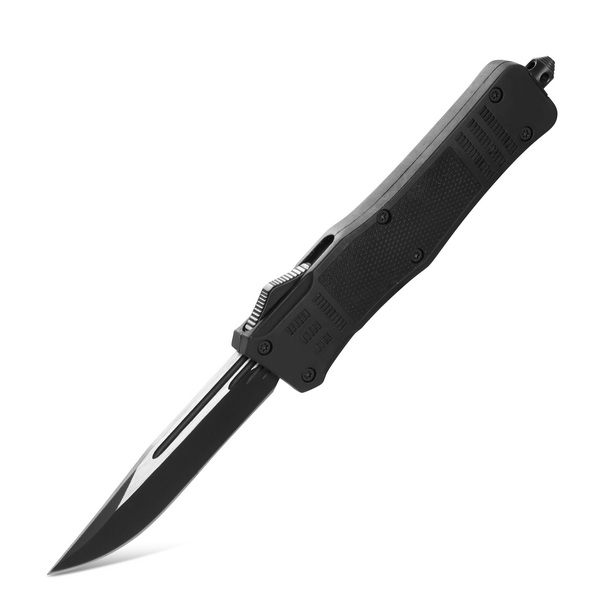
An Automatic OTF Knife (out‑the‑front automatic) is a knife whose blade shoots straight out of the front of the handle when the user activates a control such as a button, slider, or switch. The blade is held under tension by an internal spring system; when the control is pressed, that stored energy is instantly released to drive the blade forward into the locked open position.
There are two main mechanical styles of Automatic OTF Knife:
- Single‑action automatic OTF – The spring drives the blade out automatically, but the user must manually pull or push the blade back into the handle to reset it.
- Double‑action automatic OTF – The same control is used to both deploy and retract the blade. Pushing the slider one way sends the blade out; moving it in the opposite direction pulls the blade back under spring tension.
Because of this design, an Automatic OTF Knife is capable of very fast one‑handed deployment, even when the user is wearing gloves or working in difficult conditions. The user does not have to touch the blade at all; activation happens only through the handle‑mounted control.
An assisted OTF knife also uses a spring to help open the blade, but the user must start the motion by moving the blade itself. In other words, the spring does not fire the blade from rest; it only “assists” once the user has already pushed the blade to a certain point in its travel.
On an assisted OTF, the user typically:
- Presses a thumb stud,
- Pulls a flipper tab, or
- Uses another blade‑mounted feature
to begin the opening stroke. Once the blade passes a mechanical “engagement point,” the internal spring takes over and snaps the blade fully open, where it locks in place. Until the blade crosses that point, the mechanism is designed to resist accidental opening, which is why this style is often described as having a “bias toward closure.”
The key detail is that with an assisted OTF, the activation force is applied directly to the blade or its attached tab, not to a separate button in the handle.
Although both designs use internal springs and an out‑the‑front blade track, the way they are triggered is fundamentally different. This is the real core of the difference between an Automatic OTF Knife and an assisted OTF knife.
- Automatic OTF Knife
- User presses a handle‑mounted button or slider.
- The spring is fully compressed in the closed position.
- Pressing the control releases all of that stored energy at once.
- The blade travels from fully closed to fully open with no direct contact between the user's hand and the blade.
- Assisted OTF knife
- User pushes directly on a blade‑mounted stud or tab.
- The blade moves under human power at first.
- After it passes the engagement point, the assist spring finishes the travel.
- The mechanism is designed to resist full opening until the user intentionally begins the motion.
In short: an Automatic OTF Knife is “button‑driven,” while an assisted OTF is “blade‑driven.” This mechanical detail is also what many legal definitions are built on.
Both automatic and assisted OTF knives aim to provide fast, one‑handed opening, but the feel and speed curve are slightly different.
An Automatic OTF Knife typically offers the fastest possible deployment. A simple press on the slider or button immediately dumps the spring's stored energy, sending the blade forward in a single, decisive motion. There is very little delay between intention and action. For tactical, emergency, and rescue users, this instant response can be a major advantage.
Assisted OTF knives can be almost as fast in skilled hands, but the action is split into two phases: an initial push by the user, then the spring‑assisted finish. This means:
- The first part of the movement is relatively slow and controlled.
- The second part feels very quick, but not quite as explosive as a strong Automatic OTF Knife.
Many EDC users actually prefer this sensation, because the knife feels “alive” but not overly aggressive in casual environments.
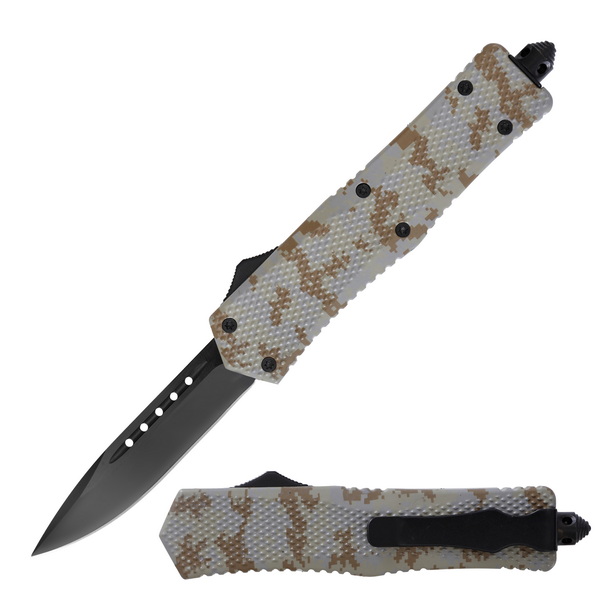
Safety is heavily influenced by how the spring and locking system are tuned, and by how the blade behaves when closed.
Automatic OTF Knife designs usually keep the spring highly energized when the blade is closed. The internal sear or catch holds everything in place. When it is released, the blade is driven fully open. To keep this safe and reliable, high‑quality Automatic OTF Knife products need:
- Robust internal sears and lock surfaces,
- Correctly heat‑treated parts, and
- Precisely calibrated spring strength.
Assisted OTF designs are typically built so that, in the closed position, the mechanism resists opening. The blade wants to stay closed until the user physically moves it past the engagement point. This “bias toward closure” is one reason many jurisdictions treat assisted knives more favorably than automatics, and it also offers extra reassurance against accidental deployment in pockets or bags.
However, with proper engineering, both Automatic OTF Knife and assisted OTF models can be safe for experienced users when used responsibly.
Many knife laws around the world base their definitions not only on the presence of a spring, but also on how the blade is activated.
Typical patterns include:
- Knives that open by pressing a button or switch in the handle are classified as automatic or switchblade, which often triggers stricter regulations.
- Knives that require the user to move the blade itself before a spring engages are often categorized as assisted‑opening or simply folding knives, which can be allowed where automatics are restricted.
Because an Automatic OTF Knife is activated by a handle‑mounted switch, it almost always falls squarely into the “automatic” category in markets that regulate switchblades. Assisted OTF knives, which require blade contact, may fall into a less restricted category—though actual law can be much more complex and vary from one country or state to another.
For overseas brands and wholesalers planning OEM orders, it is critical to:
- Check national and local regulations on blade length, opening mechanism, and carry rules.
- Distinguish clearly in product descriptions between “Automatic OTF Knife” and “assisted OTF knife” mechanisms.
- Offer different versions (automatic vs assisted) for different markets when necessary.
Factories like ours can build both mechanisms, but the correct choice depends on your market's legal environment and risk tolerance.
Each mechanism serves particular user groups and scenarios.
An Automatic OTF Knife is usually the better option for:
- Tactical and law‑enforcement users who need ultra‑fast deployment with one hand under stress.
- Rescue and emergency personnel who might operate in gloves, rain, mud, or low‑visibility conditions.
- High‑end outdoor and survival brands that want a flagship product with strong visual and mechanical impact.
In these applications, the instant deployment and straightforward button or slider activation justify the added legal and mechanical complexity.
An assisted OTF knife is often the smarter choice for:
- Urban EDC users who want a modern, fast knife but do not need pure tactical performance.
- Regions with stricter knife laws, where assisted‑opening designs are treated differently from automatics.
- Entry‑level or mid‑range product lines, where simpler mechanisms and lower cost are priorities.
For many average consumers, an assisted OTF provides a good balance of speed, perceived safety, and social acceptability.
Because both automatic and assisted OTF designs rely on internal tracks, springs, and small parts, durability largely comes down to design quality and material choice rather than the label “automatic” or “assisted.”
Key factors for a long‑lasting Automatic OTF Knife or assisted OTF include:
- Spring material and heat treatment – Coil or leaf springs should be made from high‑quality spring steel with precise tempering to avoid fatigue and breakage.
- Handle construction – CNC‑machined aluminum, stainless steel, titanium, or quality alloys provide rigidity to keep the internal track aligned.
- Blade steel – Outdoor and tactical customers often expect steels like D2, 154CM, S30V, or similar high‑performance alloys for edge retention and toughness.
- Precision machining – The internal channels, pins, and locking surfaces must be cut with tight tolerances to avoid blade wobble and misfires.
Because the blade moves inside the handle, OTF knives are more vulnerable to sand, dust, pocket lint, and dried lubricant than many traditional folders. Regular maintenance is strongly recommended for both Automatic OTF Knife and assisted OTF products:
1. Blow out debris from the front opening and internal track.
2. Use a light, high‑quality lubricant sparingly on internal moving parts.
3. Avoid overly thick or sticky oils that can slow the action.
4. For heavy professional use, schedule periodic deep cleaning or factory service.
From the user's perspective, the feel of an Automatic OTF Knife is quite distinctive. The deployment produces a strong, crisp “snap” and a noticeable recoil in the hand as the blade locks open. Many enthusiasts find this both satisfying and confidence‑inspiring, especially when they associate the sound and feel with readiness and reliability.
Automatic OTF knives often place the slider or button where the thumb naturally rests, allowing a straight‑line push to deploy and retract. Handle texturing, finger grooves, and clip placement all contribute to a secure grip when the blade fires.
An assisted OTF, by contrast, offers a more gradual and controlled opening sensation. The user feels the first phase of movement directly as the blade starts traveling, then experiences the spring's assistance near the end of the stroke. For some users, this feels less aggressive and easier to manage in everyday settings, such as opening boxes or light outdoor tasks around other people.
When designing OEM models, brands can fine‑tune:
- Spring strength and travel distance,
- Slider or stud placement,
- Handle profile and thickness,
- Surface texturing and inlay materials,
to create a signature user experience for their Automatic OTF Knife or assisted OTF series.
Mechanically, an Automatic OTF Knife typically contains more parts and more complex geometry than an equivalent assisted design. Double‑action automatic models, in particular, require precise synchronization between springs, catches, and blade movement in both directions.
This has several implications:
- Higher development and tooling cost – More complex parts and fixtures are needed.
- More demanding quality control – Each Automatic OTF Knife must be inspected for timing, lockup, and consistent firing force.
- Premium product positioning – Many brands place their OTF automatics in the upper tiers of their catalog.
Assisted OTF knives can often be produced with fewer unique components, which helps control manufacturing cost and simplifies assembly. For high‑volume EDC lines, this can be a significant advantage. However, with competent engineering and manufacturing, both styles can achieve reliable long‑term performance suitable for professional users.
Our factory can support multiple tiers—from robust entry‑level assisted OTF knives for everyday users to premium Automatic OTF Knife lines with upgraded steels, exotic handle materials, and advanced double‑action systems.
For overseas brands, wholesalers, and manufacturers planning OEM cooperation with a Chinese knife factory, the choice between an Automatic OTF Knife and an assisted OTF should be based on strategy, not just personal taste.
Consider the following questions:
1. Target market and user profile
- Are you selling primarily to tactical, law‑enforcement, or rescue users?
- Or is your main audience everyday carriers, outdoor hobbyists, and collectors?
2. Legal environment
- In your main markets, are automatic knives restricted, partially allowed, or fully prohibited?
- Would an assisted OTF be easier to import, sell, or ship?
3. Price positioning
- Do you want a premium flagship Automatic OTF Knife to represent your brand image?
- Or do you need a competitively priced, high‑volume assisted OTF for broad distribution?
4. Brand identity and differentiation
- Do you want to be known for high‑performance Automatic OTF Knife products?
- Could a unique assisted OTF design with recognizable styling become your signature model?
By working closely with a capable OEM factory, you can create a product line that includes both automatic and assisted OTF knives, matching each mechanism to different market segments and regulatory requirements.
The difference between automatic and assisted OTF knives centers on how the blade is activated and how the spring behaves. An Automatic OTF Knife uses a handle‑mounted button or slider to release stored spring energy in a single, instant motion, making it ideal for tactical, rescue, and high‑performance outdoor applications. An assisted OTF, on the other hand, requires the user to start moving the blade before the spring takes over, offering a more controlled opening action that often fits everyday carry needs and legal frameworks more comfortably.
For overseas brands and wholesalers working with a Chinese advanced outdoor knife factory, choosing between these mechanisms is a strategic decision involving law, user expectations, pricing, and brand positioning. By understanding how an Automatic OTF Knife differs from an assisted OTF in mechanics, speed, safety, and cost, you can design a product line that delivers the right balance of performance and compliance for every target market.
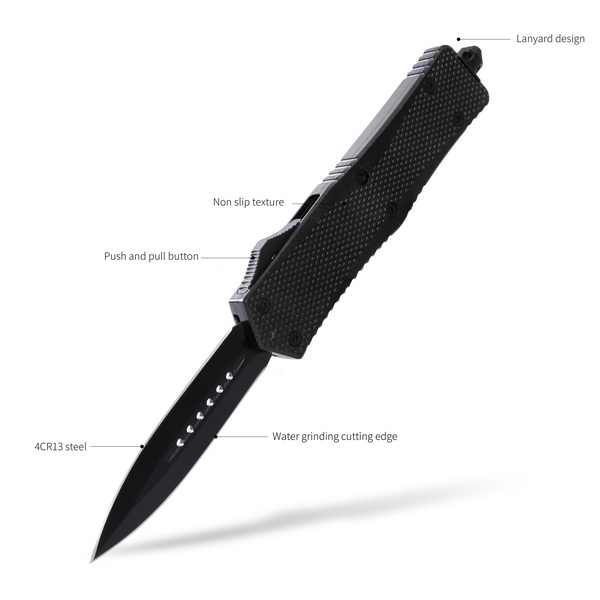
The main difference lies in activation. An Automatic OTF Knife opens when the user presses a button or slider on the handle, instantly releasing a spring that drives the blade forward. An assisted OTF knife requires the user to move the blade first with a thumb stud or flipper; only after the blade passes a certain point does the spring assist and complete the opening.
In general, an Automatic OTF Knife is faster because the blade moves from fully closed to fully open with a single press of a handle‑mounted control. Assisted OTF knives can be very quick once the user is practiced, but the action is split into a manual start and a spring‑assisted finish, making them slightly slower overall than a strong automatic.
No. Legal status depends entirely on local law. Many jurisdictions do impose stricter rules on automatic knives, including Automatic OTF Knife designs, because they open by pressing a handle‑mounted switch. Assisted OTF knives may be treated more leniently if the law distinguishes between “automatic” and “assisted‑opening” mechanisms, but some areas still restrict them. Brands and buyers must always check local regulations.
For most everyday carry users, an assisted OTF knife offers plenty of speed with a slightly more controlled, less aggressive opening and potentially fewer legal complications. In markets where it is clearly legal and socially accepted, an Automatic OTF Knife can be an excellent choice for users who value maximum deployment speed and strong tactical performance.
Brands should consider target users, law and import rules, desired price point, and brand image. If your focus is tactical and professional customers in markets that allow automatic knives, a well‑engineered Automatic OTF Knife can be your flagship product. If you need broader legal compatibility and higher volume, adding assisted OTF models to your OEM order will help you cover more customers and sales channels.
[1](https://knifeinformer.com/the-best-otf-knife-for-your-money/)
[2](https://www.recoilweb.com/best-otf-knife-out-the-front-is-back-187300.html)
[3](https://bladeops.com/blog/otf-knife-buyers-guide/)
[4](https://hiconsumption.com/gear/best-otf-knives/)
[5](https://sharperapex.com/benchmade-shootout-an-otf-in-the-back-of-the-pack/)
[6](https://ravencresttactical.com/ravencrest-tactical-otf-knife-buyers-guide/)
[7](https://www.tacticalsportinggoods.com/blogs/news/ultimate-guide-to-the-top-10-otf-knives-of-2025-features-reviews-and-recommendations)
[8](https://www.youtube.com/watch?v=mk0jqi3VmUg)
[9](https://knife-depot.com/blogs/sharpened-values/otf-knives-explained-the-complete-guide)
[10](https://tacknivesusa.com/the-ultimate-otf-knife-buying-guide/)


