
Views: 222 Author: Leah Publish Time: 2025-11-30 Origin: Site


Content Menu
● What Is an Automatic OTF Knife?
● Single‑Action vs Double‑Action Mechanisms
● Inside the Automatic OTF Knife Mechanism
● Why Choose an Automatic OTF Knife for EDC?
● Core Features for EDC‑Ready Automatic OTF Knife Models
● Optimum Blade Length and Profile
● Handle Design, Materials, and Grip
● Safety Systems and Best Practices
● Maintenance and Care for Automatic OTF Knife Longevity
● Automatic OTF Knife vs Traditional Folding Knives
● Everyday Use Scenarios for Automatic OTF Knife
● Tactical and Professional Applications
● Legal Landscape of Automatic OTF Knife EDC
● OEM and Private‑Label Opportunities for Automatic OTF Knife
● Design Customization for Different Markets
● How to Choose the Best Automatic OTF Knife for You
● Responsible Ownership and Everyday Confidence
● FAQ
>> 1) Is it safe to carry an Automatic OTF Knife in the pocket every day?
>> 2) How often should I clean and lubricate my Automatic OTF Knife?
>> 3) Can I legally travel with an Automatic OTF Knife?
>> 4) What are the signs of a high‑quality Automatic OTF Knife mechanism?
>> 5) Why do some Automatic OTF Knife models cost significantly more than others?
An Automatic OTF Knife remains one of the most efficient and impressive choices for everyday carry thanks to its rapid deployment, compact form factor, and modern engineering. An EDC‑focused Automatic OTF Knife can deliver fast, one‑hand access to a razor‑sharp blade while staying discreet and comfortable in the pocket.
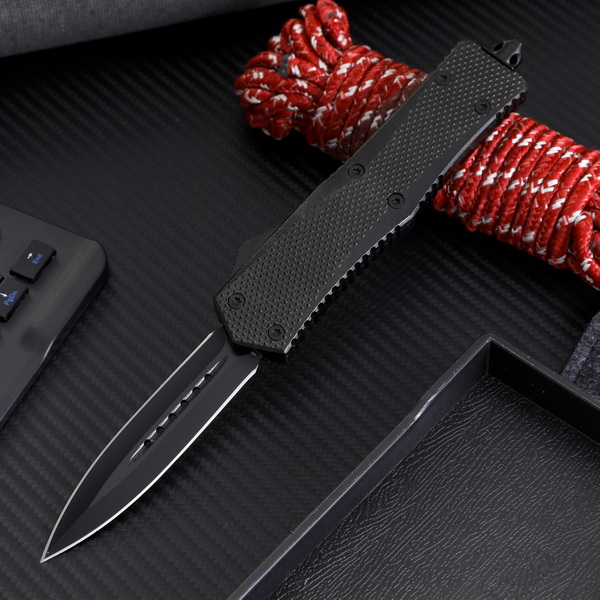
An Automatic OTF Knife (Out‑The‑Front knife) is an automatic knife whose blade moves in a straight line out of the front of the handle instead of swinging from the side like a traditional folder. This linear motion is powered by an internal spring system that stores energy when the blade is closed and releases it when the user activates a button or sliding switch.[1][2]
Unlike assisted‑opening or manual folding knives, an Automatic OTF Knife fully deploys its blade without additional hand force once the mechanism is triggered. This makes an Automatic OTF Knife ideal where speed, minimal motion, and one‑hand operation are priorities, such as work sites, outdoor activities, or emergency contexts.[2][1]
Automatic OTF Knife mechanisms generally fall into two categories: single‑action and double‑action. A single‑action Automatic OTF Knife fires the blade out automatically but requires the user to manually retract it, often via a separate lever or re‑cocking step that resets the spring.[9][1]
By contrast, a double‑action Automatic OTF Knife both deploys and retracts the blade using the same control—usually a slide that moves forward to extend the blade and backward to pull it in. This double‑action style provides a completely one‑handed, repeatable motion, which is why most modern EDC‑oriented Automatic OTF Knife designs use it.[8][2]
Internally, an Automatic OTF Knife relies on a set of carefully engineered components that work together to produce a rapid, controlled blade movement. A high‑carbon steel spring is compressed when the blade is in the closed position, and an actuator or firing plate holds the energy under tension until the user activates the control.[1][2]
When the button or slide is pushed, the firing plate releases the stored spring energy and drives the blade along internal rails until it locks into place at full extension. In a double‑action Automatic OTF Knife, a second part of the system reengages the spring when the control is pulled back, retracting the blade and resetting the mechanism for the next deployment.[2][9][1]
For many owners, the main reason to carry an Automatic OTF Knife is deployment speed. With only a short motion of the thumb or index finger, the blade becomes instantly usable, which can be crucial when the other hand is busy or when fine motor skills are limited by gloves or stress.[8][2]
Another advantage is the straight‑out blade path of an Automatic OTF Knife, which works well in confined spaces such as vehicles, narrow corridors, or crowded workbenches. This makes an Automatic OTF Knife especially attractive to first responders, tradespeople, and outdoor users who need reliable access to a cutting tool in awkward positions.[11][2]
When evaluating an Automatic OTF Knife for everyday carry, several core features strongly influence real‑world performance. Blade steel and heat treatment determine edge retention and corrosion resistance, while blade geometry affects how well the Automatic OTF Knife slices, pierces, or performs detailed cuts.[12][13]
Handle materials and ergonomics are equally important for an Automatic OTF Knife that will ride in a pocket all day. Lightweight aluminium or high‑strength polymers reduce fatigue while still supporting a robust internal mechanism, and thoughtful texturing or contouring helps the user keep a secure grip in wet, cold, or gloved conditions.[5][13][12]
For most users, an Automatic OTF Knife blade between about 2.5 and 3.5 inches offers the best balance between cutting power, control, and portability. Many jurisdictions that allow automatic knives use length limits in this range, making these sizes a natural fit for legal EDC in those areas.[14][15][2]
Blade profile also matters. A drop‑point Automatic OTF Knife tends to be versatile and easy to control, a dagger‑style Automatic OTF Knife offers strong piercing capability, and a tanto‑tip Automatic OTF Knife emphasizes a reinforced point for cutting denser materials. The right profile depends on whether the EDC focus is utility, tactical use, or a mix of both.[13][11]
Good ergonomics are essential for an Automatic OTF Knife that might see dozens of small tasks each day. Handles built from 6061‑T6 aluminium or similar alloys can be both light and very strong, and precision CNC machining helps ensure tight tolerances for the internal track and moving parts.[3][6][5]
A well‑designed Automatic OTF Knife handle usually includes traction such as milling, inlays, or rubberized sections to keep the knife stable in the hand during deployment and cutting. Pocket clips tailored for deep‑carry and, where possible, reversible mounting allow users to customize how the Automatic OTF Knife sits in the pocket for maximum comfort and discretion.[7][12][13]
Because the blade travels directly out of the handle, safety features are a core part of any responsible Automatic OTF Knife design. Many models incorporate an internal safety that prevents full deployment if the blade encounters an obstruction, so the tip does not punch through clothing or other objects by accident.[6][10]
Owners should always point an Automatic OTF Knife away from themselves and others before activating the mechanism and avoid placing fingers or gear in front of the blade opening. Engaging external safeties (where present), using a secure pocket clip position, and periodically checking screws and fasteners all help keep the Automatic OTF Knife functioning safely over time.[16][12]
A well‑maintained Automatic OTF Knife will deploy faster, feel smoother, and last longer. Dust, lint, and grit often accumulate in the blade channel and around the actuator, so periodic cleaning with compressed air, soft brushes, and minimal disassembly (when permitted by the manufacturer) can restore consistent operation.[12][1]
Lubrication should be light and targeted, as flooding the internal cavity with thick oil can slow an Automatic OTF Knife or attract more debris. Owners should also maintain a regular sharpening routine; a keen edge lets the Automatic OTF Knife cut effectively without forcing the blade, which reduces stress on both the edge and the mechanism.[13][2][12]
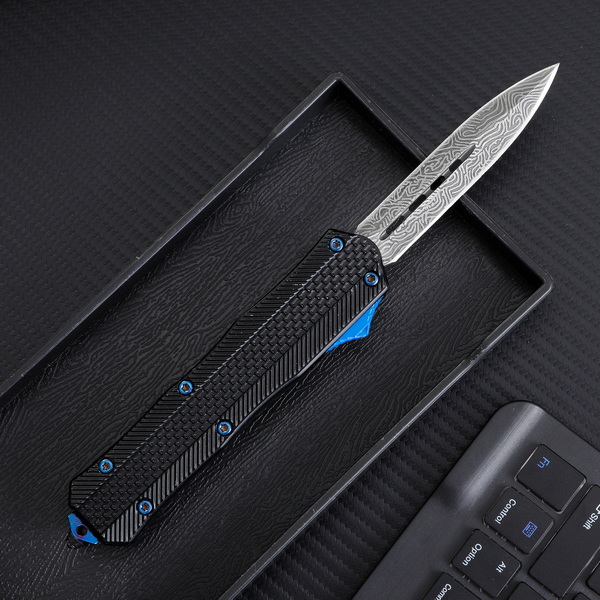
When deciding between an Automatic OTF Knife and a classic folder, the key difference is how quickly and easily the blade appears. Many users find that an Automatic OTF Knife provides nearly instant deployment with minimal thumb or wrist motion, whereas traditional folders rely on thumb studs, flippers, or nail nicks that demand more deliberate movement.[11][2]
Traditional folding knives may offer simpler construction and sometimes face fewer legal limitations than an Automatic OTF Knife, depending on jurisdiction. Nonetheless, for owners who prioritize one‑hand deployment under stress or while wearing gloves, the speed and linear access of an Automatic OTF Knife can outweigh the added mechanical complexity.[17][14][11]
An Automatic OTF Knife can handle a wide variety of everyday tasks beyond self‑defense. Office workers and warehouse staff may use an Automatic OTF Knife to break down cardboard boxes, slice shrink‑wrap, and cut strapping or zip ties in seconds.[18][12]
Outdoor users often rely on an Automatic OTF Knife for preparing camp equipment, cutting paracord, trimming fishing line, or handling quick food prep at a campsite. Because the Automatic OTF Knife stays compact in the pocket, it is easier to keep it close at hand than bulkier fixed blades or large folders, which encourages consistent EDC use.[19][18]
In tactical or professional environments, an Automatic OTF Knife may function as a backup tool that complements other gear. Law enforcement, security personnel, and some military users value how swiftly an Automatic OTF Knife can be deployed with limited motion, particularly in confined spaces like vehicles or narrow passageways.[10][16][19]
Rescue and emergency personnel may also benefit from an Automatic OTF Knife when cutting seatbelts, ropes, or clothing in urgent scenarios. The ability to hold or stabilize a victim with one hand while deploying an Automatic OTF Knife with the other can be a genuine advantage when seconds matter.[19][2]
The legal status of an Automatic OTF Knife varies widely by region. Some areas have modernized their knife laws and permit automatic knives under certain blade length limits or purpose‑based exceptions, while others still prohibit them completely or restrict concealed carry.[15][20][14]
Anyone considering an Automatic OTF Knife for EDC needs to research national, state, and local regulations regarding automatic knives, switchblades, and overall blade length. When traveling, it is wise to default to conservative choices and, if necessary, leave an Automatic OTF Knife at home to avoid confiscation, fines, or more serious legal consequences.[21][22][17]
For overseas brands, wholesalers, and importers, OEM partnerships make it possible to develop unique Automatic OTF Knife models without building manufacturing facilities from scratch. Knife‑specialized regions such as Yangjiang in China host factories that can take a concept for an Automatic OTF Knife and turn it into a production‑ready design.[23][24][25]
These OEM partners typically help with selecting steels, specifying handle materials like 6061 aluminium, engineering reliable double‑action mechanisms, and stress‑testing Automatic OTF Knife prototypes. They can also assist with logo application, color schemes, and packaging, allowing clients to deliver cohesive Automatic OTF Knife product lines tailored to different EDC segments and legal markets.[24][25][26]
One advantage of working with an OEM factory on an Automatic OTF Knife range is the ability to tune each model to legal and cultural expectations in target markets. Brands can commission compact Automatic OTF Knife designs with sub‑3‑inch blades for regions with strict limits, while offering longer, more tactical versions where regulations are more permissive.[20][14][2]
Handle shapes, texture patterns, and colorways can also be tailored to different user groups. Urban EDC customers may favor sleek, low‑profile Automatic OTF Knife finishes, while outdoor and tactical buyers might prefer high‑visibility handles and aggressive milling that helps maintain grip in harsh environments.[12][13]
Choosing the right Automatic OTF Knife begins with clarifying your main use case: general EDC, outdoor adventure, professional work, or collection. Once that purpose is clear, you can narrow options by blade length, steel, mechanism (single‑ or double‑action), and desired features such as safety switches or glass breakers.[2][13][12]
New owners often benefit from a compact double‑action Automatic OTF Knife with a corrosion‑resistant stainless steel blade and a comfortable aluminium handle. Enthusiasts may gravitate toward premium steels, distinctive grinds, or limited‑edition Automatic OTF Knife releases that showcase advanced engineering and finishing.[3][6][13]
Owning an Automatic OTF Knife also involves developing responsible habits: safe deployment direction, controlled retraction, respectful handling around others, and awareness of how the knife may be perceived in public spaces. Good etiquette ensures that carrying an Automatic OTF Knife supports everyday tasks without causing unnecessary concern.[16][19]
Storing the Automatic OTF Knife in a dedicated pocket away from keys or loose metal objects can help prevent accidental activation and cosmetic damage. Combined with routine inspection and cleaning, these simple practices ensure that an Automatic OTF Knife stays dependable and ready whenever it is genuinely needed.[1][12]
An Automatic OTF Knife blends precision engineering, rapid deployment, and compact convenience into a tool that suits many modern EDC needs. By understanding the internal mechanism, safety systems, and key design features, users can confidently select an Automatic OTF Knife that fits their daily life, professional demands, and local legal environment.[14][1][2]
For brands and wholesalers, partnering with experienced OEM manufacturers in established knife hubs enables the creation of tailored Automatic OTF Knife lines for different regions and user groups. With careful design, reliable components, and responsible ownership, an Automatic OTF Knife can be both a practical everyday companion and a showcase of advanced knife technology.[25][26][23][24]
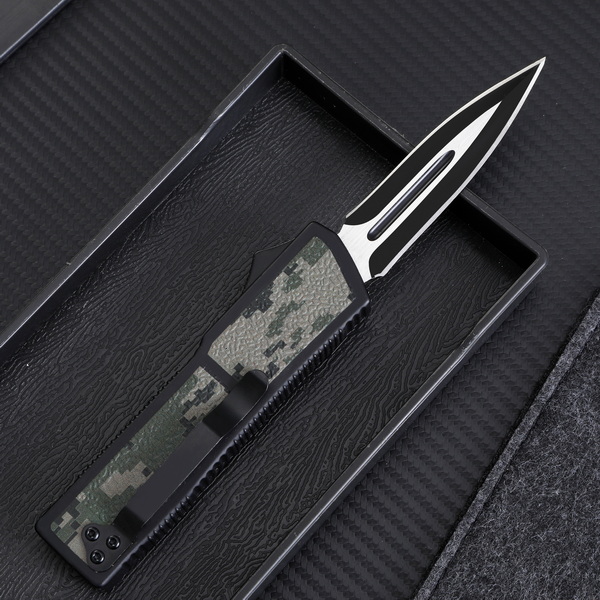
Carrying an Automatic OTF Knife can be safe if the knife features reliable internal locks, a secure pocket clip, and, ideally, a secondary safety switch. Users should always ensure the blade is fully retracted, keep the opening clear of objects, and avoid loose carry that allows the Automatic OTF Knife to tumble in the pocket.[6][16][12]
The ideal schedule depends on how dusty or dirty your environment is, but an Automatic OTF Knife that sees regular EDC use typically benefits from a quick cleaning every few weeks and a more thorough service several times a year. If deployment feels sluggish or gritty, it is a sign that the Automatic OTF Knife likely needs debris removal and a small amount of fresh lubricant.[1][2][12]
Travel rules for an Automatic OTF Knife are often stricter than for standard folding knives, especially on planes and in certain cities or countries. Before traveling, check transportation security rules, local regulations at your destination, and any intermediate stops, and consider leaving the Automatic OTF Knife at home or transporting it only where explicitly legal.[22][15][21][14]
A well‑made Automatic OTF Knife usually shows crisp, reliable deployment with minimal blade play, precise machining of the handle and actuator, and consistent lock‑up both open and closed. Premium steels, clean internal finishing, and robust components like coil springs and rails are further indicators that the Automatic OTF Knife is built for long‑term EDC performance.[10][3][2]
Price differences often reflect blade steel quality, handle materials, engineering complexity, and manufacturing precision in the Automatic OTF Knife. Premium models may use advanced steels, intricate double‑action mechanisms, and tight CNC tolerances that raise production costs but deliver smoother action, better durability, and enhanced overall value for serious EDC users.[6][13][2]
[1](https://nobliecustomknives.com/what-is-an-otf-knife-and-how-does-an-otf-knife-work/)
[2](https://knife-depot.com/blogs/sharpened-values/otf-knives-explained-the-complete-guide)
[3](https://www.benchmade.com/products/5370fe-shootout-otf)
[4](https://tacknivesusa.com/what-is-an-otf-knife-and-how-is-it-different-from-other-switchblades/)
[5](https://cobratecknives.com/product/special-purpose/utility-knives/otf-utility-knife/)
[6](https://ocasoknives.com/products/lucent-automatic-otf-black-large)
[7](https://store.smith-wesson.com/tactical/knives/smith-wesson-mp-1084314-grey-spear-tip-otf/1084314.html)
[8](https://www.tektoknives.com/blogs/news/understanding-different-types-of-switchblades)
[9](https://bladeops.com/blog/the-history-of-otf-knives-from-military-tool-to-everyday-essential/)
[10](https://www.sogknives.com/pentagon-otf-black/)
[11](https://artisancutlery.net/blogs/knife-knowledge/otf-vs-folding-knives-comparison-guide)
[12](https://eknives.com/blog/the-benefits-of-buying-an-otf-knife/)
[13](https://hiconsumption.com/gear/best-otf-knives/)
[14](https://uppercuttactical.com/blogs/news/are-otf-knives-legal-state-laws-on-otf-knives)
[15](https://sanityjewelry.com/blogs/news/otf-knife-state-laws-legality-explained-by-sanity-jewelry)
[16](https://bladeops.com/blog/the-advantages-and-disadvantages-of-otf-knives-in-tactical-settings/)
[17](https://www.tektoknives.com/blogs/news/otf-knife-laws-guide)
[18](https://tacknivesusa.com/the-benefits-of-buying-an-otf-knife/)
[19](https://crateclub.com/blogs/loadout/are-otf-knives-good-for-self-defense-a-comprehensive-analysis)
[20](https://www.akti.org/state-laws-regarding-automatics/)
[21](https://ravencresttactical.com/otf-knife-laws/)
[22](https://www.vipertecknives.com/blogs/all-tactical/the-legal-landscape-of-automatic-knives-what-you-need-to-know)
[23](https://www.made-in-china.com/manufacturers/yangjiang-knife.html)
[24](https://yjgrandsharp.en.alibaba.com)
[25](https://rank1982.en.alibaba.com/index.html?from=detail&productId=1601160025843)
[26](https://www.58hrcknives.com)


