
Views: 222 Author: Leah Publish Time: 2025-11-27 Origin: Site


Content Menu
● Understanding Automatic OTF Knife Construction
● Blade Steels for Automatic OTF Knives
>> Premium powder‑metallurgy stainless steels
>> 440C and other conventional stainless steels
>> Specialty steels and Damascus options
● Handle Materials for Automatic OTF Knives
>> Composite and polymer materials
● Internal Mechanism and Spring Materials
>> Firing and retraction springs
>> Carriage, track, and contact surfaces
● Hardware: Screws, Clips, and Glass Breakers
● Surface Treatments and Coatings
● Manufacturing Considerations for OEM Automatic OTF Knives
>> Heat treatment and quality control
● Matching Materials to Market Position
>> Entry‑level and value lines
>> Mid‑range professional and EDC lines
>> High‑end and enthusiast lines
● FAQ
>> 1. Which blade steel should I choose for my Automatic OTF Knife project?
>> 2. Why is 6061‑T6 aluminum so common for Automatic OTF Knife handles?
>> 3. Are zinc alloy handles suitable for professional Automatic OTF Knives?
>> 4. How important are springs and internal parts compared with blade and handle materials?
>> 5. How should OEM buyers specify materials when ordering Automatic OTF Knives from a factory?
Automatic OTF Knivesare precision tools that rely on carefully selected blade steels, handle alloys, internal springs, and small hardware to achieve fast deployment, reliable locking, and long service life. For OEM brands and wholesalers, choosing the right materials directly determines performance level, warranty risk, and market positioning.
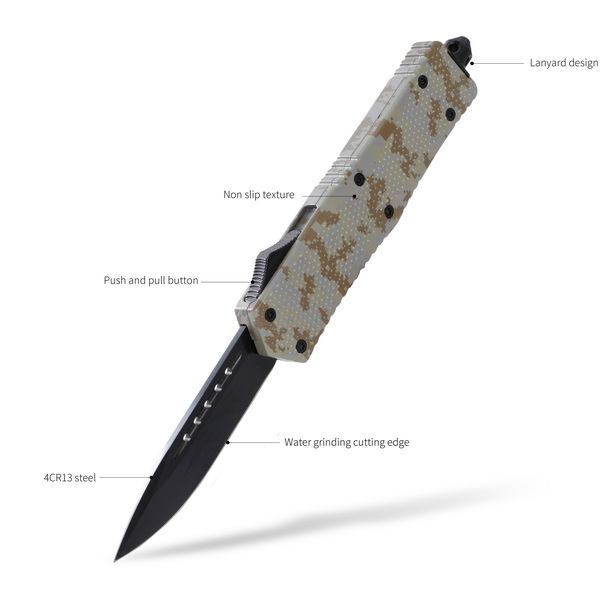
An Automatic OTF Knife (Out‑The‑Front) deploys and retracts its blade along a straight track through the front of the handle using a spring‑powered mechanism and a switch or button. The core components include the blade, two‑piece handle body, internal carriage, firing and retraction springs, locking elements, safety switch, and screws or stand‑offs.
Because the blade moves inside a closed chassis, tolerances must be extremely tight; any error in material choice, heat treatment, or machining can cause sluggish deployment or failure to lock. This makes the materials used in every part of an Automatic OTF Knife more critical than in many ordinary folding knives.
D2 tool steel is one of the most popular options for Automatic OTF Knife blades because it combines high wear resistance, good edge retention, and relatively moderate cost. With its high carbon and chromium content, D2 is ideal for users who need a working Automatic OTF Knife that stays sharp through prolonged cutting tasks such as rope, cardboard, and packaging.
When correctly heat‑treated, D2 can reach high hardness while maintaining enough toughness to resist chipping at the thin edge of an Automatic OTF Knife blade. This makes it especially suitable for OEM production where durability and cutting performance must be consistent across large batches.
High‑end Automatic OTF Knives often use advanced steels such as Bohler M390, Elmax, or similar powder‑metallurgy grades. These steels offer outstanding edge retention, high hardness, and excellent corrosion resistance, making them ideal for users who carry an Automatic OTF Knife daily in humid, coastal, or sweaty environments.
Although these steels are more expensive and harder to machine than conventional grades, they support top‑tier product lines and justify premium pricing. For OEM customers targeting the high‑end tactical or enthusiast market, specifying M390 or comparable steels can strongly differentiate an Automatic OTF Knife range from mid‑tier competitors.
For mid‑priced Automatic OTF Knife models, 440C and related stainless steels remain reliable choices. They provide a balanced combination of hardness, stain resistance, and ease of sharpening while keeping material costs under control.
A well‑heat‑treated 440C blade can perform very well in everyday carry and light tactical use, especially when paired with a robust grind and good edge geometry. This makes 440C suitable for OEM orders where buyers want stainless performance and good value without moving into the cost of exotic steels.
Some manufacturers use steels like MagnaCut, S90V, or nitrogen‑rich stainless grades in limited or specialized Automatic OTF Knife models. These steels can deliver extreme edge retention or exceptional corrosion resistance, which is attractive in marine, rescue, or salt‑spray environments.
Pattern‑welded Damascus is also used for collector‑grade Automatic OTF Knife blades, combining acceptable cutting performance with unique layered patterns. Although Damascus is more about aesthetics than pure performance, it can help OEM brands build limited editions and signature models that enhance brand image and profit margin.
6061‑T6 aluminum is widely used for Automatic OTF Knife handles because it is light, strong, and easy to CNC‑machine into complex internal cavities. This alloy allows the two‑piece chassis to be milled with precise tracks, pockets, and stops for the internal carriage and springs, while keeping overall knife weight comfortable for pocket carry.
After machining, 6061‑T6 handles are usually tumbled, bead‑blasted, and anodized. Anodizing hardens the surface, improves wear resistance, and offers a wide color palette so OEM customers can design distinctive Automatic OTF Knife series for different markets.
Zinc alloy handles give an Automatic OTF Knife a heavier, more solid feel and are often paired with rubberized or textured coatings. The density of zinc creates a sense of robustness and can make the knife feel extremely secure in hand, especially in larger tactical models.
Coatings on zinc alloy handles also improve grip and protect the underlying metal from corrosion and cosmetic damage. This combination of cost‑effective casting, comfortable weight, and strong hand feel makes zinc alloy a good choice for value‑oriented Automatic OTF Knife lines.
Engineered polymers and composite materials can be used in some Automatic OTF Knife bodies or outer scales to reduce weight and provide thermal comfort in cold weather. These materials resist sweat, moisture, and many chemicals, while also offering design freedom in texture and shape.
Often, composites are paired with internal aluminum or steel supports to maintain stiffness and dimensional stability. This hybrid approach can create an Automatic OTF Knife that is lightweight yet still robust enough for daily carry and outdoor use.
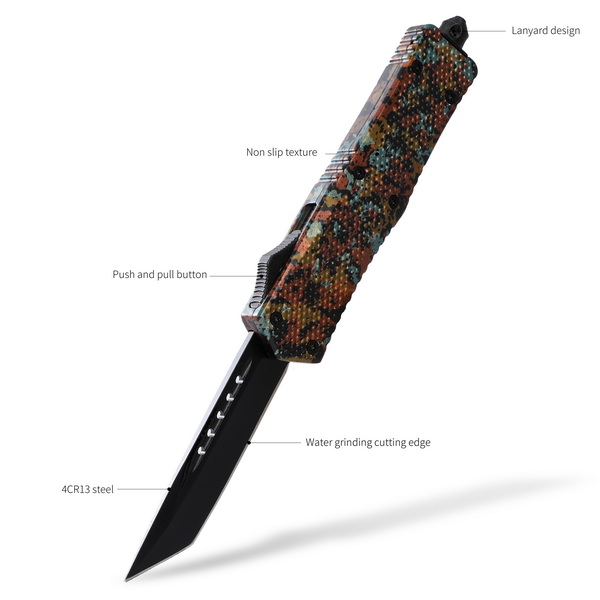
Inside a double‑action Automatic OTF Knife, powerful springs drive the blade forward and pull it back into the handle. These are usually made from high‑carbon spring steel or stainless spring alloys designed to resist fatigue and retain elasticity after thousands of cycles.
Correct spring design is crucial: too weak and the Automatic OTF Knife deploys slowly or fails to lock; too strong and the mechanism wears prematurely or becomes difficult to operate. Consistent spring material and controlled heat treatment help OEM factories deliver smooth, reliable deployment batch after batch.
The sliding carriage or firing plate connects the blade to the external switch and runs in longitudinal tracks inside the handle. These parts are often machined from aluminum or stainless steel and must be accurately finished to avoid binding.
High‑wear contact points may use hardened steel inserts or carefully polished surfaces to reduce friction and long‑term wear. In a quality Automatic OTF Knife, the interaction between the carriage, tracks, and blade base is tuned so the knife fires crisply yet remains secure against blade wobble.
Locking gates and stops secure the blade in both open and closed positions. These components are normally produced from hardened steels or strong alloys because they take the direct load when the Automatic OTF Knife is used for cutting or piercing.
Safety switches and sliders must withstand repeated thumb movement without rounding off or losing texture. Metals such as aluminum or stainless steel with machined grooves or knurling are popular, providing positive control even with wet or gloved hands.
Small hardware may look unimportant, but it has a big impact on real‑world reliability and user perception of quality. Precision Torx screws and stand‑offs, typically made from stainless steel, keep the Automatic OTF Knife chassis rigid and allow for disassembly during maintenance.
Pocket clips are often formed from spring stainless to balance clamping force and flexibility. On tactical Automatic OTF Knife models, glass breakers may incorporate hardened steel or carbide tips, enabling emergency window breaking without damaging the rest of the knife.
Blade coatings serve both aesthetic and functional purposes. Black or dark ceramic coatings, PVD finishes, and black oxide can increase surface hardness, reduce glare, and enhance corrosion resistance on an Automatic OTF Knife blade.
Stonewash or satin finishes can also hide minor scratches from everyday use and give the blade a more uniform appearance over time. For OEM brands, offering different finishes on the same Automatic OTF Knife platform is a simple way to expand SKU variety without changing the core design.
Aluminum handles are commonly bead‑blasted or tumbled before anodizing to achieve a consistent matte texture that resists fingerprints and minor scuffs. Different anodizing colors and surface textures can match brand identity or help dealers differentiate product lines.
Zinc alloy handles often receive rubberized paint, powder coating, or other grip‑enhancing treatments. These coatings make the Automatic OTF Knife comfortable to hold, especially in wet or cold environments, and can also provide additional corrosion protection.
Most high‑quality Automatic OTF Knife handles begin as aluminum bar stock or plate that is cut, deburred, and then CNC‑milled through multiple operations. Each machining step creates internal tracks, pockets, and end stops with tolerance control often tighter than a fraction of a millimeter.
Blades are usually laser‑cut or blanked from steel sheet slightly oversize, then ground and milled down to final dimensions through several stages. This gradual approach allows the factory to maintain strict tolerances and avoid warping or distortion during heat treatment.
Proper heat treatment is essential for blade steels and springs. Controlled heating, quenching, and tempering set the final hardness and toughness balance for each Automatic OTF Knife blade. Even top‑tier steel will not perform well if the heat treatment is inconsistent.
Quality control typically includes hardness testing, dimensional inspection, and functional testing of the mechanism. In a well‑run OEM factory, sample Automatic OTF Knife units from each batch are repeatedly fired, checked for lockup security, and examined for cosmetic defects before shipment.
For budget‑friendly Automatic OTF Knife projects, OEM buyers often combine 440C or similar stainless steels with zinc alloy or basic aluminum handles. This configuration keeps costs manageable while delivering acceptable performance for casual EDC or light utility.
Rubberized or painted finishes, simple blade grinds, and standard stainless screws and clips round out these value‑oriented Automatic OTF Knife lines, which are ideal for large retail chains and online platforms.
Mid‑range Automatic OTF Knife series typically use D2 or upgraded stainless steels paired with 6061‑T6 anodized aluminum handles. CNC‑precision internals, improved springs, and more refined finishing give these knives faster deployment, better edge retention, and longer service life.
This segment targets law enforcement, outdoor users, and enthusiasts who want reliable performance but do not require the most exotic steels. For OEM customers, this is often the best balance of performance, cost, and sales volume.
At the top end, Automatic OTF Knife models may use M390 or comparable powder steels, carefully tuned dual‑spring systems, hardened internal parts, and premium coatings. Limited editions may feature Damascus blades, unique anodizing patterns, or custom inlays.
These Automatic OTF Knife products suit collectors and demanding professionals who value cutting performance, fit and finish, and brand image. Although volumes are smaller, margins per unit are higher and help lift the overall brand profile.
Material selection is the foundation of every serious Automatic OTF Knife project. From blade steels like D2, 440C, and M390 to handle alloys such as 6061‑T6 aluminum and zinc, each choice influences cutting performance, deployment speed, corrosion resistance, and overall durability. When these materials are combined with precise CNC machining, proper heat treatment, and well‑engineered springs and locks, the result is an Automatic OTF Knife platform that performs reliably in real work and earns user trust.
For overseas brands, wholesalers, and manufacturers working with an OEM factory, clearly defining steels, handle materials, spring alloys, and surface treatments in advance ensures stable quality and predictable costs. By building a coherent material strategy—value, mid‑range, and premium—an Automatic OTF Knife portfolio can effectively cover different price points and user groups while maintaining a consistent reputation for reliability and performance.
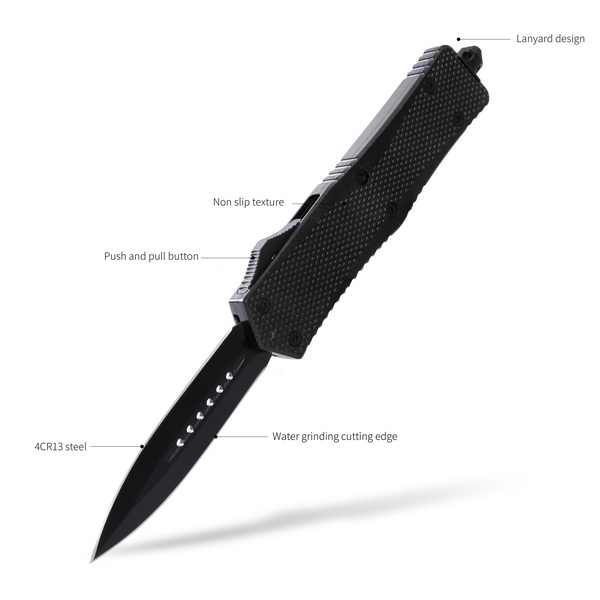
If you want strong performance at a reasonable cost, D2 is an excellent starting point because it offers long‑lasting edges and good wear resistance for most EDC and tactical tasks. For premium Automatic OTF Knife lines, steels such as M390 or similar powder‑metallurgy grades deliver superior edge retention and corrosion resistance, though at higher material and machining costs.
6061‑T6 aluminum is light, strong, and easy to CNC‑machine into the complex internal channels that an Automatic OTF Knife requires. After anodizing, it gains enhanced surface hardness and abrasion resistance, while also allowing a wide range of colors and textures for brand differentiation.
Zinc alloy can be very suitable when the design emphasizes solid hand feel, impact resistance, and cost‑effective production. With proper coatings and internal engineering, zinc‑handled Automatic OTF Knives can perform well in duty or tactical roles, although they will usually be heavier than aluminum‑handled models.
Springs and internal components are just as critical as the blade and handle, because they control deployment speed, lock reliability, and overall safety. Using high‑grade spring steels, precise carriages, and hardened lock parts ensures that an Automatic OTF Knife will keep firing smoothly and locking securely over thousands of cycles.
OEM buyers should list exact steel grades, handle alloys, spring materials, and surface finishes in their technical drawings and contracts, along with target hardness ranges for blades and springs. Clear specifications allow the factory to select suitable raw materials, set appropriate heat‑treatment processes, and maintain consistent quality across every Automatic OTF Knife batch.
[1](https://www.youtube.com/watch?v=EwG2oytZCl8)
[2](https://www.youtube.com/watch?v=krPPEd3X1sM)
[3](https://eknives.com/blog/microtech-knives-manufacturing-process/)
[4](https://knifedogs.com/threads/sr1-scale-release-automatic-build-tutorial.52152/)
[5](https://cobratecknives.com/product/special-purpose/utility-knives/otf-utility-knife/)
[6](https://bladeops.com/blog/otf-knife-care-101-maximize-the-life-of-your-knife/)
[7](https://www.reddit.com/r/knifeclub/comments/yjaawh/why_are_automatic_knives_almost_always_aluminum/)
[8](https://nobliecustomknives.com/what-is-an-otf-knife-and-how-does-an-otf-knife-work/)
[9](https://www.youtube.com/watch?v=_TEVM4NAlxk)
[10](https://www.reddit.com/r/EngineeringPorn/comments/7ioglk/making_a_knife_the_hightech_way/)


