
Views: 222 Author: Leah Publish Time: 2025-11-27 Origin: Site


Content Menu
● What Is an Automatic OTF Knife?
● Mechanism and Internal Construction
>> Automatic OTF Knife Mechanism
● Deployment Speed and One‑Hand Operation
>> Speed of an Automatic OTF Knife
● Durability, Reliability, and Maintenance
>> Automatic OTF Knife Durability
>> Safety of an Automatic OTF Knife
● Size, Portability, and Ergonomics
>> Form Factor of an Automatic OTF Knife
>> Form Factor of a Folding Knife
● Cost, Complexity, and OEM Production
>> Manufacturing an Automatic OTF Knife
>> Manufacturing a Folding Knife
● Ideal Applications and Target Users
>> When an Automatic OTF Knife Shines
>> When a Folding Knife Is the Smarter Choice
● How to Choose for Your Brand or OEM Project
● FAQ
>> 1. Is an Automatic OTF Knife really faster than a folding knife?
>> 2. Which is better for daily carry: an Automatic OTF Knife or a folding knife?
>> 3. Do Automatic OTF Knives break or jam easily?
>> 4. Which knife type is safer for beginners?
>> 5. For OEM private label, should a brand start with Automatic OTF Knives or folding knives?
An Automatic OTF Knife and a traditional folding knife serve similar cutting tasks but differ greatly in deployment speed, mechanical design, durability, safety, legality, and market positioning. For brands and wholesalers working with a professional OEM factory, understanding these differences helps build the right product mix for tactical, EDC, and outdoor customers.
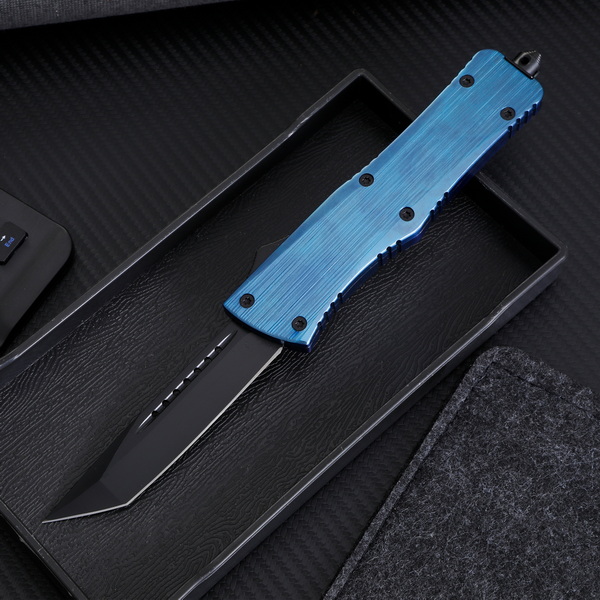
An Automatic OTF Knife (Out‑The‑Front knife) is an automatic knife whose blade slides straight out of an opening in the front of the handle instead of pivoting from the side. The blade is fully enclosed inside the handle when retracted and driven forward along internal rails or channels by a spring‑powered mechanism.
Most modern Automatic OTF Knife designs are “double‑action”: one thumb slider or button both deploys and retracts the blade, giving a distinct “snap” in both directions. This linear, aggressive action, combined with a slim, tactical silhouette, is a major part of why the Automatic OTF Knife has become popular with collectors, law‑enforcement professionals, and high‑end EDC users.
A folding knife is a knife with a blade that rotates around a pivot and folds into the handle when not in use. The blade is manually opened using a nail nick, thumb stud, thumb hole, or flipper tab, and then locked in place by a mechanism such as a liner lock, frame lock, back lock, or axis‑style lock.
Because the blade folds sideways into the handle, folding knives can be very compact while offering a wide range of blade shapes, sizes, and handle designs. For everyday users, the folding knife is often seen as a practical, friendly work tool—ideal for EDC, outdoor activities, and general utility tasks.
Inside an Automatic OTF Knife, the blade rides in a straight channel with springs, latches, and a carrier that engages the blade. When the user pushes the slider or button forward, it compresses a spring and then releases it, propelling the blade out the front. Pulling the slider back engages a second spring to retract the blade.
This means:
- Multiple precision parts (springs, blade carrier, sears, stops, rails) must work together smoothly.
- Tolerances on the handle channel, blade, and internal hardware are tight to maintain smooth travel and solid lock‑up.
- The mechanism is more complex than a typical folding knife and requires stricter quality control.
A folding knife pivots around a single axis at the front of the handle. The key components are the pivot, washers or bearings, the blade, and the lock. When opened, the lock engages the tang of the blade and keeps it from closing under pressure.
This leads to:
- Fewer moving parts and relatively simple geometry.
- Easier maintenance and tuning (cleaning around a pivot is usually straightforward).
- Great design flexibility for locks and blade shapes without dramatically increasing complexity.
The core advantage of an Automatic OTF Knife is instant, one‑hand deployment. The user simply pushes the slider or button and the blade shoots out in a straight line. Under stress, with gloves on or with limited mobility in one hand, this simple gross‑motor motion can be easier than manipulating a thumb stud or flipper.
For tactical, rescue, or emergency users, this “from pocket to cutting” speed is a major selling point:
- Rapid deployment with minimal hand movement.
- Same control (slider/button) for both opening and closing in double‑action designs.
- Very intuitive for users once they are familiar with the mechanism.
Modern folding knives can also be extremely fast, especially:
- Flipper knives on bearings.
- Assisted‑opening folders.
- Designs with wave‑style features that open as the knife is drawn from the pocket.
For normal EDC tasks like opening boxes or cutting cord, the fraction of a second difference compared to an Automatic OTF Knife is rarely critical. However, the motion is usually a bit more complex: the user must position the hand, engage a stud or flipper, and then make a longer motion to get the blade fully open.
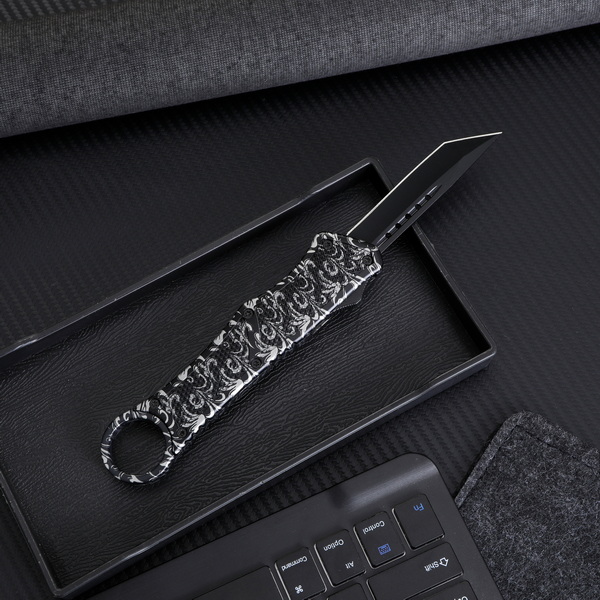
The internal track and multiple springs of an Automatic OTF Knife are more sensitive to contamination and wear:
- Dust, sand, mud, metal shavings, and pocket lint can enter the handle opening and accumulate in the blade channel.
- Heavy contamination can cause slow deployment, incomplete lock‑up, or misfires.
- Regular flushing with compressed air or mild solvent and a careful drop of lubricant are recommended.
A well‑engineered Automatic OTF Knife made from quality materials and built by a precision OEM factory can still be highly reliable. But the user must treat it more like a fine mechanism than a disposable tool.
Folding knives generally tolerate rough, dirty environments better:
- The main wear points are the pivot and lock interface, which are easier to clean.
- Fewer internal cavities mean less chance for grit to disrupt the action.
- The lock and pivot can be tuned by adjusting a screw or replacing washers.
For hard‑use work environments (construction, warehouse, agriculture), a robust folding knife usually keeps working even after abuse that would force an Automatic OTF Knife to be cleaned or serviced.
When closed, the blade of an Automatic OTF Knife is fully enclosed inside the handle, which reduces accidental cuts while carrying. Modern double‑action designs usually have:
- A strong “closed” detent or lock to prevent unintentional deployment.
- A defined “open” lock position to keep the blade from retracting under normal cutting loads.
However, there are some considerations:
- If the mechanism is blocked or the nose encounters an obstacle during deployment, the blade may not fully lock and will feel “loose.”
- Some users and regulators view any automatic knife, especially an Automatic OTF Knife, as more “dangerous,” even when technically safe in normal use.
Folding knives rely on deliberate manual opening before the lock engages. This makes unintentional deployment in the pocket less likely, especially on models with strong detents. Many users find them more psychologically comfortable because:
- They are familiar tools seen in trades and outdoor activities.
- Locks are easy to understand, and accidental opening is rare with modern designs.
For new or conservative users, a folding knife is often seen as the safer, more approachable option compared with an Automatic OTF Knife.
Because the entire blade and the drive mechanism must fit inside the handle, an Automatic OTF Knife tends to have:
- A rectangular, elongated handle profile.
- A thickness sufficient to house the blade, carrier, and springs.
- A prominent slider or button located on the spine or side.
This gives the Automatic OTF Knife a distinctive, tactical look that many enthusiasts love. The symmetrical grip is comfortable for thrusting and quick orientation, but can be less organic than contoured folding knife handles for long cutting sessions.
Folding knives offer much more freedom in handle design:
- Curved, contoured handles to match the hand.
- Thinner, more compact closed profiles that disappear in the pocket.
- Wide range of lengths, thicknesses, and weights.
For office, urban EDC, or gentleman carry, a slim folding knife often feels more discreet and acceptable than a bold Automatic OTF Knife.
Automatic knives, including any Automatic OTF Knife, are regulated or restricted in many countries, states, and cities. Common rules involve:
- Prohibitions or special permits for automatic knives or “switchblades.”
- Blade length limits for automatic models.
- Restrictions on import, mail‑order sales, or concealed carry.
Folding knives, especially non‑automatic ones, are generally more widely legal and socially accepted. While some jurisdictions still have blade length or locking restrictions, many people can legally carry a folding knife where an Automatic OTF Knife would not be allowed.
For overseas brands, wholesalers, and manufacturers, this difference is critical. Often the best strategy is:
- Sell Automatic OTF Knife models only in permissive markets and through channels familiar with knife regulations.
- Use folding knives as the core product line for regions with stricter rules.
From an OEM perspective, an Automatic OTF Knife is a high‑precision product:
- Complex internal milling or EDM work for the blade channel and hardware pockets.
- Tight tolerance control to keep the blade centered and ensure consistent deployment.
- More assembly time per unit, plus more thorough functional testing.
This increases cost but also supports higher retail pricing and strong branding. An Automatic OTF Knife can be positioned as a flagship or halo product with advanced engineering, premium materials, and eye‑catching action that differentiates a brand.
Folding knives are more flexible for large‑volume OEM programs:
- Simpler internal structures and fewer precision interfaces.
- Huge design choice for blade shapes, locks, and handle styles at different price levels.
- Easier scaling for mass production, from entry‑level value folders to mid‑range and premium models.
For many private‑label customers, starting with folding knives helps them build volume and brand recognition, then adding Automatic OTF Knife models later as specialty or tactical lines.
An Automatic OTF Knife is usually the better choice when:
- Target customers prioritize instant, one‑hand deployment (tactical, rescue, law‑enforcement, security).
- The brand image focuses on modern tactical style, innovation, and the “wow” factor of an automatic mechanism.
- The target market has relatively permissive automatic‑knife laws and an enthusiast customer base that understands both benefits and maintenance needs.
For these users, an Automatic OTF Knife is not only a tool, but also part of their identity and gear collection.
A folding knife usually wins when:
- Serving general EDC users, outdoor enthusiasts, workers, and first‑time knife buyers.
- Selling into markets where automatic knives face legal uncertainty or negative public perception.
- Prioritizing ruggedness, simple maintenance, and maximum reliability under rough, dirty conditions.
Folding knives also allow brands to offer a complete line from budget to premium without the legal and mechanical complexity of an Automatic OTF Knife.
When planning a product range with a Chinese OEM factory, it is practical to think in terms of segments:
- Entry‑level and work EDC: Focus on durable folding knives with proven lock systems and mainstream blade shapes.
- Outdoor and survival: Strong, corrosion‑resistant folding knives with comfortable handles and robust locks.
- Tactical and enthusiast: Add Automatic OTF Knife models with double‑action mechanisms, premium steels, and aggressive styling.
- Collector and limited editions: High‑end Automatic OTF Knife designs with unique finishes, special inlays, and small production runs.
By combining folding knives and Automatic OTF Knife models, a brand can cover a wide range of users, price points, and legal environments.
An Automatic OTF Knife offers unmatched deployment speed, a striking tactical profile, and strong emotional appeal for enthusiasts and professionals who value quick access and advanced mechanisms. In return, it demands higher production precision, more maintenance, higher cost, and careful attention to legal restrictions.
Traditional folding knives provide broad legality, mechanical simplicity, high durability in dirty real‑world conditions, and huge flexibility in design and pricing. For most everyday and work users, a good folding knife is still the most practical choice, while the Automatic OTF Knife becomes a specialized, premium option.
For overseas brands, wholesalers, and manufacturers working with a capable Chinese outdoor knife factory, the best strategy is usually a balanced portfolio: robust folding knives as the backbone of the line, complemented by carefully selected Automatic OTF Knife models for tactical, enthusiast, and high‑end markets. This approach maximizes coverage, builds brand image, and leverages OEM strengths in both precision automatic mechanisms and high‑volume folding knife production.
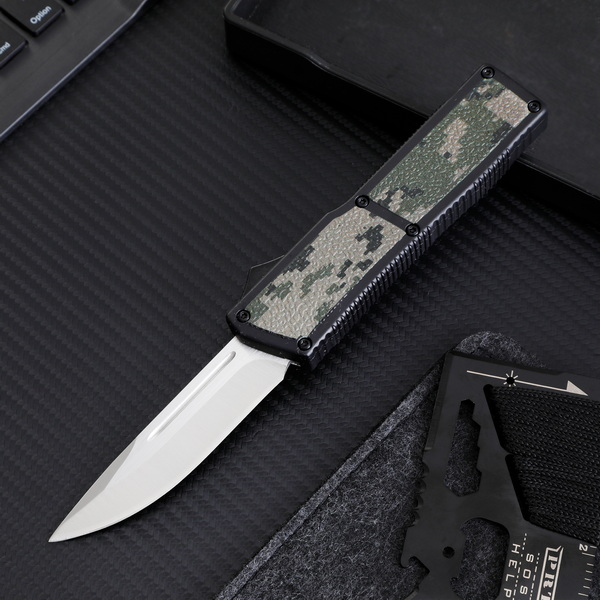
Yes, in most cases an Automatic OTF Knife is faster because the blade deploys instantly with a short push of a slider or button. A well‑designed flipper or assisted folding knife can be quick, but it still requires a longer, more complex motion than the straight‑line action of an Automatic OTF Knife.
For pure practicality and legality, a folding knife is usually the safer choice for daily carry, especially in cities or workplaces with conservative attitudes. An Automatic OTF Knife is ideal for users who value maximum speed and tactical style and who live in regions where automatic knives are clearly legal.
A quality Automatic OTF Knife from a professional factory is reliable, but the internal mechanism is more sensitive to dirt and debris than a simple folder. If the user regularly cleans the blade channel and applies a small amount of lubricant, a good Automatic OTF Knife can function smoothly for a long time without jamming.
For beginners, a standard folding knife is typically safer and easier to understand. The slower, deliberate opening process gives new users more control, and the familiar work‑tool image makes it less intimidating. An Automatic OTF Knife can still be safe, but beginners must respect the instant deployment and keep fingers and objects clear of the blade path.
Most brands should start with folding knives because they are easier to sell globally, simpler to support, and suitable for a wider audience. After building a stable customer base, the brand can introduce Automatic OTF Knife models as premium or tactical products, using them to upgrade image, attract enthusiasts, and expand into higher price segments.
[1](https://artisancutlery.net/blogs/knife-knowledge/otf-vs-folding-knives-comparison-guide)
[2](https://www.guns.com/news/otf-vs-folding-knives-for-daily-carry)
[3](https://www.bladeforums.com/threads/otf-vs-auto-for-daily-use.1737360/)
[4](https://www.reddit.com/r/knifeclub/comments/14i8f0b/otf_or_folder/)
[5](https://bladeops.com/blog/automatic-knife-vs-manual-folding-knife-which-is-right-for-you/)
[6](https://tacknivesusa.com/otf-knives-vs-standard-pocket-knives-which-is-better/)
[7](https://www.tektoknives.com/blogs/news/a-buyers-guide-to-automatic-knives)
[8](https://www.fieldandstream.com/outdoor-gear/hunting/knives/best-automatic-knives)
[9](https://www.youtube.com/shorts/tkAZI82jmu4)
[10](https://www.ar15.com/forums/general/-ARCHIVED-THREAD-OTF-or-other-Automatic-vs-Assisted-or-Manual-Opening-Knife/5-2574834/)


