
Views: 222 Author: Leah Publish Time: 2025-11-28 Origin: Site


Content Menu
● Introduction: Patents and the OTF Knife Industry
● Patent Landscape: From Utility to Design Claims
>> Design Patents and Brand Identity
● Engineering Innovations Enabled by Patents
>> Double-Action OTF Mechanism Technology
>>> Safety and Reliability Advances
>> Material and Process Patents in the OTF Knife Sector
● Legal Considerations and Freedom to Operate (FTO)
>> Mapping Patents for OEM Differentiation
>> Licensing and Cross-Licensing for Market Entry
>> Global Legality and Regulatory Challenges
● Practical Workflow of Patent-Aware OTF Development
>> Step-by-Step Approach for Factories
● Case Studies: Patent-Driven Breakthroughs
>> Early Development and Modern Innovations
● Manufacturing Best Practices Under Patent Constraints
>> OEM Strategies for Product Innovation
>> Avoiding Infringement Pitfalls
● The Future of Automatic OTF Knife Patents
>> Continuous Opportunities for Innovation
● FAQ
>> 1) What is the difference between single-action and double-action Automatic OTF Knives?
>> 2) Why are patents important for OTF knife innovation?
>> 3) How can OEMs avoid patent infringement while developing Automatic OTF Knives?
>> 4) Are Automatic OTF Knives legal worldwide?
>> 5) What are the major engineering trends currently shaping Automatic OTF Knife innovation?
Patents are driving forces behind Automatic OTF Knife innovation—shaping everything from deployment mechanisms to locking systems and design aesthetics. By mapping patent claims, respecting utility and design boundaries, and applying pioneering solutions, OEM factories achieve compliant, market-leading models that blend safety, reliability, and standout branding for overseas partners.[1][2]
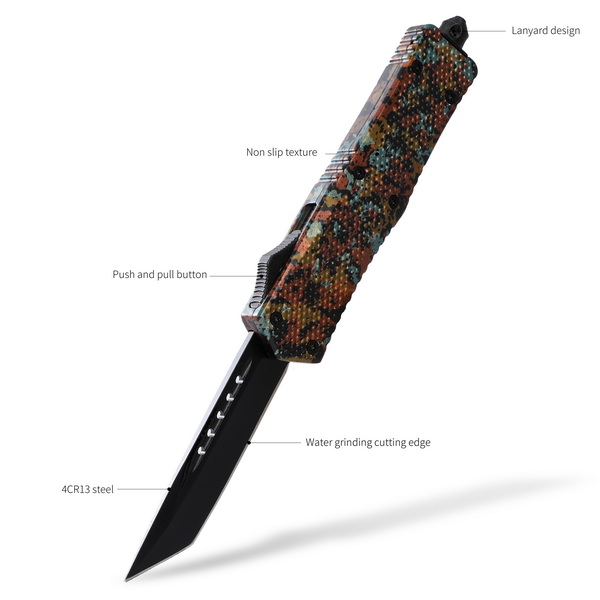
Automatic OTF Knives (“Out-The-Front” knives) are celebrated for their rapid, one-handed blade deployment and retraction—features that depend on complex internal engineering and robust safety mechanisms. Such knives are protected by a broad array of patents, forming the legal backbone for manufacturing innovation and distinguishing premium products in the global marketplace. For Chinese OEM factories, navigating this landscape is essential to success.[3][1]
Utility patents for Automatic OTF Knives safeguard vital technical features including the double-action sliders (enabling both deployment and retraction), multi-point locking structures, spring-based actuation systems, and anti-misfire controls. By granting 20 years of exclusivity to inventors, these patents prevent competitors from copying internal functional details—forcing OEMs to develop original, non-infringing mechanisms, or to license protected technology.[2][4][1]
Design patents protect the ornamental aspects: handle silhouette, actuator appearance, and clip shape. Major brands file these to ensure their knives are instantly recognizable, supporting premium positioning and reducing copycat threats. OEMs must innovate distinct surface treatments and handle shapes to avoid infringement, which also helps develop unique brand stories for export clients.[5][1][2]
Patented double-action OTF knives offer two-way movement—both deployment and retraction—via a single switch. Mechanisms feature channels for sliders, springs carefully tensioned to store and release energy, and locking bars that secure the blade in both open and closed positions. Advanced designs employ a set of front and back locking paddles with associated springs, shoe assemblies, and support frames, all working in harmony for reliable operation and minimized blade play.[4][1]
Earlier OTF designs sometimes suffered from weak lock-up and accidental blade deployment. Contemporary patents detail three-point interconnections between the blade and handle, spring pre-load timing, and trigger geometry that collectively increase operational strength and reduce chance of misfires. These standards are especially critical for knives intended for tactical, outdoor, or emergency use.[1][4]
Manufacturing innovations in steel alloys, injection-molded components, ceramic inserts, and wear-resistant coatings are all covered by process patents. These advances are critical for mass-producing robust OTF knives, extending product lifespans and improving user safety. OEM factories adhering to patented manufacturing processes ensure repeatable quality, making them preferred suppliers for demanding clients globally.[2][1]
Before launching a new Automatic OTF Knife model, successful OEMs conduct exhaustive patent mapping to catalog active utility and design claims for sliders, springs, locking mechanisms, chassis parts, and exterior features. This “FTO audit” highlights technological white spaces—areas open for creative new engineering—and steers clear of infringement. Such diligence is now a cornerstone of safe, lucrative OEM partnerships.[3][1]
To speed up product launches or access field-tested mechanisms, OEMs often license patented technology from holders. Cross-licensing deals allow integration of proven internals with fresh external stylings, blending reliability and distinct brand recognition. This strategy reduces legal risks and accelerates entry into high-end and specialized markets.[1][2]
Automatic OTF Knife legality varies by jurisdiction; for instance, U.S. states each have their own regulations regarding switchblades. International OEMs must research local laws, tailor shipments accordingly, and label products clearly to avoid customs issues or buyer disputes. Patent-backed claims of enhanced safety and performance help secure acceptance in compliant regions.[6][1]
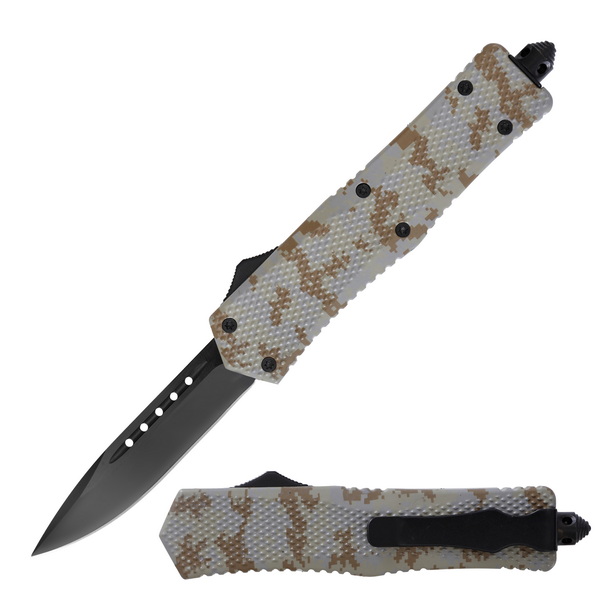
- Patent Landscape Analysis: Review active patents for handles, sliders, locks, and assemblies protecting Automatic OTF Knife innovation.[2][1]
- Concept Selection Based on FTO: Choose design and mechanical concepts within legal “white space” to ensure freedom to operate or license where needed.[3][1]
- Prototyping: Build test models to confirm mechanical functionality, ergonomic feel, and lock-up reliability—without infringing claim language.[4][1]
- Documenting and Filing: Link features to patentable innovations, filing applications promptly to protect new developments.
This approach ensures new OTF knives appeal to global buyers while avoiding legal pitfalls, supporting long-term OEM success.[1][2]
Historical patents (e.g., George Schrade's 1908 telescoping knife, Christiansen's 1923 enhanced lock) formed the template for OTF mechanisms that balance deployment speed, safety, and portability. Modern designs are distinguished by multi-point locking systems, auto-tension springs, and anti-wobble technology, with each patented advance raising the bar for global competitors.[7][4][1]
Double-action mechanisms described in recent patents combine sliders, locking bars, and paddles that can be sloped or inversely angled for improved user safety. Handle construction often favors modular shells, high-strength fasteners, and reinforced glass breaker nubs, supporting emergency use scenarios.[4][2][1]
- Mechanism Differentiation: Adjust cam and stop angles, slider track geometry, and lock paddle arrangements to deliver original deployment cycles and tactile feedback.[4][1]
- Material Innovation: Use process patents to introduce ceramics, advanced steel alloys, and hybrid coatings for improved wear resistance.[2][1]
- Assembly and Ergonomics: Prototype various handle shapes and actuation controls for comfort and branding, while maintaining robust lock-up and legal compliance.
Copying patented mechanisms or ornamental styling can invite litigation; successful OEMs combine rigorous FTO mapping with creative engineering (distinct actuator profiles, handle geometry, clip designs) and strategic licensing when necessary. This minimizes risk, maximizes creativity, and preserves partner trust.[5][1][2]
Current patent activity prioritizes features like anti-wobble technology, low-friction surfaces, tool-less maintenance, and ergonomic controls for gloved or extreme-condition operation. Additive manufacturing and hybrid-material solutions are increasingly common, pointing towards next-generation Automatic OTF Knives with both advanced features and striking new looks.[1]
As the technical and aesthetic horizons expand, OEMs remain pivotal by inventing original actuation, lock geometry, and handle profiles. Filing new patents not only protects investments but also enhances international reputation and partner appeal.[3][1]
Patents are central to driving progress and ensuring safety, reliability, and brand identity in the Automatic OTF Knife sector. Chinese OEM factories that honor this framework—by conducting patent mapping, licensing key technology, and inventing distinct mechanisms—build successful, legally compliant, and innovative lines for global partners. Navigating both utility and design claims ensures maximum market access and sustainable competitiveness in automatic knife exports.
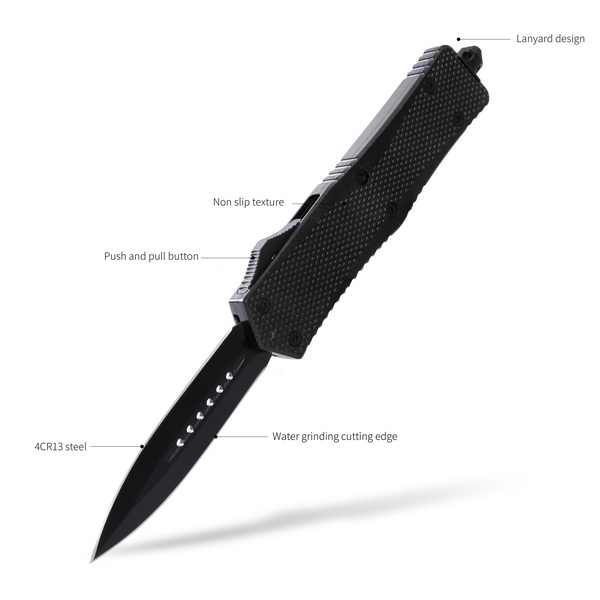
Single-action OTF knives use a spring to deploy the blade, requiring manual retraction. Double-action knives allow both deployment and retraction via a switch, using internal mechanisms to automate both movements.[4][1]
Patents protect new deployment mechanisms, locking systems, ornamental designs, and manufacturing processes, allowing manufacturers and brands to invest in original designs that support safety and brand identity.[2][1]
By conducting thorough freedom-to-operate reviews, choosing non-overlapping mechanism geometries and external stylings, documenting innovations through filed patents, and licensing where needed.[3][1]
Legality varies by country and state. OEMs and brands must research local laws for importation, marketing, and use, and tailor shipments and labeling to regulatory requirements.[6][1]
Trends include multi-point locking for enhanced safety, anti-wobble mechanisms, advanced materials for durability, low-friction coatings, and ergonomic controls for users in tactical and outdoor environments.[1][4]
[1](https://patents.google.com/patent/US9498889B1/en)
[2](https://patents.justia.com/patent/D945240)
[3](https://www.58hrcknives.com/the-role-of-patents-in-designing-innovative-otf-pocket-knives.html)
[4](https://patents.google.com/patent/US20070175045A1/en)
[5](https://patents.google.com/patent/USD986023S1/en)
[6](https://ravencresttactical.com/otf-knife-laws/)
[7](https://www.scribd.com/document/730292066/hawlk-otf)


