
Views: 222 Author: Leah Publish Time: 2025-11-12 Origin: Site


Content Menu
● What Is an OTF Pocket Knife?
● The Anatomy of an OTF Pocket Knife
● The Internal Mechanism: Detailed Functionality
>> Blade Catches, Stops, and Safety Features
● OTF Pocket Knife: Key Variations
>> By Locking/Trigger Mechanism
● The Engineering Behind the Scenes
>> Materials
● OTF Pocket Knives in Practice
>> Cleaning
>> Lubrication
>> Sharpening
>> Storage
● How to Choose the Best OTF Pocket Knife
>> Intended Use
● Innovations and Future Trends in OTF Pocket Knives
● FAQ
>> 1. What does “OTF” mean for a pocket knife?
>> 2. How is an OTF pocket knife different from a regular folding knife?
>> 3. What's the difference between single- and double-action OTF pocket knives?
>> 4. Are OTF pocket knives legal to own and carry?
>> 5. How do I maintain an OTF pocket knife?
OTF pocket knives—short for “Out-the-Front pocket knives”—are a revolution in the world of outdoor and tactical tools. Their defining feature is a blade that deploys straight out from the front of the handle, thanks to an advanced internal mechanism, offering unprecedented speed, convenience, and utility. Whether for law enforcement, outdoor enthusiasts, military users, or collectors, the OTF pocket knife stands out as a blend of engineering precision and practical functionality. This article explores the intricate workings, mechanical details, usage scenarios, and ownership tips for OTF pocket knives.
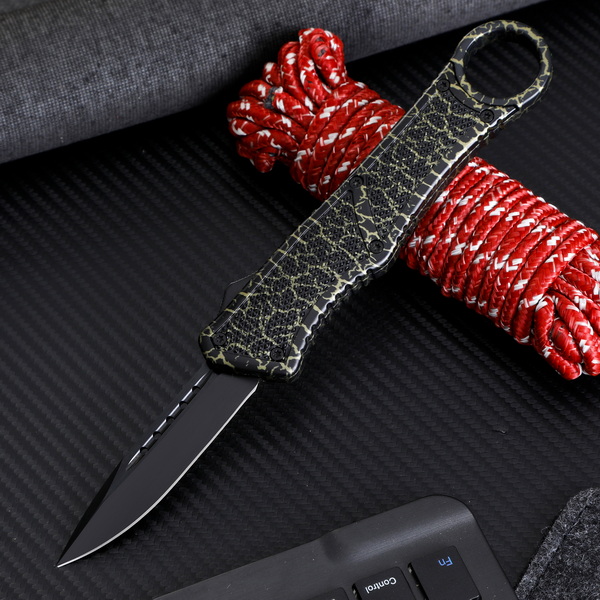
Out-the-Front (OTF) pocket knives are a type of automatic knife where the blade slides forward—from the front of the handle—instead of swinging out from the side like traditional folding knives. This linear movement is powered by a spring-driven mechanism inside the handle, enabling rapid, one-handed deployment or retraction. OTF knives have become a mainstay among tactical professionals and hobbyists alike due to their reliability, durability, and unique aesthetic.[6][7][8]
Every OTF pocket knife comprises carefully engineered components working in harmony:
- Handle: Typically constructed of aluminum, stainless steel, or robust polymers, the handle houses all internal mechanisms and provides a secure, ergonomic grip.[6]
- Blade: The blade, often made of high-quality stainless or high-carbon steel, is sharpened for utility and engineered for rapid projection and safe retraction.[5]
- Blade Carrier and Track System: A precisely machined blade carrier rides in a channel inside the handle, ensuring straight-line travel and preventing blade misalignment.[5]
- Firing Button / Slider / Lever: This external piece allows the user to activate the internal spring mechanism, initiating either blade projection or retraction.[4]
- Internal Spring Mechanism: The cornerstone of the OTF system, the coiled or tensioned spring, stores potential energy for deployment or retraction of the blade.[1][5]
- Locking Mechanism: After deployment, specialized mechanisms keep the blade locked in position—maintaining user safety and practical reliability.[4][5]
A single-action OTF knife deploys its blade automatically via a spring but requires manual retraction, usually by pulling a lever or physically guiding the blade back into the handle. This simplicity appeals to users who prioritize reliability with minimal moving parts, although resetting the blade is less convenient compared to double-action variants.[7][8][1][4]
Double-action OTF pocket knives epitomize modern engineering. With a single button or slider, the user can both deploy and retract the blade. This is achieved through a more complex system of opposed springs, latches, and catches that manage tension and guide the blade in both directions. The result is effortless, repeatable, one-handed operation, making double-action OTF knives the preferred choice for tactical applications and daily carry.[8][7][4][5]
At the heart of every OTF pocket knife lies a compressed coil spring (typically high-strength steel) inside the handle. When a user activates the firing switch, stored energy in the compressed spring is unleashed, which, through a connected blade carrier, drives the blade rapidly forward via a channel or track.[1][5]
Quality OTF knives feature precisely machined tracks to ensure the carrier glides smoothly and the blade emerges directly from the handle, minimizing friction and misalignment.[5]
The button, lever, or slider on the knife is directly connected to the internal spring system. A press or slide of this switch:
- Releases the spring's stored energy
- Sends the blade carrier forward, extending the blade
- Engages a locking mechanism (typically a ball-bearing, mechanical, or friction lock) that secures the blade in an open position for safe use[4][5]
Double-action models use the same mechanism in reverse for blade retraction. When the slider is pulled back, spring tension reverses, retracting the blade and locking it securely closed. These systems are engineered to prevent accidental deployment in pockets, enhancing safety and reliability.[3][6][4][5]
To control the movement and end positions of the blade, OTFs employ a series of blade catches and stops. High-end models feature precision grooves, latches, and blade stops to guarantee the blade fires out or retracts exactly as intended—never too far, never short.[4][5]
OTF knives may have secondary switches or safeties that prevent unintentional firing while carried, strengthening user confidence in even the most demanding environments.[6][5]
OTF pocket knives are made in a wide range of sizes, from small EDC (everyday carry) models to large, heavy-duty tactical tools. Compact versions excel in subtlety and portability, while larger versions provide greater cutting power and grip for challenging tasks.[5][6]
OTF blades come in various shapes, such as:
- Tanto
- Dagger
- Drop Point
Choice of blade influences penetration, slicing ability, and overall knife aesthetics.[7][6]
Some models are strictly single-action, suited to cost-conscious users. Most modern high-end OTFs are double-action, prized for versatility and true one-handed operation.[10][8][4]
Trigger configuration is another area of variance: some knives use a spine-mounted lever, others feature a side-mounted body lever or a button (referred to as “plunge lock”)—each style impacting deployment speed, ergonomics, and safety.[4]
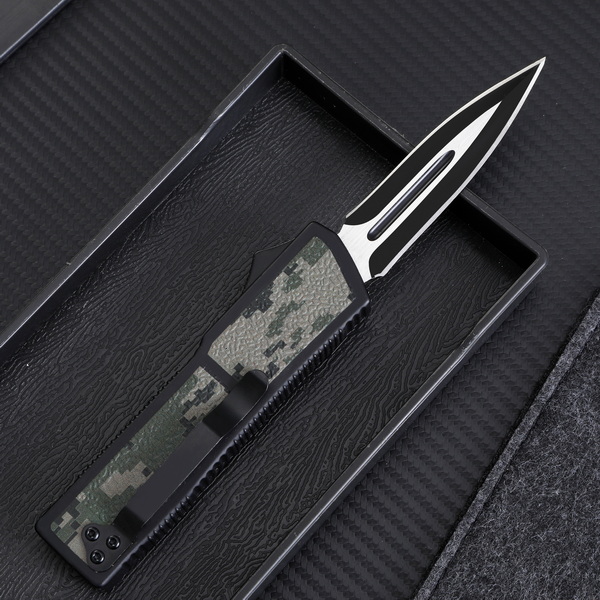
Creating a reliable OTF pocket knife requires careful CNC machining, quality material selection, and stringent assembly standards. Blade tracks, carriers, and spring chambers must be perfectly aligned to prevent binding and ensure consistent performance.[5]
- Blades: Hardened tool steels or stainless steels (for resistance to wear, corrosion, and frequent use)
- Handles: Lightweight but durable metals or polymers
- Springs: High-tensile steel for repeated cycling without fatigue
Premium manufacturers test every OTF knife extensively for blade play, alignment, deployment speed, and lock strength, ensuring safe and dependable performance even after prolonged use.[5]
The tactical community—military, police, EMTs—favors OTF pocket knives for their instant one-handed access, which can be crucial in situations requiring rapid response. Emergency responders appreciate the ability to deploy a blade with gloved or injured hands.[11][7]
Hikers, campers, hunters, and everyday users choose OTF knives for their convenient deployment when one hand is occupied. They excel in everyday tasks such as box opening, rope cutting, food prep, and gear adjustment.[12][6]
Knife collectors are drawn to OTF pocket knives because of their unique mechanisms, high machining tolerances, and the sensation of rapid deployment, which differs greatly from manual folders.[13][11]
Dust, debris, and pocket lint can accumulate in the internal track and blade carrier, impairing performance. Regularly clean the interior (following maker instructions) with compressed air, a soft brush, and minimal solvent to avoid lubricating the wrong areas.[14][6]
Apply a light, high-quality oil to moving mechanical surfaces and bearings for lasting smoothness, but avoid excess that may attract dirt.[14]
Standard sharpening tools and methods apply. Maintain the edge according to the blade's grind and steel composition, using stones, rods, or systems rated for the steel's hardness.[6]
Store OTF pocket knives dry, inside provided cases or sheaths, or attached to a pocket via a clip, to prolong functional life and prevent corrosion.[12]
- EDC: Look for a compact, lightweight model with double-action convenience.
- Tactical: Opt for larger, robust models with advanced locking and rapid deployment.
High-carbon and stainless steels remain favorites for their edge retention, corrosion resistance, and tensile strength.[6]
Choose a handle material and grip texture that complements your working environment, comfort, and usage pattern.[12][6]
Global knife brands, wholesalers, and manufacturers seeking original equipment manufacturing (OEM) partners often source from expert Chinese factories, which offer customizability, advanced CNC shaping, and tight quality standards tailored to international needs.
OTF pocket knives are not permitted in all markets. Laws vary by country, state, and even city—always check regional regulations regarding purchase, possession, and carriage of automatic knives before acquiring or using an OTF pocket knife. Such attention to legality is essential for both consumers and international retailers.[11][5]
The OTF market continues to see innovation as materials tech, precision engineering, and user-driven design evolve. New blade steels offer greater edge retention and corrosion resistance. Advanced handle materials improve strength-to-weight ratio. Precision assembly allows even tighter tolerances, which translates to faster, safer blade launches and retractions. Some leading OEMs now provide smart safety interlocks, modular construction for blade swaps or upgrades, and more eco-friendly manufacturing processes.
Custom options from Chinese factories allow brands to specify blade profiles, steel types, locking mechanisms, color finishes, and personalized logos, making OTF pocket knives a highly customizable product for the global B2B ecosystem.
OTF pocket knives, with their lightning-fast front-blade deployment and ingenious internal mechanics, deliver unmatched convenience, utility, and tactical potential to users worldwide. From their precisely engineered springs and locking systems to their adaptability across outdoor, tactical, and collector circles, OTF pocket knives occupy a unique space in the modern knife landscape. If you demand rapid, one-handed blade access, robust construction, and eye-catching engineering, an OTF pocket knife is a worthy addition to your kit—provided you always adhere to your local laws and safety practices.
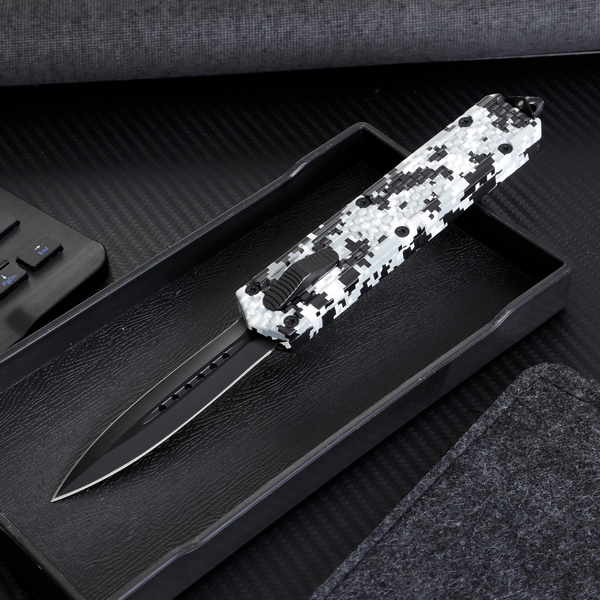
“OTF” stands for “Out-the-Front”—the knife's blade shoots straight out the front of the handle, powered by an internal spring.[8][6][5]
While regular folders swing the blade outward from the handle's side, OTF pocket knives push the blade out the front, enabling faster and often true one-handed deployment.[7][8]
Single-action OTF knives automatically deploy the blade but require manual retraction. Double-action OTF knives deploy and retract the blade via the same button or slider—no manual reset needed.[8][7][4][5]
Legality depends on your location—check local, state, and national regulations before acquiring or carrying an OTF knife.[11][5]
Regularly clean out debris from the handle, lubricate moving parts sparingly with proper oil, keep the blade sharp, and store the knife in a dry place. Follow the manufacturer's guidelines for long-term care.[14][6]
[1](https://uppercuttactical.com/blogs/news/how-does-an-otf-knife-work)
[2](https://www.youtube.com/watch?v=dkaA4wZeLdQ)
[3](https://tacknivesusa.com/how-does-an-otf-knife-work/)
[4](https://takcom.com/different-locking-and-trigger-mechanisms-of-a-premium-otf-knife/)
[5](https://knife-depot.com/blogs/sharpened-values/otf-knives-explained-the-complete-guide)
[6](https://www.tosahwi.com/fr/blogs/what-is-an-otf-knife/)
[7](https://crateclub.com/blogs/loadout/are-otf-knives-good-for-self-defense-a-comprehensive-analysis)
[8](https://bladeops.com/blog/the-history-of-otf-knives-from-military-tool-to-everyday-essential/)
[9](https://www.youtube.com/watch?v=z0BAYjki2AU)
[10](https://www.tektoknives.com/blogs/news/understanding-different-types-of-switchblades)
[11](https://www.bladehq.com/cat--Out-The-Front-Automatics--41)
[12](https://blade-city.com/collections/otf-knives)
[13](https://bladeops.com/knives/out-the-front/)
[14](https://tacknivesusa.com/how-to-videos/)


