
Views: 222 Author: Leah Publish Time: 2025-10-15 Origin: Site


Content Menu
● Understanding the Heavy-Duty OTF Knife
● Key Components Affecting Strength
>> Blade Material and Hardness
>> Handle Construction and Ergonomics
● How to Test the Strength of a Heavy-Duty OTF Knife
>> 1. Deployment and Retraction Test
>> 2. Blade Edge Retention Test
>> 3. Flex and Impact Resistance Test
>> 4. Handle Strength and Ergonomics Test
>> 5. Corrosion Resistance Test
>> 6. Real-World Utility Tests
● Maintenance and Care for Longevity
● FAQ
>> 1. What makes a Heavy-Duty OTF Knife different from regular knives?
>> 2. How often should I test my OTF knife's blade strength?
>> 3. Is the handle material important for the knife's strength?
>> 4. Can I perform strength tests at home?
>> 5. How does OEM manufacturing affect Heavy-Duty OTF Knife quality?
The Heavy-Duty OTF Knife is a remarkable tool designed for outdoor enthusiasts, survivalists, and tactical operators who demand reliability, strength, and precision. Testing the strength of this knife is essential to ensure it meets the rigorous standards expected in the field. This article explores comprehensive methods to assess the durability and performance of a heavy-duty OTF knife,offering insight into mechanical testing, material properties, handling, and maintenance considerations.
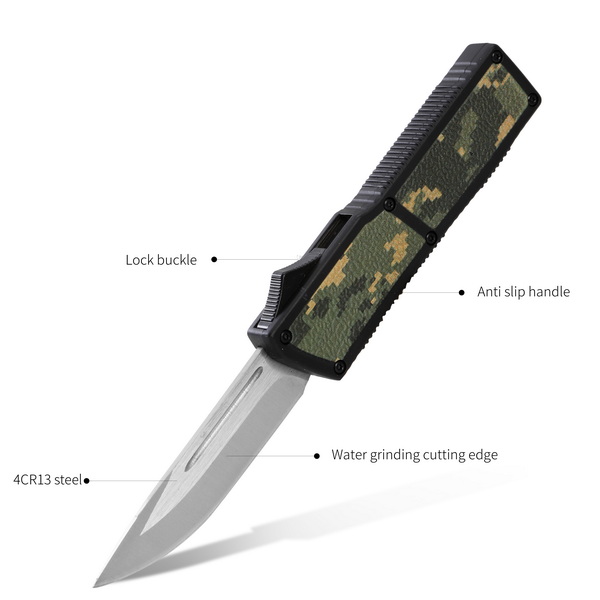
OTF stands for "Out The Front," a mechanism that allows the blade to deploy and retract through an opening in the handle's front. Heavy-Duty OTF knives are engineered to withstand harsh conditions, combining robust blade materials with resilient handle construction. Typically, these knives feature high-grade steels like stainless steel or tool steel, hardened for edge retention and toughness, paired with durable corrosion-resistant handles made from aluminum, titanium, or reinforced polymers.
These knives are widely used in tactical operations, rescue missions, and outdoor tasks requiring a compact tool with quick blade access and exceptional strength.
The blade's composition and hardness rating dramatically influence longevity and strength. Popular steel types for heavy-duty OTF knives include:
- 154CM Stainless Steel: Known for excellent corrosion resistance and hardening capability.
- S35VN: Highly regarded for edge retention and toughness.
- D2 Tool Steel: Offers superior wear resistance though slightly prone to rust.
The hardness is often measured using the Rockwell Hardness Scale (HRC), where values between 58-62 HRC balance edge retention with toughness for heavy-duty use.
The handle must endure impact without cracking or deformation. A solid frame lock or liner lock mechanism enhances the knife's safety and durability under pressure. Ergonomic design ensures comfortable and secure handling, preventing slips which can be dangerous during rigorous use.
Testing an OTF knife's strength involves both mechanical stress tests and real-world utility assessments. These tests evaluate blade sharpness, structural integrity, deployment mechanism, and the handle's grip and resilience.
The core feature of an OTF knife is its blade deployment mechanism. Testing involves cycling the blade open and closed repeatedly to check for smooth operation without jamming or failure. A high-quality Heavy-Duty OTF knife should withstand thousands of cycles without a drop in performance.
Edge retention measures how long the blade remains sharp after repeated cutting tasks. Standard methods include:
- Cutting ropes or fibrous materials repeatedly.
- Performing shaving tests on wood or paper.
Post-test, microscopic analysis or sharpness gauges assess blade wear. Heavy-duty OTF knives should sustain sharpness longer than typical knives due to premium materials and heat treatment.
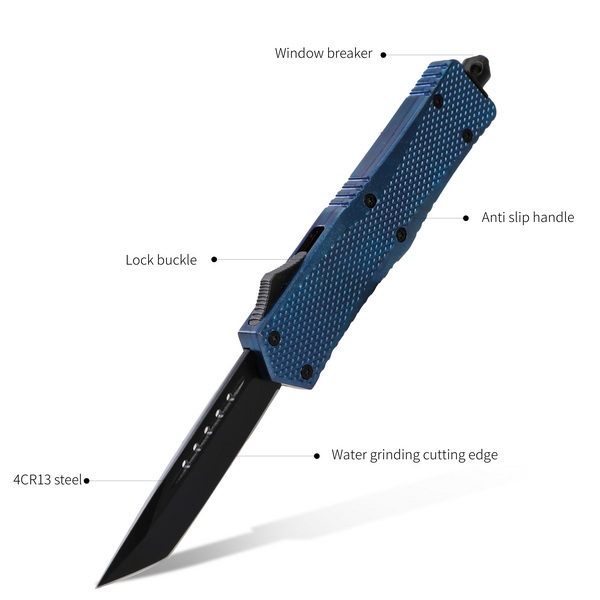
This test evaluates the blade's toughness under bending and impact stress, simulating harsh field conditions:
- The blade is bent gradually to test its flexibility without permanent deformation or breakage.
- Impact testing involves striking the blade against a hard surface (simulating accidental drops or striking use).
A Heavy-Duty OTF knife blade should flex moderately and return to its original shape without cracking.
Assess the handle's structural strength by applying lateral and torsional forces to simulate gripping under pressure. The integrity of locking mechanisms is crucial—lock failure can cause accidents. Additionally, handle texture and shape are evaluated to confirm a firm, slip-resistant grip during wet or sweaty conditions.
Exposure to moisture, saltwater, and other corrosive elements tests the knife's resistance to rust and corrosion. Blades are often soaked or sprayed with saline solutions, then inspected for signs of degradation.
Heavy-Duty OTF knives should be tested in scenarios mimicking typical field uses, such as:
- Cutting through heavy-duty fabrics and cords.
- Carving wood.
- Opening packages or food processing tasks.
These practical assessments ensure the knife performs well in actual conditions beyond lab tests.
Maintaining a Heavy-Duty OTF Knife is essential to preserve its strength and performance. Regular cleaning, lubrication of the deployment mechanism, and sharpening are necessary practices. Proper storage away from moisture and corrosive substances prolongs the knife's service life.
Testing the strength of a Heavy-Duty OTF Knife is a vital process that assures its reliability, safety, and longevity in demanding environments. From evaluating blade hardness and edge retention to examining handle durability and corrosion resistance, manufacturers and users must pay close attention to comprehensive testing methods. Adhering to these protocols guarantees that the Heavy-Duty OTF Knife lives up to its promise as a trusted tool for professionals and outdoor enthusiasts alike.
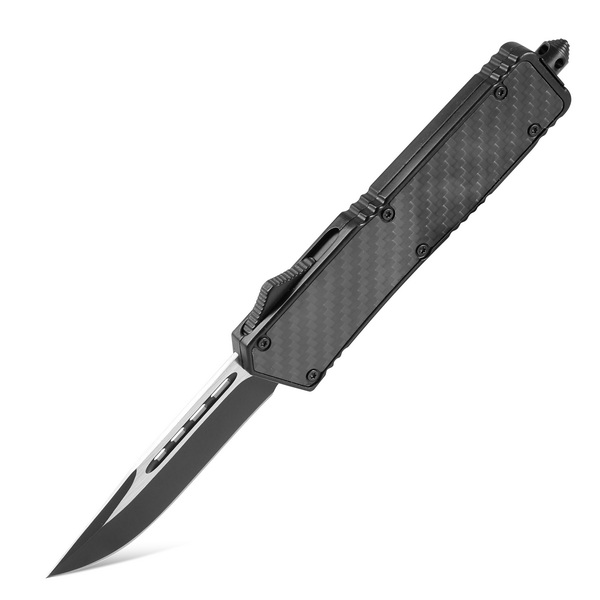
Heavy-Duty OTF knives feature an out-the-front blade deployment mechanism, robust materials, and high engineering standards to withstand extreme usage and conditions, unlike regular fixed or folding knives.
Routine testing depends on usage intensity, but for heavy-duty applications, testing every few months is recommended to ensure performance remains optimal.
Absolutely. A durable handle material like aluminum or reinforced polymer provides resistance to impact and pressure, enhancing overall knife strength.
While some basic tests like deploying the blade repeatedly or cutting materials can be done at home, advanced tests such as flex resistance or corrosion tests require specialized equipment.
OEM manufacturing allows customization with premium materials and specific design features, ensuring high quality that meets client needs and market standards.


