
Views: 222 Author: Leah Publish Time: 2025-11-05 Origin: Site


Content Menu
● What Is a Tactical OTF Knife?
● Historical Context and Engineering Evolution
● Internal Mechanics: The Heart of OTF Technology
>> Button and Actuator Variations
● Blade Deployment Types: Which Is Best for Tactical Use?
● Blade Shapes and Their Tactical Benefits
>> Tanto Point
>> Drop Point
>> Clip Point
>> Spear Point and Double Edge
● Blade Edge Types: Tactical Application
>> Plain Edge
>> Combo Edge
● Blade Steel Selection for Tactical OTF Knives
● Key Features and Selection Criteria for OEM and Buyers
>> Blade Length
>> Locking and Safety Features
● Tactical Use Cases: Why Professionals Trust OTF Knives
>> Law Enforcement and Military
>> Outdoor and Survival Applications
● Maintenance, Care, and Long-Term Reliability
● Legal and Ethical Considerations
● Latest Innovations and Trends in Tactical OTF Knives
● FAQ
>> 1. What makes tactical OTF knives superior for emergency situations?
>> 2. Which blade shape and edge are best for tactical OTF knives?
>> 3. Are OTF knives legal everywhere?
>> 4. How do I maintain my tactical OTF knife?
>> 5. What materials deliver the best performance for tactical OTF knives?
Tactical OTF knives—formally known as “out-the-front” knives—hold an esteemed reputation in the worlds of military, law enforcement, and outdoor adventure. Renowned for their rapid deployment and mechanical innovation, these knives exemplify high performance in crucial moments when lives and safety are on the line. Selecting the right OTF knife for tactical operations requires a nuanced understanding of blade structure, deployment mechanism, materials, and practical features. This comprehensive guide explores every essential aspect of tactical OTF knives, empowering OEM partners, international wholesalers, and discerning end-users to make the most strategic purchasing decisions.[1][4][11]
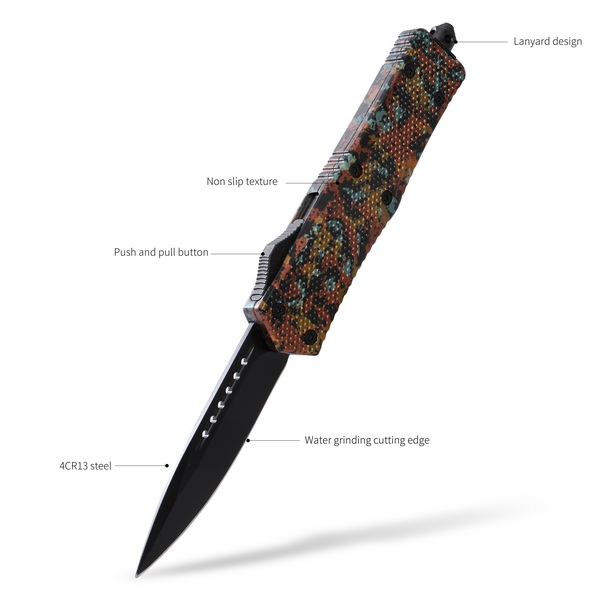
A tactical OTF knife is defined by its unique blade deployment: the blade extends directly out from the tip of the handle, rather than folding out from the side as in traditional knives. Driven by a spring-loaded or slide-assisted mechanism, an OTF knife's blade can be deployed or retracted with one hand, ensuring unmatched speed in emergencies and real-world tactical scenarios.[2][12][1]
- Rapid, one-handed action: The ultimate advantage for duty-bound professionals.
- Strong lock-up: Ensures the blade remains rigid and safe during heavy use.
- Compact, ergonomic form: Designed for pocket or vest carry without bulk.
- Premium materials: High-quality steel and advanced handles for long-term durability.
OTF knives are increasingly favored in global tactical gear markets for their performance and adaptability, with applications across self-defense, survival, rescue, law enforcement, and specialized military needs.[8]
Originating in the mid-20th century, OTF knives initially attracted attention in both military and civilian circles. Modern tactical OTF knives leverage more sophisticated engineering and materials science, blending traditional reliability with 21st-century innovation. Mechanisms have evolved from single-action models to advanced double-action and even hybrid variants capable of sustained tactical use under extreme conditions.[7][2]
Understanding the internal structure of OTF knives reveals why these tools outperform most other blade types in a tactical environment.[1][7]
At the core of every OTF knife is a robust spring system—often made of tempered, high-carbon steel. This spring compresses when the blade is retracted, storing potential energy. Once released by a button, slide, or lever, the spring propels the blade forward in a controlled motion, locking it into place.[1]
The blade is mounted on a guided carrier that moves along precision-engineered tracks inside the handle. This prevents wobble, minimizes friction, and ensures both speed and accuracy during deployment and retraction.[1]
Tactical OTF knives use several types of locking systems:
- Ball-bearing locks utilize steel balls under tension to lock the carrier.[1]
- Mechanical (interlock) mechanisms provide high reliability for mission-critical gear.
- Friction locks are simple but less secure, used mostly in budget or backup designs.[1]
The actuator may be a side-mounted button, a thumb slide, or a tactical switch—each engineered for reliability and ergonomics under pressure. Double-action actuators use the same control for both blade extension and retraction, while single-action models separate these functions.[2][8]
These knives fire open at the press of a button but require manual retraction. Their simpler mechanism often allows for greater mechanical strength and reliability, especially under hard use or in harsh environments.[4][7]
Advantages:
- Fewer moving parts; lower risk of malfunction.
- Strong, forceful deployment for piercing dense materials.
- Often more affordable.
Best For: Heavy-duty tactical roles, breaching, and field utility tasks.
Double-action tactical OTF knives use a single actuator to both deploy and retract the blade. This true one-handed operation is ideal for rapidly repeated tasks, immediate situational response, or urban EDC (Everyday Carry).[5][4][7]
Advantages:
- Faster re-deployment and closure; safe for high-stress use.
- Preferred for law enforcement, rescue, and EDC.
- Smoother user experience.
Best For: Law enforcement, quick response teams, EMTs, and general EDC.
A less common category, manual tactical OTF knives utilize a sliding button to open and close the blade without springs. While legal in more regions, they sacrifice much of the tactical speed and power of spring-driven designs.[8]
Each blade shape offers distinct tactical capabilities:
- Strength: Angular transition reinforces the tip—resistant to breakage.
- Tactical Function: Superior piercing for armor, tough fabric, and prying.
- Usage Context: SWAT, police, military breaching, and field utility.[5]
- Versatility: Sloping spine brings balance between strength and precision.
- Tactical Function: Excellent for slicing, skinning, controlled cuts.
- Usage Context: Military, survivalists, rescue environments.[5]
- Precision: Thin, sharp tip for detail work.
- Tactical Function: Accurate cutting, puncturing, and detailed EDC use.
- Usage Context: Combat, self-defense, first responders.[5]
- Symmetry: Often double-edged, optimized for stabbing and multi-directional use.
- Tactical Function: Penetration capability in defense and tactical thrusting tasks.
- Usage Context: Military, special operations, concealed carry.[5]
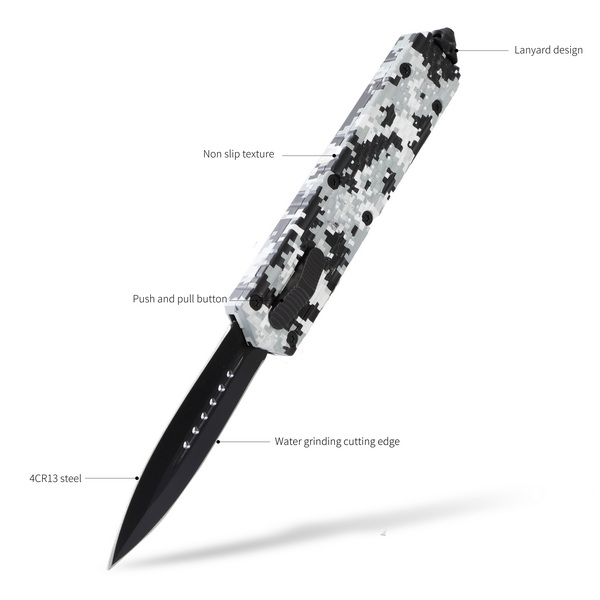
The go-to for clean, precise cutting and easy sharpening. Preferred for detailed tactical work where control is essential.
Excels at slicing through rope, webbing, and other fibrous tactical materials. Serrations retain their utility even when partially dulled, making them vital for emergency teams and search-and-rescue.[10]
A hybrid solution combining plain edge precision with a serrated section for versatility in the field—highly prized where users face varied cutting challenges.
Material affects every aspect of performance—durability, ease of sharpening, corrosion resistance, and longevity.[5]
- D2 Tool Steel: Tough, with good edge retention, requires maintenance against corrosion.
- CPM-S30V / S35VN: Premium choices for edge retention and toughness in adverse tactical environments.
- M390 / CTS-204P: Top-tier wear resistance when extended field deployment is required.
- AUS-8, 8Cr13MoV: Balanced options for fleets and budget-conscious agencies.
- Short blades (<3”): Better for legal urban EDC, backup roles.
- Standard blades (3.25-4”): Most common for tactical use—balance of reach and portability.
- Large blades (>4”): For intensive outdoor and fieldwork.[1]
- Aircraft-grade aluminum: Lightweight, strong, corrosion resistant.
- G10 composite and titanium: Provide optimal grip, strength, and weatherproofing.
- Ergonomics: Textured, contoured handles reduce fatigue; integral guards enhance safety.
- Strong mechanical lockup: Essential for tasks involving force.
- Safety switches: Prevent accidental deployment—a must in tactical operations.
OEM manufacturers must balance blade type, steel, deployment mechanism, and aesthetics with cost, end-market expectations, and regional legalities. Custom laser etching, unique handle textures, and modular design promptly add value for professional clients.
For police, SWAT, and military personnel, tactical OTF knives provide critical one-handed access to a sharp blade when entangled, restrained, or multitasking. They are loved for their immediate readiness and ability to pierce through clothing, web gear, or even light armor.[6][12][13]
In life-threatening emergencies, OTF knives quickly cut seatbelts, heavy clothing, and barriers. EMTs rely on combo edge OTF blades for swift response to accidents or natural disasters.[6][8]
Hunters, campers, and survivalists benefit from the robust build and field maintenance advantages of tactical OTF knives. They serve multiple roles—from food prep and shelter building to defense against animals.
Modern users also choose OTF knives for EDC, appreciating their portability, ease of deployment, and rugged appeal. Urban dwellers value the blend of tactical readiness and legal-conscious design features.
Proper care maximizes the performance and lifespan of tactical OTF knives:
- Regular cleaning: Remove dust, blood, dirt, and residue before retracting.
- Lubrication: Use light synthetic oils on the track and trigger mechanism.
- Inspection: Test lock-up, blade centering, and spring integrity monthly if in daily use.
With diligent maintenance, a high-quality tactical OTF knife will deliver years of reliable service, even in the most demanding settings.[2][1]
The legality of OTF knives varies markedly around the globe. Some regions restrict ownership based on blade length, spring mechanism, or intended use. When exporting or wholesaling, always review the recipient country's import and carry laws to avoid legal complications.[11][4][2]
Advanced blade steels, improved safety actuators, and integration of tactical accessories (window breakers, rescue hooks, glass breakers) mark the next evolution in this segment. Some models now incorporate stealth coatings and improved corrosion resistance for maritime and extreme climates, while ergonomic research continues to drive handle innovation for superior control under stress.
Tactical OTF knives exemplify the perfect synergy of speed, strength, and reliability. Mastering the differences among blade shapes, deployment mechanisms, and materials allows users and OEM buyers to select the exact knife for their requirements—be it law enforcement, military, rescue, survival, or prepared urban carry. The tactical OTF knife continues to evolve, cementing its place as a must-have for anyone who demands performance and dependability in critical situations.[12][14]
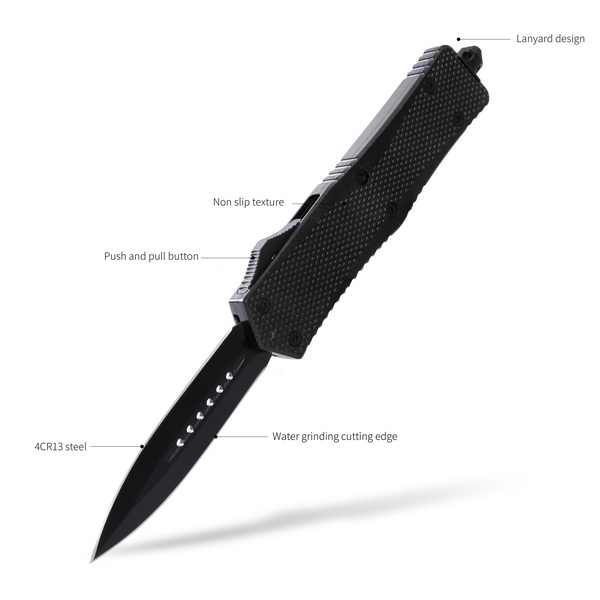
Tactical OTF knives deploy instantaneously at the push of a button or slide, providing life-saving speed and easy, one-handed access for responders working under pressure.[6][2]
Tanto and spear point blades offer the best penetrating power, while combo or fully serrated edges excel at slicing rope and tough synthetic fabrics.[10][5]
No; legality varies by region, especially regarding blade length and opening mechanism. Always check and comply with local and export laws.[4][11][2]
Regularly clean, lightly lubricate the mechanism, and store the knife dry. Check lockup and spring integrity every month if used daily.[2][1]
Premium blade steels like CPM-S30V, M390, or D2 combined with aircraft-grade aluminum or titanium handles ensure the best combination of strength, sharpness, and durability.[5]
[1](https://knife-depot.com/blogs/sharpened-values/otf-knives-explained-the-complete-guide)
[2](https://www.selfdefensesupply.com/otf-knives-guide)
[3](https://ravencresttactical.com/otf-knife-buyers-guide/)
[4](https://bladeops.com/blog/otf-knife-buyers-guide/)
[5](https://bladeops.com/blog/otf-knife-buyers-guide-what-to-look-for-in-your-next-otf-knife/)
[6](https://www.tacticalsportinggoods.com/blogs/news/understanding-otf-knives-a-comprehensive-guide-to-their-features-and-uses)
[7](https://www.stunster.com/blog/the-ultimate-guide-to-otf-out-the-front-knives/)
[8](https://dnkknives.com/blog/what-you-need-to-know-about-otf-knives/)
[9](https://www.youtube.com/watch?v=WN8PDfEbZw4)
[10](https://uppercuttactical.com/blogs/news/otf-plain-vs-serrated-edge-guide)
[11](https://www.bladehq.com/blog/how-to-choose-an-otf-knife)
[12](https://bladeops.com/blog/pros-and-cons-of-otf-knives-for-tactical-operations/)
[13](https://ravencresttactical.com/otf-tactical-knives-advantages-and-uses/)
[14](https://bladeops.com/blog/the-advantages-and-disadvantages-of-otf-knives-in-tactical-settings/)


