
Views: 222 Author: Leah Publish Time: 2025-11-08 Origin: Site


Content Menu
● Understanding Tactical OTF Knives
● Key Features Relevant to Self-Defense
>> Speed and One-Handed Access
● Practical Advantages for Self-Defense
>> Versatility and Everyday Utility
>> Reliability and Maintenance
● Tactical Techniques for Effective Use
● OTF Knives in Tactical and Professional Use
>> Military and Law Enforcement Contexts
● Tactical OTF Knives vs Other Defensive Knives
● Laws and Regulations: Know Before You Carry
● Choosing and Maintaining a Tactical OTF Knife
● Real-World Effectiveness and Professional Opinions
● Summing Up: Are Tactical OTF Knives Practical for Self-Defense?
● FAQ
>> 1. Are tactical OTF knives legal everywhere for self-defense?
>> 2. Can a tactical OTF knife be relied on during emergencies?
>> 3. Are OTF knives the best choice for personal defense?
>> 4. What skills are needed for effective self-defense with an OTF knife?
>> 5. How often should tactical OTF knives be maintained?
Tactical OTF knives—short for “Out-The-Front” knives—are a favored choice among professionals and enthusiasts seeking compact, high-speed defensive tools. Their reputation for reliability, rapid deployment, and intimidating presentation makes them a hot topic in self-defense discussions. But how practical are they for real-life self-defense situations? This article delves into the mechanisms, advantages, limitations, legal landscape, and tactical techniques associated with Tactical OTF Knives, providing a thorough, expert-backed perspective for users and buyers.
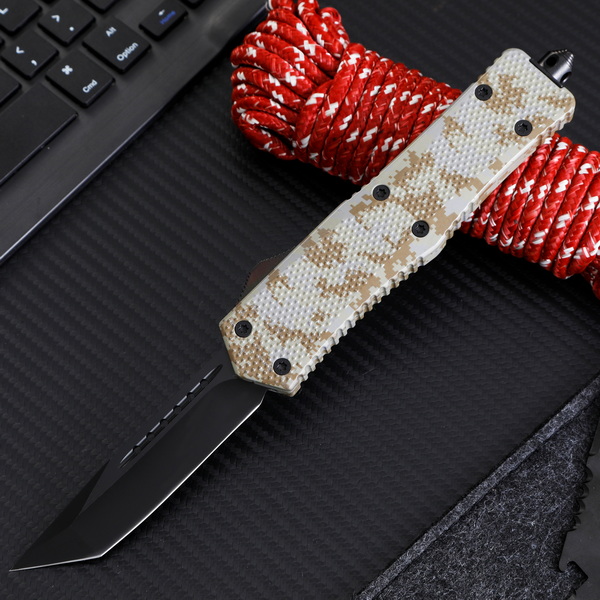
A tactical OTF knife is an automatic knife in which the blade is deployed out the handle's front with the press of a button. Unlike folding knives, OTF blades slide straight out, providing immediate access in stressful or emergency conditions.[1][5]
- Double-action OTF: Both deploys and retracts with a button.
- Single-action OTF: Deploys automatically; manual blade retraction required.
Critical parts include the spring mechanism, locking system, strong grip surface, and safety features that prevent accidental deployment.[10][11]
OTF knives offer different blade configurations for varied tactical needs:
- Tanto blades: Strong point, ideal for piercing.
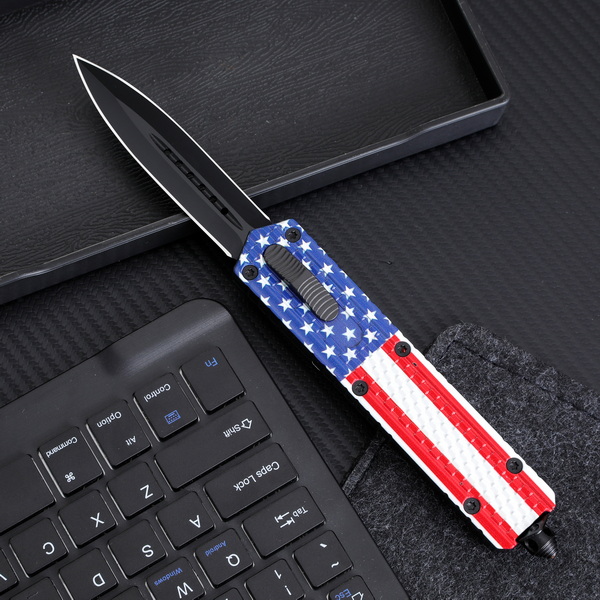
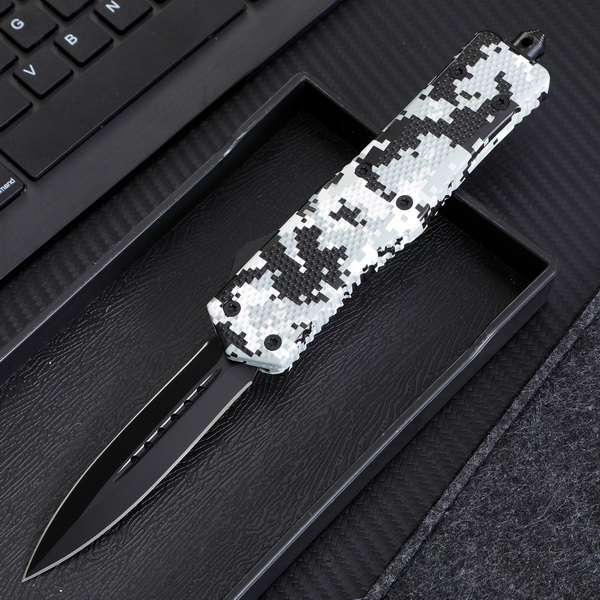
- Dagger blades: Double-edged, excellent for quick thrusts.
- Drop point blades: All-purpose, balancing durability and precision.[2]
Blade length is important—3 to 4 inches provides a balance between reach and maneuverability.[1]
Instant deployment is the hallmark feature of tactical OTF knives. Whether pressed for time or dealing with occupational multitasking, the ability to launch the blade with one hand, without shifting grip, offers crucial defensive advantages.[5][1]
- Enables immediate response without grip adjustment or extra movements.
- Can be operated with either hand, providing flexibility under pressure.[1]
The slim body and pocket clip make OTF knives easily concealable for everyday carry. The ergonomic designs also ensure a comfortable, secure hold, minimizing the chance of hand fatigue or slippage when responding to threats.[5][1]
OTF knives allow instant, controlled blade access in high-pressure scenarios, where fast reactions can be life-saving.[6][5][1]
- Deploy at the push of a button, no need for wrist flicks or two-handed opening.
- Blade is fully extended and locked, reducing risk of partial deployment.[2]
The sight and sound of an OTF knife's rapid blade extension can dissuade aggression, offering a powerful psychological deterrent that may be enough to end a confrontation before force is necessary.[2]
In addition to self-defense, tactical OTF knives shine in EDC (everyday carry), emergency rescue, and utility situations:
- Cutting secure materials in emergencies (seatbelts, rope, layers)
- Everyday tasks: opening packages, food preparation, or basic repairs.[12][6]
Despite their speed, tactical OTF knives generally lack the deep penetration power of fixed-blade knives due to internal mechanisms and structural constraints.[2]
- The need for a deployment channel adds mechanical complexity, reducing robustness.
- Not all OTF knives are optimized for heavy duty; poor build quality can compromise effectiveness when force is needed.
- Spring and Lock Wear: Extended use can degrade internal springs or locks, leading to faulty deployment or blade play.[1]
- Requires regular cleaning, lubrication, and careful inspection.
Cheaper OTF knives are particularly prone to malfunction, making quality selection and maintenance paramount.[2]
Proper technique maximizes an OTF knife's self-defense potential:
- Hammer Grip: Hold like a hammer for powerful, controlled thrusts. Ideal for short, direct stabs.
- Reverse Grip: Hold with blade pointed downward for slashes or upward strikes in confined spaces.
- Avoid over-gripping—keep the hand firm but relaxed for faster reaction.[1]
- Straight Thrusts: Fast forward pushes aimed at the torso or limb; takes advantage of straight-line deployment.[1]
- Defensive Slashes: Precise cuts to hands or arms to prevent attackers from seizing control.
- Blocking and Creating Space: Use the knife to force distance, reducing the attacker's ability to grab or strike.
The goal: Disable the threat enough to escape, not prolonged engagement.[1]
Professional users prize tactical OTF knives for speed and versatility:
- Quick access for removing restraints, breaching, or medical emergencies.
- Ability to multitask during high-stress missions, keeping one hand free for other tools.[5]
Civilian carriers value OTF knives for discretion, multi-use capability, and the rapid intimidation factor. For those prioritizing self-defense and preparedness, a reliable OTF knife can provide peace of mind.[13][14]
- Maximum penetration power, simple construction, and reliability.
- Less concealable; may be illegal in some areas.
- More compact and legal in more locations.
- Slower deployment; often requires two hands or complex motion.
- Unmatched speed and intimidation factor, compact and concealable.
- Lower stabbing power, potential mechanical failure, and greater legal restrictions.
OTF knives face extensive legal scrutiny worldwide:
- United States: Laws vary by state—some allow OTF knives under certain blade lengths, while others restrict or ban them completely. Airports, schools, and government facilities universally prohibit automatic knives.[15][16][17]
- Other Countries: Many nations restrict or outright ban OTF knives as “dangerous weapons.”
- Claiming “self-defense” as justification doesn't always protect against prosecution.
Advice: Always research and comply with regional knife legislation. Carrying illegal weapons, even for self-defense, can result in severe penalties.[16][18][15]
Careful selection is vital for reliability and legal compliance:
- Build Quality: Prioritize reputable brands and high-strength materials.
- Blade Profile: Select the right blade shape and length for self-defense without exceeding legal limits.[11]
- Handle Ergonomics: Look for handles that fit your grip and prevent slippage.
- Clean and lubricate the mechanism regularly.
- Inspect springs and locks for wear and replace as needed.
- Sharpen blades while preserving deployment path integrity.
OTF knives are praised for their role in self-defense and tactical contexts but are not without criticism:
- Speed and one-handed use receive universal acclaim for emergency and defensive readiness.[6][5][1]
- Limited penetrative force keeps them secondary to fixed blades for heavy-duty or life-threatening engagements.[2]
- Law enforcement and self-defense instructors underline the importance of regular training and practicing deployment under stress conditions.[1]
- Simulate self-defense scenarios to refine deployment and retraction speed.
- Learn how to switch grip styles under pressure.
- Practice blade manipulation, defensive blocking, and disengagement techniques.
- Ensure knife is locked and secure in the pocket or sheath.
- Store away from children and in compliance with legal standards.
Tactical OTF knives bring impressive speed, convenience, and intimidation to the self-defense toolkit. Their compact size, rapid deployment, and psychological deterrence make them attractive for both professionals and civilians. However, they are best seen as a supplement to personal safety, not a sole solution. Limitations in stabbing power, potential for mechanical failure, and significant legal restrictions mean they require careful selection, regular training, and strict legal awareness. For those who prioritize quick action and multi-functionality, a high-quality tactical OTF knife can be a lifesaver if chosen and used wisely.[15][16][5][2][1]
No. OTF knives face heavy restrictions and legal bans in many states and countries. Always check regional regulations before purchase or carry.[18][16][15]
High-quality models are reliable, but cheap or poorly maintained knives can fail. Routine maintenance is vital for safety and usability.[2][1]
OTF knives excel in speed and intimidation, but fixed blades offer superior power and reliability. OTFs should supplement—not replace—a comprehensive defense strategy.[5][2][1]
Regular practice in deployment, grip changes, defensive movements, and safe disengagement is essential, along with general situational awareness.[1]
Regular cleaning, lubrication, blade sharpening, and inspection of moving parts should be performed every few weeks or after heavy use.[11][1]
[1](https://bladeops.com/blog/what-you-need-to-know-about-otf-knives-for-self-defense/)
[2](https://crateclub.com/blogs/loadout/are-otf-knives-good-for-self-defense-a-comprehensive-analysis)
[3](https://www.reddit.com/r/CCW/comments/18shr70/whats_the_best_otf_knife_for_self_defense/)
[4](https://hiconsumption.com/gear/best-otf-knives/)
[5](https://bladeops.com/blog/pros-and-cons-of-otf-knives-for-tactical-operations/)
[6](https://ravencresttactical.com/otf-tactical-knives-advantages-and-uses/)
[7](https://swordsswords.com/blog/why-automatic-knives-are-the-ultimate-self-defense-tool/)
[8](https://knifeinformer.com/the-best-self-defense-knife-for-your-money/)
[9](https://www.youtube.com/watch?v=pVMbT2zY_vE)
[10](https://uppercuttactical.com/blogs/news/how-does-an-otf-knife-work)
[11](https://knife-depot.com/blogs/sharpened-values/otf-knives-explained-the-complete-guide)
[12](https://www.tacticalsportinggoods.com/blogs/news/understanding-otf-knives-a-comprehensive-guide-to-their-features-and-uses)
[13](https://www.reddit.com/r/knives/comments/12oftl8/people_who_edc_an_otf_why_people_who_dont_why_not/)
[14](https://tacknivesusa.com/are-otf-knives-practical/)
[15](https://uppercuttactical.com/blogs/news/are-otf-knives-legal-state-laws-on-otf-knives)
[16](https://crateclub.com/blogs/loadout/is-it-legal-to-carry-a-tactical-knife-understanding-the-laws-and-regulations)
[17](https://ravencresttactical.com/otf-knife-laws/)
[18](https://www.vipertecknives.com/blogs/all-tactical/the-legal-landscape-of-automatic-knives-what-you-need-to-know)


