
Views: 222 Author: Leah Publish Time: 2025-11-25 Origin: Site


Content Menu
● What Is an OTF Pocket Knife?
● Why OTF Pocket Knives Are Growing in Popularity
● The Logic of Multi-Brand Portfolios
● Segmenting Tactical, Outdoor and EDC Users
● Price Tiering and Margin Strategy
● Design Diversity and Collector Appeal
● Legal, Safety and Compliance Flexibility
● Supply Chain Security and OEM Partnerships
● Marketing Synergies Across OTF Brands
● Data-Driven Merchandising and Inventory Control
● Working with a Chinese OEM OTF Pocket Knife Factory
● Long-Term Strategic Advantages for Distributors
● FAQ
>> Q3: What role do OEM factories play in supporting multi-brand OTF Pocket Knife strategies?
>> Q5: How does sales data improve decisions about OTF Pocket Knife assortments?
For knife distributors, carrying a diversified portfolio of OTF Pocket Knifemodels across multiple brands has become a core strategy for growth, risk control, and long‑term competitiveness in today's tactical and outdoor markets. A multi-brand OTF Pocket Knife portfolio allows distributors to serve different price points, user groups, and regional regulations while locking in better terms with OEM manufacturers and building a stronger market presence.[1][4][5]
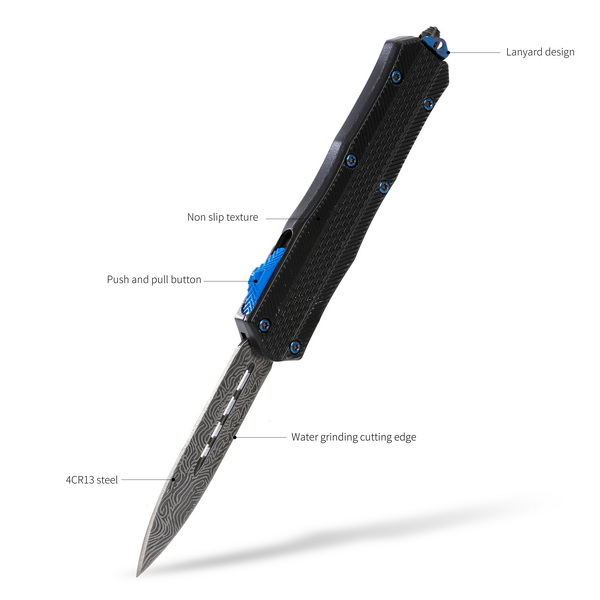
An OTF Pocket Knife (Out‑The‑Front pocket knife) is a knife whose blade travels linearly out of the front of the handle instead of pivoting from the side like a classic folder. Most modern OTF Pocket Knife designs use a spring‑driven mechanism activated by a button or thumb slide, and many double‑action models allow the same control to both deploy and retract the blade.[4][5]
Compared with conventional folders, an OTF Pocket Knife offers extremely fast one‑hand access, a compact closed profile, and a visually impressive action that appeals to both professionals and enthusiasts. Because of these advantages, OTF Pocket Knife lines have moved from niche status into the mainstream EDC and tactical categories.[5][9]
Recent market reports show that tactical and fighting knife segments, including OTF Pocket Knife products, are growing at a robust compound annual growth rate driven by outdoor recreation and personal‑safety demand. In 2025, manufacturers emphasize smoother deployment systems, better blade steels, and refined ergonomics, which make the OTF Pocket Knife a reliable working tool rather than just a novelty item.[6][4][5]
User feedback highlights instant blade access, compact carry and modern styling as main reasons for choosing an OTF Pocket Knife over traditional folders. As more brands launch OTF Pocket Knife collections and reviewers publish tests and rankings, distributors see sustained interest from both first‑time buyers and long‑term collectors.[2][9][1][5]
Relying on a single OTF Pocket Knife brand concentrates risk and limits a distributor's flexibility when market conditions or regulations change. A multi-brand portfolio allows distributors to combine premium, mid‑tier and entry‑level OTF Pocket Knife ranges so that each customer segment can find a suitable product without leaving the distributor's ecosystem.[2][4][5]
With several OTF Pocket Knife brands on hand, distributors can also better manage supply interruptions, product recalls, or sudden legal restrictions on particular models. If one OTF Pocket Knife supplier faces issues, orders and marketing focus can quickly shift to other brands while maintaining a complete shelf assortment.[4][5]
A successful strategy assigns each OTF Pocket Knife brand to a clear user segment instead of allowing internal competition. Tactical‑oriented OTF Pocket Knife lines focus on robust construction, aggressive blade profiles, and features like glass breakers and textured grips for gloved use. Outdoor and utility‑focused OTF Pocket Knife models emphasize corrosion‑resistant steels, secure retention in wet conditions, and handle designs that remain comfortable during prolonged cutting tasks.[9][5][6]
In parallel, urban EDC OTF Pocket Knife products tend to be slimmer, lighter and more visually refined so that they fit comfortably in pockets and look appropriate in everyday environments. By assigning each OTF Pocket Knife brand to one or two of these segments, distributors build a portfolio that covers real‑world needs while minimizing overlap.[5][2]
A multi-brand OTF Pocket Knife portfolio makes it easy to construct a clear “good–better–best” pricing ladder. Entry‑level OTF Pocket Knife models—often under or around the fifty‑dollar mark—bring new users into the category and generate high unit volume. Mid‑range OTF Pocket Knife products deliver stable margins and performance that satisfies demanding hobbyists, while premium and limited‑edition pieces strengthen brand prestige and encourage repeat purchases from enthusiasts.[10][1][2][5]
Distributors can design upgrade paths where marketing content compares a basic OTF Pocket Knife with a mid‑tier and premium option and explains why a customer might step up in materials, mechanism smoothness, or warranty coverage. Over time, this structure increases lifetime value per buyer without making the product range confusing.[1][2]
Different OTF Pocket Knife brands provide distinct design languages—blade shapes, grind styles, coatings, handle textures and colorways—that appeal to a wide range of tastes. Some brands prioritize minimal, modern aesthetics with monochrome finishes, while others highlight bold anodizing, themed engravings, or collaborations with firearm and tactical companies.[9][1][5]
Collectors often chase unique releases across several OTF Pocket Knife brands, such as special‑edition steels, signature designer models, or limited production runs. By stocking multiple brands, distributors become a natural destination for enthusiasts seeking variety, which improves traffic, newsletter sign‑ups and cross‑sales.[1][2]
Knife laws affecting OTF Pocket Knife sales vary significantly between countries and even between regions within the same country. Some jurisdictions restrict automatic mechanisms, impose maximum blade lengths, or require certain safety features, which directly influences which OTF Pocket Knife models can be offered.[4][5]
With a multi-brand portfolio, distributors can stock compliant OTF Pocket Knife alternatives that vary in size, action type and locking mechanisms to match local regulations. Many modern OTF Pocket Knife brands incorporate advanced safeties, double‑action systems that “bounce” off obstructions and robust locks, and distributors can highlight these features in product content to show commitment to responsible selling.[5][9][4]

The global OTF Pocket Knife market relies heavily on capable OEM manufacturers that provide precision machining, heat treatment, assembly and quality control at scale. Working with multiple brands often means working with several OEM facilities or with one advanced OEM that can support different label requirements through flexible production lines.[4][5]
For distributors, this structure improves supply security because production can be shifted between OTF Pocket Knife models or brands without losing technical capability. It also creates opportunities for co‑developed or exclusive OTF Pocket Knife designs, where an OEM factory and distributor collaborate on blade geometry, materials and aesthetics tailored for the distributor's target markets.[5][4]
Having a portfolio of OTF Pocket Knife brands unlocks powerful content and marketing synergies. Distributors can publish comparison guides, “best of” lists, and category breakdowns that feature several OTF Pocket Knife options side by side, encouraging readers to stay within the same store when deciding what to buy. Video reviews, blog posts and email campaigns can showcase budget and premium OTF Pocket Knife models in the same narrative, which naturally increases cross‑selling and up‑selling opportunities.[2][1][4]
Influencer and community partnerships can also be fine‑tuned: for example, rugged OTF Pocket Knife lines can be promoted through tactical trainers and outdoor channels, while compact, stylish models are placed with EDC and lifestyle creators. Coordinated launches, giveaways and user‑generated content campaigns benefit every OTF Pocket Knife brand in the portfolio, strengthening the distributor's overall reputation as a category expert.[9][5]
Managing multiple OTF Pocket Knife brands yields richer sales data than working with a single manufacturer. Distributors can analyze which blade lengths, steels, handle textures, deployment strengths and price points perform best within each OTF Pocket Knife label and in each region or sales channel.[4][5]
These insights guide purchase planning, shelf allocation and online merchandising layouts, ensuring that high‑performing OTF Pocket Knife items remain well stocked while slow movers are gradually phased out. Data also supports targeted product development requests to OEM partners, such as launching a compact OTF Pocket Knife with a popular steel and color that repeatedly sells through in competitor brands.[5][4]
For international distributors, partnering with a specialized Chinese OEM factory makes it easier to implement a multi-brand OTF Pocket Knife strategy while keeping production efficient. Modern Chinese OEMs combine rapid prototyping, advanced CNC machining, precision heat treatment and automated assembly, enabling them to produce complex OTF Pocket Knife mechanisms with consistent tolerances at scale.[4][5]
Such factories can manufacture multiple OTF Pocket Knife brands or private labels at the same time by changing logos, finishes, steel types and packaging while sharing core processes and quality systems. This approach helps distributors and foreign brand owners bring customized OTF Pocket Knife lines to market quickly, maintain stable quality, and benefit from competitive pricing that supports long‑term partnerships.[5][4]
Over the long term, distributors that invest in multi-brand OTF Pocket Knife portfolios build stronger, more defensible positions in their markets. They become trusted sources of category knowledge, able to advise customers on the pros and cons of different OTF Pocket Knife mechanisms, steels and designs. Their relationships with OEM manufacturers deepen as they collaborate on iterations and exclusive runs, which are harder for competitors to copy quickly.[2][4][5]
At the same time, the flexibility of multi-brand OTF Pocket Knife assortments allows distributors to adapt to new materials, design trends and legal changes without rebuilding their business model from scratch. In a segment that continues to innovate rapidly, this adaptability is just as valuable as short‑term profit.[4][5]
A well‑planned multi-brand OTF Pocket Knife portfolio brings distributors clear advantages in risk management, customer coverage and profitability. By combining tactical, outdoor and EDC‑focused OTF Pocket Knife lines across several price tiers, distributors can serve a wide variety of buyers while driving natural upgrade paths and repeat purchases.
Partnerships with capable OEM factories—especially advanced Chinese manufacturers—make it possible to support diverse OTF Pocket Knife brands with stable quality, fast development cycles and competitive costs. As market interest in OTF Pocket Knife designs continues to grow worldwide, distributors that embrace this multi‑brand strategy will be best positioned to capture demand and build durable, high‑value knife businesses.[5][4]

A multi-brand OTF Pocket Knife portfolio spreads risk across several suppliers and reduces vulnerability to production delays, recalls or regulatory changes affecting one brand. It also allows distributors to cover multiple price tiers and user segments, increasing total sales and strengthening negotiation power with each OTF Pocket Knife manufacturer.[2][4][5]
Distributors should define clear roles for each OTF Pocket Knife brand—tactical, outdoor, or EDC—and assign distinct price levels and design languages. With this structure, brands complement each other instead of overlapping, and customers can easily understand which OTF Pocket Knife line suits their needs.[9][5]
OEM factories provide the engineering, machining, assembly and quality systems required to manufacture high‑precision OTF Pocket Knife mechanisms at scale. They can produce multiple branded or private‑label OTF Pocket Knife lines simultaneously, enabling distributors to expand or adjust their portfolios without changing core suppliers.[4][5]
Distributors should study local knife laws related to blade length, opening mechanisms and carry restrictions, then select OTF Pocket Knife models that satisfy those rules. Working with brands that offer compliant variations and clear safety features helps maintain lawful sales and reduces liability.[5][4]
Sales and inventory data reveal which OTF Pocket Knife designs, steels, colors and price points perform best in each channel or region. Distributors can use these insights to refine purchasing, drop weak performers, and request new OTF Pocket Knife models from OEM partners that match proven demand patterns.[4][5]
[1](https://smkw.com/knife-101-best-otf-knives-of-2025)
[2](https://www.bladehq.com/blog/best-otf-knives)
[3](https://www.recoilweb.com/best-otf-knife-out-the-front-is-back-187300.html)
[4](https://www.accio.com/business/trending-otf-knives-automatic)
[5](https://www.58hrcknives.com/top-knife-trends-in-2025-why-otf-knives-lead-the-market.html)
[6](https://blade-city.com/blogs/gun-knife-blog/the-best-automatic-pocket-knives-of-2025-for-everyday-carry)
[7](https://gunsmagazine.com/news/new-knives-for-2025/)
[8](https://bladeops.com/knives/out-the-front/)
[9](https://pocketmags.com/us/tread-magazine/tread-sepoct-2025/articles/cutting-edge)
[10](https://www.youtube.com/watch?v=B1VqrKHBd58)


