
Views: 222 Author: Leah Publish Time: 2025-11-04 Origin: Site


Content Menu
● What Makes an OTF Knife “Tactical”?
>> Precision Engineering and Rapid Deployment
>> Compact and Low-Profile Structure
● Key Blade Features and Materials
● OTF Knife Internal Mechanics Explained
● Advantages of Tactical OTF Knives
>> True One-Handed Functionality
>> Secure Lockup and Stability
>> Versatile Field Application
● Important Drawbacks and Considerations
>> Maintenance and Mechanical Complexity
>> Blade Strength and Limitations
>> Higher Cost
● Comparing OTF Knives with Other Tactical Knives
● Choosing the Right OTF Knife: Practical Selection Factors
>> Deployment Action: Single vs Double
>> Additional Tactical Features
● Maintenance and Long-Term Care
● Common Misconceptions About Tactical OTF Knives
● Summary
● Frequently Asked Questions (FAQ)
>> 1. What makes a tactical OTF knife different from traditional knives?
>> 2. Are tactical OTF knives suitable for heavy-duty tasks?
>> 3. How should tactical OTF knives be maintained?
>> 4. What blade material is best for tactical OTF knives?
>> 5. Are tactical OTF knives legal to carry?
Tactical OTF (Out-The-Front) knives are rapidly gaining popularity among military professionals, law enforcement personnel, emergency responders, and outdoor enthusiasts worldwide. The technological innovations and robust functionalities of these knives make them a unique category in the tactical blade market. Unlike traditional folding or assisted-opening knives, tactical OTF knives deploy their blade straight out of the handle, offering unrivaled speed and one-handed operation. This article explores the critical features to consider when selecting a tactical OTF knife, delving into their mechanics, advantages, drawbacks, and proper maintenance. Through detailed analysis and expert insights, readers will learn why tactical OTF knives have become the tool of choice for demanding, high-pressure environments.[2][3][5]
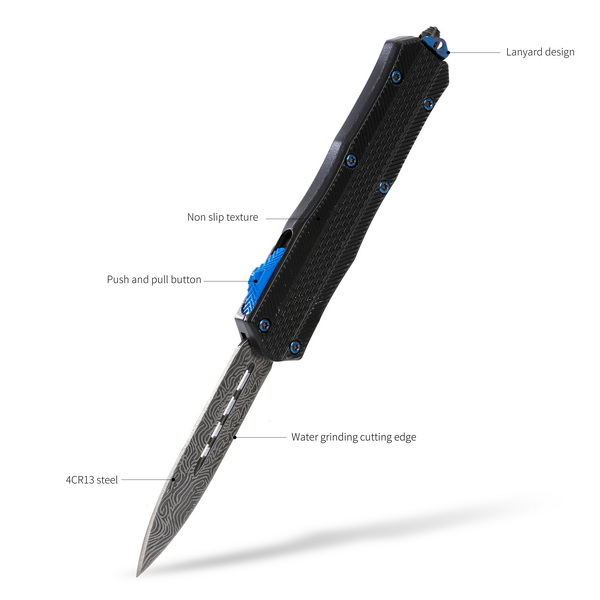
The core feature of any tactical OTF knife is its ability to deploy the blade instantly with a one-handed mechanism. Tactical OTF knives come in two primary variations:
- Double-Action OTF Knives: The blade is deployed and retracted automatically by moving the actuator forward and backward, dramatically improving the speed of use and convenience.
- Single-Action OTF Knives: The blade deploys automatically with a button press but requires manual retraction for closure, simplifying internal components and offering enhanced deployment force.[4][6]
This rapid deployment—without the extra movements required by folding knives—can be life-saving in critical moments. Whether operating in austere outdoor conditions or responding to emergencies, single-handed operation and instantaneous blade access mark the hallmark of the tactical OTF design.[5]
Tactical OTF knives are designed for discreet carry while maintaining robust functionality. Their slim, streamlined profiles facilitate seamless pocket or vest carry, avoiding bulk or excess weight. Most models feature reversible or deep-carry pocket clips and “rubberized” or textured handles made from aircraft-grade aluminum, zinc alloy, or specially treated polymers for a non-slip grip in any weather.[7][9][2]
Tactical OTF knives rely on advanced blade steels to withstand rigorous use. Prominent steel choices include:
- CPM S30V / S35VN: High-end steels offering exceptional edge retention and corrosion resistance, favored for their longevity and low maintenance.
- D2 Tool Steel: Tough and wear-resistant, though requiring more attention to protect from rust.
- AUS-8 and 440C Stainless: Popular in both budget and mid-tier OTF knives for their balance of durability, edge holding, and rust resistance.
- M390 / 20CV Stainless: Premium options known for retaining super-sharp edges and withstanding harsh environments.[1][8]
Tactical OTF knives are available with a variety of blade point styles to match specific needs:
- Tanto Point: Reinforced tip for piercing and breaching tasks.
- Drop Point: All-purpose design for control and slicing.
- Dagger/Double-Edge: Symmetrical shape for thrusting and tactical self-defense.
- Spear Point: Well-balanced profile for penetration and control.
Knife edges range from plain and serrated to combination types, enhancing versatility for cutting ropes, textiles, or fibrous materials commonly encountered in rescue or field operations.
Each tactical OTF knife contains a powerful spring mechanism—typically high-carbon steel—compressed while the blade is closed. Activation of the thumb slide, button, or actuator releases this tension, channeling the blade smoothly along precision-machined tracks. The tracks ensure straight, reliable deployment and minimize the chance of jamming or misalignment.[3][7]
A secure blade lock is vital for safe operation. Common systems include:
- Mechanical Locks: Complex interlocking parts for maximum stability.
- Ball-Bearing Locks: Spring-loaded bearings hold the blade open or closed.
- Friction Locks: Simpler designs utilizing precise friction between components.
These features prevent accidental closure and guarantee safe, reliable cutting during high-stress conditions.[3]
Many OTF knives integrate safety mechanisms that halt blade deployment if the pathway is obstructed, preventing accidental injury and allowing the user to reset the action smoothly. Integrated glass breakers at the pommel further expand tactical utility for breaking windows or as an impact tool in emergencies.[8][2]
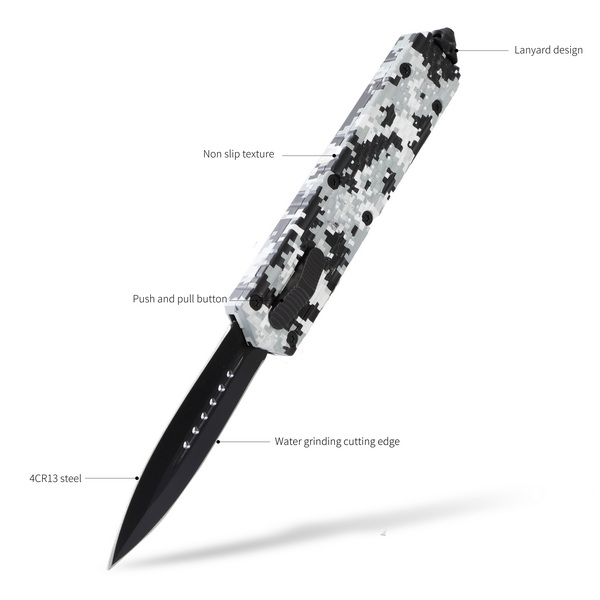
The primary advantage is the unmatched speed at which the blade can be deployed, making OTF knives invaluable in time-critical scenarios such as search and rescue, self-defense, or tactical engagement.[5]
Tactical OTF knives outperform most conventional folding knives by enabling operation with only one hand, freeing the other for essential tasks like stabilization, carrying gear, or defensive maneuvers. This advantage becomes pivotal in environments where time and coordination are in short supply.[4][5]
Engineering advancements have produced solid internal locking mechanisms that keep the blade rigid, even under duress. This locks the blade firmly open, preventing accidental closure and minimizing wobble—vital for controlled, safe handling.[5]
Thanks to a compact form and deep-carry clips, tactical OTF knives can be discreetly concealed and quickly accessed without adding bulk, crucial for both professionals and civilians seeking effective everyday carry.[2][5]
Tactical OTF knives excel beyond basic cutting tasks. Their robust tips are ideal for prying, breaking glass, or defensive thrusts, while serrated options handle rope-cutting or medical emergencies. Many models are purpose-designed for multi-role adaptability.[7][8]
Despite their advantages, OTF knives have intricate internal components that need periodic cleaning and lubrication. Exposure to dust, sand, or dirt can impair performance; failure to properly maintain the knife may result in malfunction or sluggish blade action.[3]
The nature of OTF deployment means that such knives are generally less suitable for heavy prying or brutal leverage tasks compared to fixed blades, as the internal mechanisms may limit overall blade strength.
Premium materials, sophisticated internal mechanisms, and exacting tolerances cause tactical OTF knives to be more expensive than many high-quality folding knives or even some fixed-blade models. However, the investment is typically justified by performance for those requiring instant access and reliability.[6]
It's important to check local regulations before purchasing or carrying tactical OTF knives. Some jurisdictions restrict or prohibit the possession and use of automatic knives, regardless of intent.
| Feature | OTF Knives | Folding Knives | Fixed Blades | Assisted-Open Knives |
| Deployment | Instant, button/slider | Manual (slower) | Always exposed, no action | Quick with manual assist |
| One-Handed Use | Yes | Sometimes | Yes | Yes |
| Maintenance | Moderate | Low | Low | Low to Moderate |
| Blade Stability | Moderate, good locks | Good | Highest | Good |
| Carry Convenience | Slim, pocketable | Varies | Bulky; needs sheath | Thin, pocketable |
| Tactical Application | Best for speed/precision | General utility | Heavy-duty/Survival | Everyday tactical/utility |
- Single-action: Stronger deployment force but needs manual reset.
- Double-action: Greater convenience, faster retraction, but more mechanical complexity.[6]
High-quality OTF knives often utilize aluminum (6061-T6 aircraft grade), titanium, or advanced plastics for optimal balance of strength and weight. Rubberized and textured designs enhance grip and reduce slippage with wet or gloved hands.[9][7]
Blade length restrictions may apply in some regions (often limited to 3–3.5 inches). Compact blades are easier to conceal while still effective for tactical purposes. Assess tip design and edge type to match anticipated requirements in the field.
Many tactical OTF knives include integrated features for enhanced functionality:
- Glass breakers: Rescue operations and emergency response.
- Lanyard holes: Retention on gear, preventing loss during activity.
- Reversible/pocket clips: Ambidextrous, discreet carry for all users.
Reputable brands often provide lifetime warranties, ensuring the readiness and longevity of these precision tools—a critical consideration for professional users relying on their gear's ongoing performance.[2][7]
Proper maintenance is crucial for reliable OTF performance:
- Regular Cleaning: Remove debris with compressed air and clean moving parts with a soft cloth. For deeper cleaning, use isopropyl alcohol and carefully access the interior if needed.[3]
- Lubrication: Light synthetic lubricants or PTFE sprays keep the action smooth. Avoid over-lubrication, which can attract dust.
- Sharpening: Maintain the factory bevel using ceramic sharpeners or whetstones, and polish with a strop as required.
- Inspection: Routinely check for blade play, spring performance, locking function, and loose screws.
- Safe Storage: Keep dry in a protective pouch and avoid high-humidity environments to prevent rust.
- OTF Knives Are Illegal Everywhere: While restrictions exist, many places permit ownership and carry with proper understanding and adherence to the law.
- OTF Knives Are Fragile: Modern top brands have engineered robust models; with correct use and care, tactical OTF knives provide years of reliable service.
- Only Professionals Need Tactical OTF Knives: While favored by military or law enforcement, OTF knives are also practical for outdoor adventurers, first responders, and everyday users seeking speed and versatility.
Tactical OTF knives are the pinnacle of speed, precision, and single-handed usability in the blade world. By considering materials, mechanics, safety features, and maintenance needs, users can select an OTF knife suited perfectly for their professional, personal, or tactical requirements. The appeal of the tactical OTF knife comes not only from its mechanical sophistication but also from its unmatched ability to respond instantly in emergencies, making it indispensable for those operating in demanding environments. Careful selection and proper maintenance ensure years of reliable, high-performance use.
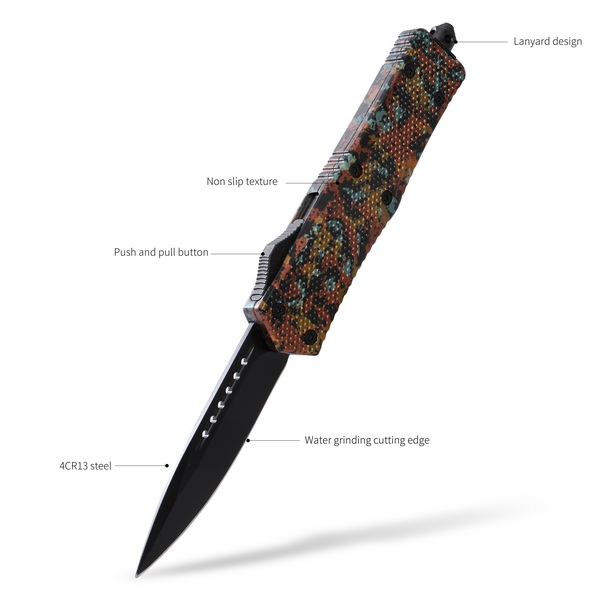
Tactical OTF knives offer instant, one-handed deployment straight out the front, unlike folding knives that require manual opening or fixed blades that need a sheath.
They excel at quick cutting and rescue tasks but are less suitable for heavy prying or batoning due to the internal mechanism.
Regularly clean and lubricate the internal parts, keep the blade sharp, and inspect for mechanical wear.
Premium stainless steels such as CPM S35VN, M390, or D2 offer the best combination of strength, wear, and corrosion resistance.
Legality varies by region. Always research local knife laws before purchase or carry to ensure compliance.
[1](https://www.benchmade.com/products/5370fe-shootout-otf)
[2](https://ravencresttactical.com/product-category/otf-knives/)
[3](https://knife-depot.com/blogs/sharpened-values/otf-knives-explained-the-complete-guide)
[4](https://uppercuttactical.com/blogs/news/how-does-an-otf-knife-work)
[5](https://bladeops.com/blog/pros-and-cons-of-otf-knives-for-tactical-operations/)
[6](https://www.selfdefensesupply.com/otf-knives-guide)
[7](https://cobratecknives.com/product/special-purpose/utility-knives/otf-utility-knife/)
[8](https://store.smith-wesson.com/tactical/knives/smith-wesson-swotf9b-assist-opening-otf/SWOTF9B.html)
[9](https://conquesttactical.com/knife-specifications/)


