
Views: 222 Author: Leah Publish Time: 2025-11-23 Origin: Site


Content Menu
● OTF Knives and Their Tactical Advantages
● Why Spain Is a Strong Base for Tactical OTF Knives
● Key Features of Quality Tactical OTF Knives
● Overview of Leading Spanish Tactical OTF Knife Makers
● Role of Chinese OEM Partners Serving the Spanish and European Market
● Inside the Tactical OTF Knife Manufacturing Process
>> Handle fabrication and machining
>> Blade production and heat treatment
>> Mechanism components and assembly
● OEM and Private‑Label Options for Global Buyers
● Legal and Regulatory Considerations in Tactical OTF Trade
● Current and Emerging Trends in Tactical OTF Knife Design
● How to Choose the Right Tactical OTF Supplier in Spain
● Positioning Spanish Tactical OTF Knives in the Global Market
● FAQ
>> Q1: What makes Spanish tactical OTF knives attractive to international buyers?
>> Q3: How important are tolerances in an OTF knife mechanism?
>> Q4: What steels are commonly used for high‑end tactical OTF blades?
>> Q5: Are there legal restrictions on importing OTF knives from Spain?
Spain has become an increasingly important destination for global buyers seeking high‑qualitytactical OTF (Out The Front) knives and reliable OEM partners. With a blend of traditional European blade heritage and modern precision manufacturing, the leading tactical OTF knives manufacturers and suppliers in Spain now serve military, law‑enforcement, outdoor, and EDC markets across the world.[1][5]
Spain's OTF knife ecosystem is also closely connected with specialized OEM factories in China that support European brands with cost‑effective, custom‑engineered products while maintaining strict quality control standards. This synergy makes Spain an excellent sourcing base for foreign brands, wholesalers, and knife producers looking for tactical OTF models, private‑label runs, and long‑term manufacturing partnerships.[5][1]

An OTF knife deploys its blade straight out of the front of the handle rather than folding from the side, using a spring‑assisted or fully automatic mechanism. In double‑action models, the same control (usually a slider or button) both deploys and retracts the blade, allowing rapid one‑handed operation in tight or high‑stress environments.[6]
These characteristics make tactical OTF knives attractive to law‑enforcement officers, first responders, and outdoor professionals who need instant, reliable access to a sharp cutting tool. Modern Tactical OTF Knives Manufacturers and Suppliers typically emphasize secure locking systems, safety switches, and robust internal components to ensure consistent deployment performance even after thousands of cycles.[3][5][6]
Spain has centuries of blade‑making history, especially in regions such as Albacete where knife craftsmanship has been refined over generations. Over time, Spanish producers have integrated CNC machining, controlled heat treatment, and advanced finishing technologies into this traditional foundation, which is essential for the tight tolerances required by OTF mechanisms.[1][5]
The country's integration into the broader European manufacturing network also supports strong regulatory compliance and export capability. Spanish Tactical OTF Knives Manufacturers and Suppliers often adhere to EU standards for materials, environmental impact, and product safety, which reassures global importers who must meet strict domestic regulations.[5][1]
Leading tactical OTF models share a common set of design priorities that balance performance, durability, and safety. When evaluating Spanish or Spain‑based OEM partners, buyers typically focus on the following technical features:[6][5]
- Blade steels: Premium stainless steels such as D2, M390, S35VN, or 154CM deliver high hardness, edge retention, and corrosion resistance for hard use.[3][5]
- Handle materials: Aircraft‑grade aluminum, titanium, and advanced composites like carbon fiber or G10 provide light weight with excellent structural integrity.[5]
- Mechanism design: Double‑action systems with precision‑cut tracks, firing plates, and springs must hold very tight tolerances (often within thousandths of an inch) to ensure smooth deployment and reliable locking.[2][5]
- Surface finishing: Stonewashing, bead‑blasting, anodizing, and DLC (diamond‑like carbon) coatings improve wear resistance and enhance aesthetic appeal.[2][5]
- Ergonomics and safety: Chamfered edges, textured scales, and secure pocket clips improve grip, while safety switches and robust detents reduce accidental deployment risk.[6]
These engineering details are where experienced Tactical OTF Knives Manufacturers and Suppliers in Spain and their OEM partners show a clear difference compared with lower‑end mass‑produced alternatives.[1][5]
Spain's knife industry includes several well‑known brands that have expanded into tactical and automatic categories, as well as specialized producers focused on export and OEM work. While product lines and branding differ, they share an emphasis on precision engineering and consistent quality control.[1][5]
Many Spanish manufacturers supply not only their own branded knives but also private‑label products for retailers and tactical companies throughout Europe and beyond. These partnerships often cover OTF, automatic, and fixed‑blade segments, giving foreign clients a broad catalog of tactical models to adapt and customize.[5][1]
A notable trend in the European OTF market is the collaboration between European brands or distributors and highly specialized Chinese OEM factories. These factories, including those in established knife‑making hubs, provide design‑flexible, cost‑efficient production capacity that complements European design and marketing strengths.[5]
Such Chinese OEM suppliers commonly offer full‑service support: material sourcing, precision machining, surface finishing, assembly, multi‑stage inspection, and export logistics. European and Spanish Tactical OTF Knives Manufacturers and Suppliers can then focus on design direction, branding, and distribution while maintaining high performance standards and competitive pricing.[1][5]
Producing a reliable OTF knife is significantly more complex than making a typical folding blade due to the precise internal channels, moving components, and tight tolerance stack‑up. The process can be broadly divided into handle fabrication, blade production, small‑part machining, finishing, and final assembly.[2][5]
Production often begins with aluminum or titanium bar stock cut to size and carefully deburred to avoid defects that could interfere with the mechanism. Multi‑axis CNC machines then cut internal tracks, window slots, and end stops for the blade travel, frequently across several operations to maintain dimensional control.[2][5]
After machining, handles usually undergo tumbling or similar finishing to smooth sharp edges and to prepare surfaces for anodizing or other coatings. The goal is to produce a rigid yet comfortable structure that allows the blade and spring to move freely without friction points or binding.[2][5]
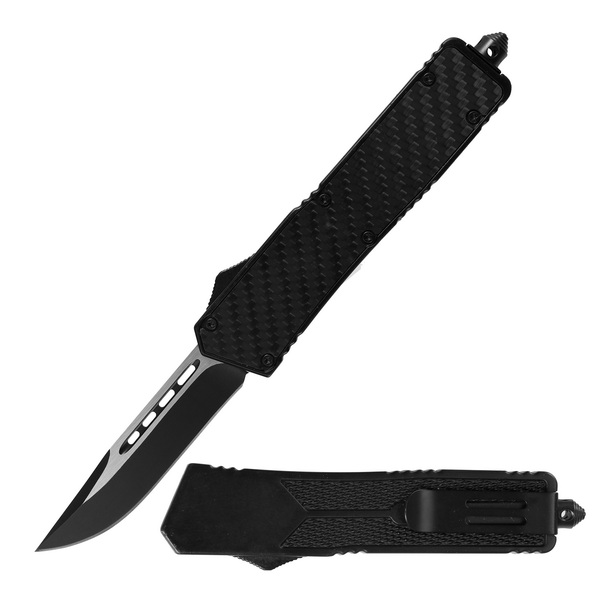
Blades are typically cut from sheets of high‑performance stainless steel, initially oversized to allow for subsequent grinding and finishing steps. Rough grinding establishes the approximate blade profile, followed by heat treatment that hardens the steel while retaining toughness for impact and lateral stresses.[3][2][5]
Once hardened, blades go through precision grinding to refine thickness, bevel geometry, and tip symmetry, followed by optional stonewashing or coating processes. Many Tactical OTF Knives Manufacturers and Suppliers add laser‑etched logos or markings at this stage before final hand sharpening for maximum cutting performance.[2][5]
Key internal parts such as springs, firing plates, sliders, and locking lugs are machined from stainless steel or spring steels and then deburred and polished for low‑friction operation. During assembly, technicians carefully fit blades, handles, and internal components, often checking function after each major step to ensure consistent deployment force and lock‑up.[6][5][2]
Final inspection typically includes multiple deployment and retraction cycles, safety checks, and edge sharpness testing. This rigorous process helps ensure that tactical OTF knives from established manufacturers meet the expectations of professional users who cannot tolerate mechanical failure in the field.[3][5]
For foreign brands, wholesalers, and knife companies, one of the main reasons to work with Spanish Tactical OTF Knives Manufacturers and Suppliers is the wide range of OEM and private‑label services. These services allow clients to customize virtually every aspect of the product while leveraging the factory's engineering and manufacturing experience.[1][5]
Typical customization options include blade steel selection, blade shape and grind, handle color and texture, logo placement, serial numbering, and packaging design. Factories can also support different price tiers by varying materials, surface finishes, and accessory packages, enabling brands to target budget, mid‑range, or premium tactical segments with distinct models.[5]
Because OTF knives are often classed as automatic or switchblade knives, regulations vary widely among countries and even within regions. Many jurisdictions impose limits on blade length, restrict automatic deployment mechanisms, or differentiate between professional and civilian use.[6][5]
Importers and brands sourcing from Spain must therefore carefully research destination‑market rules and secure any required permits or declarations before shipping. Established Tactical OTF Knives Manufacturers and Suppliers usually have export experience and can assist with documentation, labeling, and compliance advice, but the buyer remains responsible for following local law.[5]
The tactical OTF market continues to evolve as materials science and machining technology advance. Several notable trends are shaping product development in Spain and across Europe:[3][5]
- Lighter but stronger constructions: Increased use of titanium frames, carbon‑fiber overlays, and G10 scales reduces carry weight without compromising rigidity.[5]
- Higher‑performance steels: Steels like M390, S35VN, and similar alloys deliver improved edge retention, supporting demanding tactical and outdoor usage.[3][5]
- Refined double‑action mechanisms: Manufacturers focus on smoother sliding action, reduced internal wear, and improved reliability under dust, mud, or temperature swings.[2][5]
- Limited editions and personalization: Collectors and enthusiasts drive demand for unique colorways, laser‑engraved artwork, numbered runs, and custom accessories.[3][5]
These directions give both Spanish producers and their Chinese OEM partners opportunities to launch differentiated lines that serve professional users and collectors simultaneously.[1][5]
For brands and wholesalers, selecting the right manufacturing partner is critical to long‑term success in the tactical knife market. Beyond product samples, several strategic factors should guide the decision:[1][5]
1. Engineering capability: Check whether the manufacturer has experience with double‑action OTF mechanisms and can hold the required tolerances during machining and assembly.[2][5]
2. Material traceability: Reliable Tactical OTF Knives Manufacturers and Suppliers provide documentation on steel grades, heat treatment processes, and coating specifications.[5]
3. Quality‑control system: Look for multi‑stage inspection, functional testing, and recognized quality frameworks such as ISO‑based systems.[5]
4. OEM confidentiality: Ensure that your designs, logos, and specifications are protected through NDAs and controlled data handling.[5]
5. Logistics and after‑sales support: An experienced exporter can coordinate shipping, customs paperwork, and warranty or replacement service.[5]
Taking time to evaluate these points helps buyers build stable partnerships and avoid costly product failures or compliance issues later in the business cycle.[1][5]
Spanish tactical OTF knives occupy a strategic position between high‑priced boutique brands and low‑cost commodity products. With European‑level craftsmanship and the option to integrate Chinese OEM production where appropriate, Spanish suppliers can deliver strong value in both mid‑range and premium segments.[1][5]
For foreign brands, this means the ability to market knives that combine recognizable European quality cues with competitive pricing and wide customization flexibility. In a market where buyers research materials, mechanisms, and origin more than ever, this combination can be an important differentiator.[3][5]
Spain's knife industry, supported by both local expertise and international OEM connections, has transformed into a key source for tactical OTF products. Modern Tactical OTF Knives Manufacturers and Suppliers in Spain blend traditional blade knowledge with advanced CNC machining, high‑performance steels, and stringent quality‑control systems to satisfy the needs of professionals, enthusiasts, and brands worldwide.[3][1][5]
For overseas companies looking to launch or expand tactical knife lines, Spanish factories — often working closely with specialized Chinese OEM partners — offer a powerful combination of reliability, customization, and regulatory experience. By carefully selecting a partner with proven engineering capability, documented materials, and strong OEM support, buyers can bring competitive, high‑performance tactical OTF knives to demanding markets with confidence.[1][5]
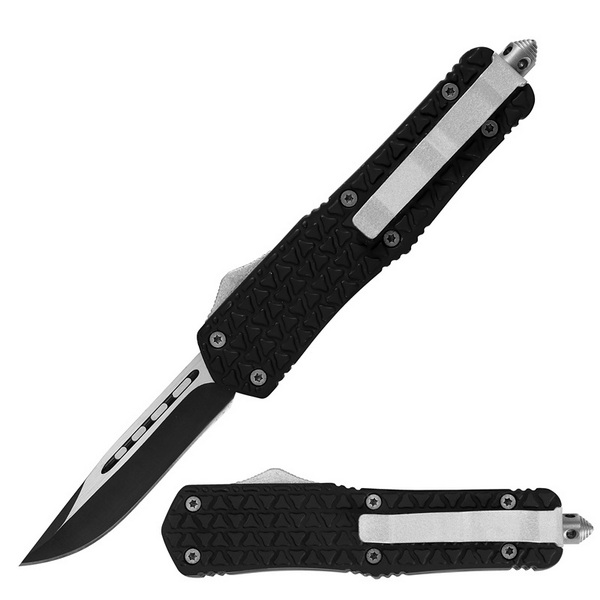
A: Spanish tactical OTF knives unite long‑standing European craftsmanship with modern machining and quality systems, providing reliable performance and strong brand value at competitive prices.[1][5]
A: Yes, many Spanish and Spain‑connected suppliers offer full OEM services, including custom blade steels, handle designs, finishes, logos, and packaging tailored to foreign brand requirements.[1][5]
A: Extremely important; internal channels, springs, and blade shoulders must be machined within very tight tolerances to ensure smooth deployment and secure lock‑up over thousands of cycles.[2][5]
A: Popular choices include D2, M390, S35VN, and 154CM, which provide a mix of hardness, edge retention, and corrosion resistance suitable for hard‑use environments.[3][5]
A: Many countries regulate or restrict automatic knives, including OTF models, so importers must research local laws on blade length, mechanism type, and permitted users before placing orders.[6][5]
[1](https://www.58hrcknives.com/top-otf-knife-manufacturers-and-suppliers-in-spain.html)
[2](https://www.youtube.com/watch?v=EwG2oytZCl8)
[3](https://bladeops.com/blog/the-history-of-otf-knives-from-military-tool-to-everyday-essential/)
[4](https://www.youtube.com/watch?v=lojT2LuLPxY)
[5](https://www.58hrcknives.com/top-automatic-otf-knife-manufacturers-and-suppliers-in-europe.html)
[6](https://nobliecustomknives.com/what-is-an-otf-knife-and-how-does-an-otf-knife-work/)
[7](https://www.youtube.com/watch?v=dkaA4wZeLdQ)
[8](https://www.tacticalsportinggoods.com/blogs/news/ultimate-guide-to-the-top-10-otf-knives-of-2025-features-reviews-and-recommendations)
[9](https://www.youtube.com/watch?v=T2xd9RlRUQU)
[10](https://infinityknifeco.com)


