
Views: 222 Author: Leah Publish Time: 2025-11-02 Origin: Site


Content Menu
● 1: Core Tactical Qualities of OTF Knives
● 2: OEM Design Considerations and Best Practices
>> Blade material and geometry:
>> Deployment mechanism and action type:
>> Manufacturing controls and QA:
● 3: Real-World Performance and Perception
>> Deployment speed as a tactical force multiplier:
>> Predictable behavior under adverse conditions:
>> The “tactical” aesthetic and its influence:
● 4: Materials, Mechanisms, and Field Benchmarks
>> Mechanism reliability under load:
>> Ergonomics and safety in practice:
● 5: Competitive Context and Market Positioning
>> OTF vs traditional folding knives:
>> Positioning for global markets:
● 6: Safety, Ethics, and Compliance
● 7: Case Studies and OEM Guidance
>> Case example 1: Deployment force tuning and enhanced locking:
>> Case example 2: Grip and coating enhancements:
>> 8: Marketing, SEO, and Global Reach
● FAQ
>> 1. What are the main advantages of using a tactical OTF knife over other types of knives?
>> 2. How does one-handed deployment enhance effectiveness in high-pressure scenarios?
>> 3. What distinguishes double-action mechanisms from single-action ones in OTF knives?
>> 4. Which materials and finishes are most important for field durability?
>> 5. What legal considerations should OEMs address when exporting OTF knives?
In the world of outdoor and tactical tooling, Out-The-Front (OTF) knives occupy a distinctive niche. A truly tactical OTF knife is more than a compact cutting tool; it is a purpose-built system designed for rapid deployment, dependable locking, ergonomic control, and enduring performance under demanding conditions. For OEM partners—foreign brands, wholesalers, and manufacturers—crafting a truly tactical OTF knife means balancing speed, safety, durability, and regulatory compliance across global markets. This article delves into the defining features, engineering considerations, and practical use cases that separate top-tier Tactical OTF Knives from ordinary knife offerings. It also provides guidance for product development, quality assurance, and end-user education that resonate with professional operators and discerning buyers. Visuals and demonstrations are referenced to illustrate concepts, while staying mindful of licensing and safety requirements.[2][11]
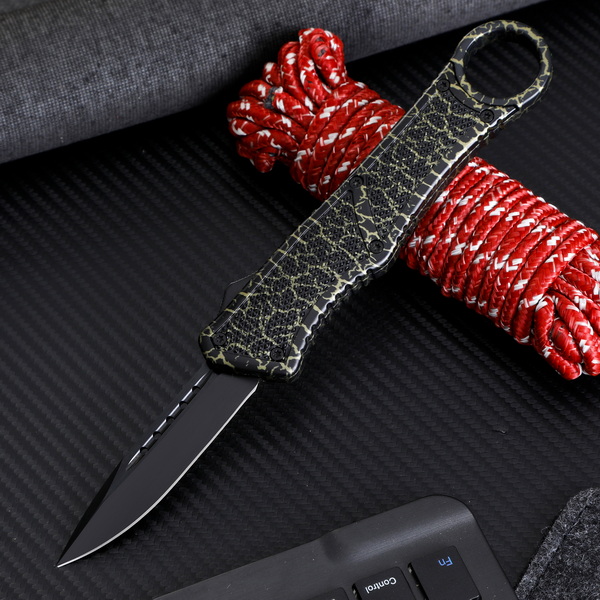
- Rapid, reliable deployment: The hallmark of a tactical OTF knife is immediate blade exposure with a clearly defined action. Deployment mechanisms are engineered to minimize travel time from concealment to ready status, enabling one-handed operation in high-stress situations. For OEM teams, this means selecting a mechanism with well-controlled travel, predictable stop points, and robust tolerances.[11]
- Safe, secure retraction and locking: A dependable lock prevents accidental closure or blade rebound, even when subjected to impact, vibration, or exposure to dust and moisture. Redundancies—such as secondary safeties or cross-locking elements—enhance field reliability. For users, a confident tactile and audible confirmation of lock engagement reinforces safety in critical moments.[11]
- Ergonomic control under demanding conditions: Textured scales, contoured grips, and balanced weight distribution improve retention and reduce fatigue during extended use. In wet, muddy, or cold environments, grip integrity remains a priority, influencing material choices and surface finishes.[11]
- Durability and field resilience: Tactical OTF knives must withstand daily carry, tactical assignments, and emergency scenarios. This includes corrosion resistance, abrasion resistance, and effective sealing from grit ingress, all of which contribute to long service life and predictable performance.[11]
- Practical versatility: In real-world operations, the knife should support a range of tasks—from rope and fabric manipulation to cutting through packaging or harnesses—without compromising safety or blade integrity. This versatility is a key driver for end-user satisfaction and repeat OEM orders.[11]
- Material selection (e.g., stainless steel grades, carbon content, and heat treatment) affects edge retention, corrosion resistance, and ease of sharpening in the field. Blade geometry should match intended tasks, with options for straight-edged, partially serrated, or full-serrated profiles as appropriate for specific markets.[11]
- Double-action systems allow both deployment and retraction with a single control, enabling faster cycles and reduced cognitive load in urgent scenarios. Single-action variants may appeal to users who prefer manual retraction or a particular tactile feel, but often require more deliberate handling during repeated use.[2][11]
- Multi-layered safety features—such as chain-locks, blade stops, and obstructed-path protection—mitigate unintended deployment and contribute to user confidence in dynamic environments. Clear feedback (visual or tactile) about engagement status supports safe operation.[11]
- Handle materials (aluminum, polymer composites, or feature-rich composites) influence grip security and durability. Texturing, finger grooves, and weight distribution should be designed to perform under moisture, sweat, and cold. Finishes (matte, non-reflective coatings) reduce glare and enhance concealability where required.[11]
- Tight tolerances around the deployment axis, locking interface, and blade seating ensure consistency across production lots. Rigorous testing—cycle testing, grit ingress simulations, impact/temperature exposure—helps validate performance and lowers after-sales issues. Documented QA procedures and traceability support global compliance.[2][11]
- In high-pressure environments, the ability to access a blade in a fraction of a second can influence outcomes in restraint release, escape, or tool-path clearance. The deployment mechanism should remain crisp, repeatable, and free of hitch or delay after repeated cycles.[11]
- Operators expect consistent deployment force and lock reliability regardless of dust, mud, or temperature. OEMs must validate performance across environmental envelopes representative of target markets.[11]
- Beyond function, a knife's visual and tactile presence communicates capability. Subdued finishes, protected actuation surfaces, and ergonomic silhouettes contribute to perceived performance. OEMs should align styling with end-use expectations while maintaining discretion where required by law.[11]
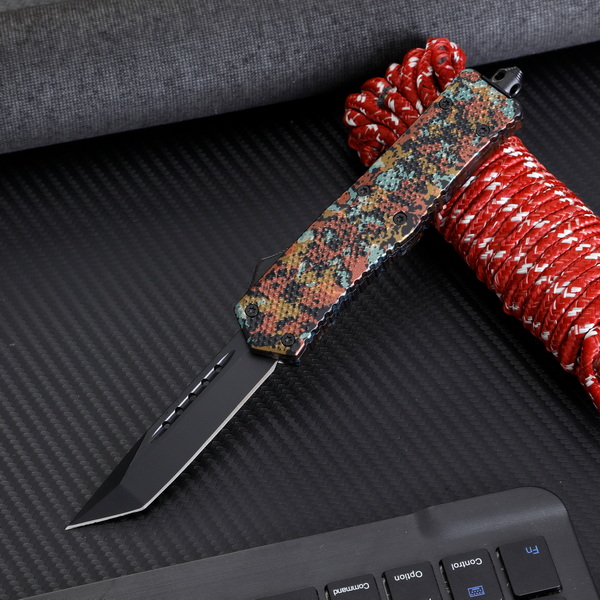
- High-performance stainless steels or tool steels with solid edge stability and corrosion resistance are commonly chosen. Coatings that reduce glare and improve wear resistance can extend service life in challenging environments.[11]
- Double-action implementations must manage blade travel, spring force, and tolerances to avoid unintended deployment or sluggish retraction. Reliability is often proven through accelerated life testing and field simulations.[2][11]
- Properly contoured handles and secure safeties provide control in one-handed operations. Safety features should be intuitive, durable, and ophthalmically inspectable to support quick verification in the field.[11]
- OTF knives provide faster, one-handed deployment with a straightforward activation path, which can be advantageous in tight spaces or multitasking scenarios. However, they require careful design to maintain safety and ensure consistent performance across conditions.[11]
- OEMs must navigate regulatory landscapes that vary by country, including blade length, automatic-opening classifications, and labeling requirements. Clear documentation and compliant marketing messages help minimize export risks and support brand integrity.[11]
- Different jurisdictions treat automatic or assisted-opening knives differently. Building in compliance checks, offering usage guidance, and educating distributors helps avert noncompliant sales or misuse.[11]
- Marketing should emphasize safe handling, appropriate contexts for use, and legal compliance. Transparent warning labels and material safety data support responsible consumer behavior.[11]
- An OEM partner refined deployment force and strengthened lock engagement to withstand extensive field cycles, resulting in higher reliability and reduced service returns. This illustrates the impact of iterative mechanical tuning on field performance.[11]
- A tactical line updated blade coatings and added deeper finger grooves to improve grip in wet conditions, correlating with higher user satisfaction and trial success. Such refinements show how subtle changes can influence real-world usability.[11]
- Ensure consistent deployment across lots through robust QA for lockup and blade seating.
- Invest in material science for coatings and handle textures that retain grip in rain, mud, or sweat.
- Provide precise, legally compliant labeling and usage guidance for global markets.[2][11]
- Tactical OTF Knives, What makes an OTF knife tactical, Deployment speed, One-handed operation, Locking mechanism, Durability and reliability, OEM knife manufacturing, Compliance, High-performance blade steel.
- Maintain a precise, professional tone appropriate for B2B audiences, balancing technical depth with accessible explanations. Include semantic variants to support SEO without sacrificing readability.[11]
A truly tactical OTF knife achieves a careful equilibrium of instant deployment, secure locking, ergonomic handling, and rugged durability. For OEM partners, the challenge is translating speed into dependable performance while complying with diverse regulatory requirements and safeguarding user safety. By focusing on deployment precision, material science, rigorous quality control, and clear end-user guidance, manufacturers can deliver Tactical OTF Knives that meet the exacting needs of professional operators and earn trust across international markets.[2][11]
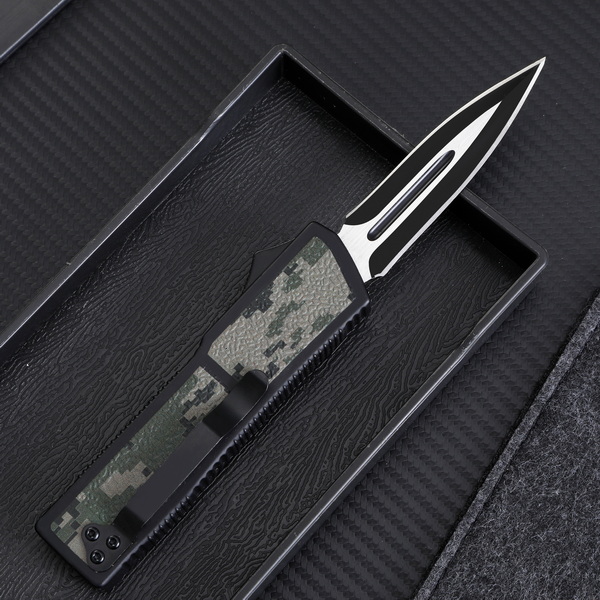
Tactical OTF knives offer rapid one-handed blade deployment, secure locking, and compact, high-strength construction suitable for urgent tasks in constrained spaces.
One-handed deployment allows the operator to keep the other hand free for stabilization, securing gear, or performing secondary tasks, accelerating response time in critical moments.
Double-action mechanisms enable both deployment and retraction with a single control, delivering faster cycling and simpler handling under stress; single-action models typically require manual retraction.
High-performance blade steels with good edge retention and corrosion resistance, combined with grippy, contour-hugging handle materials and non-glare finishes, are key for field durability in adverse conditions.
OEMs should assess local and national regulations on automatic-opening blades, ensure accurate product labeling, provide compliance documentation, and educate distributors to prevent noncompliant sales or use.
[1](https://ravencresttactical.com/product-category/otf-knives/)
[2](https://bladeops.com/blog/the-advantages-and-disadvantages-of-otf-knives-in-tactical-settings/)
[3](https://conquesttactical.com/knife-specifications/)
[4](https://www.benchmade.com/products/3300bk)
[5](https://www.budk.com/USA-Tactical-Black-OTF-Automatic-Knife-And-Belt-Sh-51255/51255.html)
[6](https://www.trueswords.com/Armed-Force-Tactical-Black-Automatic-OTF-Knife-And-51800/51800.html)
[7](https://www.kennesawcutlery.com/Armed-Force-Tactical-Non-Reflective-Automatic-OTF--51801/51801.html)
[8](https://knife-depot.com/blogs/sharpened-values/otf-knives-explained-the-complete-guide)
[9](https://cobratecknives.com/product/special-purpose/utility-knives/otf-utility-knife/)
[10](https://sharg.pl/product-eng-117925-Dulotec-OTF-Knife-Aluminium-Carbon-Fiber-Two-Tone-Finish-3Cr13MoV-K183A.html)
[11](https://bladeops.com/blog/pros-and-cons-of-otf-knives-for-tactical-operations/)


