
Views: 222 Author: Leah Publish Time: 2025-11-27 Origin: Site


Content Menu
● Understanding the Automatic OTF Knife
● Internal Mechanism and Engineering
● Blade Steel and Heat Treatment
● Blade Geometry: Profile, Grind, and Thickness
● Surface Finishes and Corrosion Resistance
● Handle Materials and Structural Design
● Double‑Action Performance and Lockup
● Durability, Testing, and Real‑World Reliability
● Maintenance and Long‑Term Care
● OEM Perspective: Building a High‑Quality Automatic OTF Knife Line
● Matching Automatic OTF Knife Features to End‑Use Scenarios
● FAQ
>> 1. What is the main advantage of an Automatic OTF Knife over a traditional folding knife?
>> 2. Is a small amount of blade play normal on an Automatic OTF Knife?
>> 3. How often should an Automatic OTF Knife be cleaned and lubricated?
>> 4. Are Automatic OTF Knives suitable for heavy outdoor work?
>> 5. What should a brand check before choosing an OEM factory for Automatic OTF Knives?
A high‑quality Automatic OTF Knife combines precise internal mechanics, premium materials, strict quality control, and user‑focused ergonomics. When these elements are engineered as a complete system, the Automatic OTF Knife becomes a fast, reliable, and safe cutting tool for professional outdoor and tactical use.
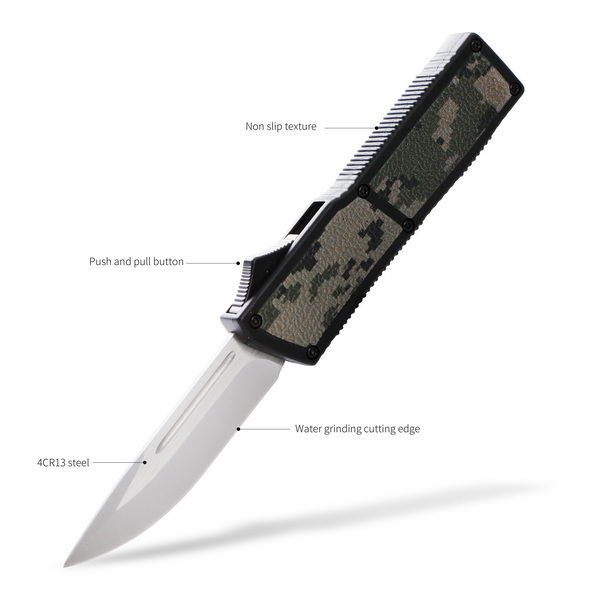
An Automatic OTF Knife (Out‑The‑Front knife) is a type of automatic knife where the blade travels straight out of the front of the handle rather than pivoting from the side. Unlike traditional folders, which rotate around a pivot, the Automatic OTF Knife relies on a linear track mechanism to guide the blade during deployment and retraction.
Most modern high‑quality designs use a double‑action system: the same switch or slider both fires the blade open and pulls it back into the handle. This gives the Automatic OTF Knife true one‑hand operation, making it ideal for military, law‑enforcement, rescue teams, and serious outdoor users.
Inside every Automatic OTF Knife is a compact but sophisticated mechanism that determines how smoothly, safely, and consistently the blade moves. The core parts usually include the blade, a spring or dual‑spring system, a sliding carrier or firing plate, locking gates or latches, and the external switch or button.
In a double‑action Automatic OTF Knife, pushing the switch in one direction compresses and then releases stored spring energy, propelling the blade forward along its track until a locking gate captures it in the open position. Pulling the switch in the opposite direction reverses the process, driving the blade back into the handle and locking it safely closed. The reliability of this sequence depends on precise tolerances, clean machining, and carefully tuned spring strength.
For a professional‑grade Automatic OTF Knife, blade steel choice is one of the most important quality indicators. Entry‑level knives may use simple stainless steels that are easy to produce but require frequent sharpening and offer only moderate corrosion resistance. High‑end OTF manufacturers favor higher‑grade stainless or powder metallurgy steels that balance hardness, toughness, and edge retention.
Equally critical is the heat‑treatment process, which sets the final hardness and toughness of the blade. Properly heat‑treated premium steel allows an Automatic OTF Knife to take a fine, durable edge that resists chipping under impact and maintains sharpness through repeated outdoor and tactical use. Inconsistent heat treatment, by contrast, results in blades that roll, chip, or wear too quickly no matter how impressive the raw steel specification looks on paper.
Beyond the type of steel, the shape and geometry of the blade strongly influence how a high‑quality Automatic OTF Knife performs. Spear‑point and drop‑point profiles are especially popular for OTF designs because they combine strong piercing tips with enough belly for efficient slicing. Tanto and dagger profiles are also common where deep penetration and tactical aesthetics are priorities.
A uniform primary grind and a consistent secondary bevel are signs of careful production. Poorly ground blades may feel sharp at first but cut inefficiently and sharpen unevenly. Thickness must also match the intended task: a stout, thicker blade spine is better for heavier prying and impact work, while a thinner profile slices more cleanly and passes through material with less resistance. A serious Automatic OTF Knife line usually offers multiple blade profiles and thickness options to match different end‑use scenarios.
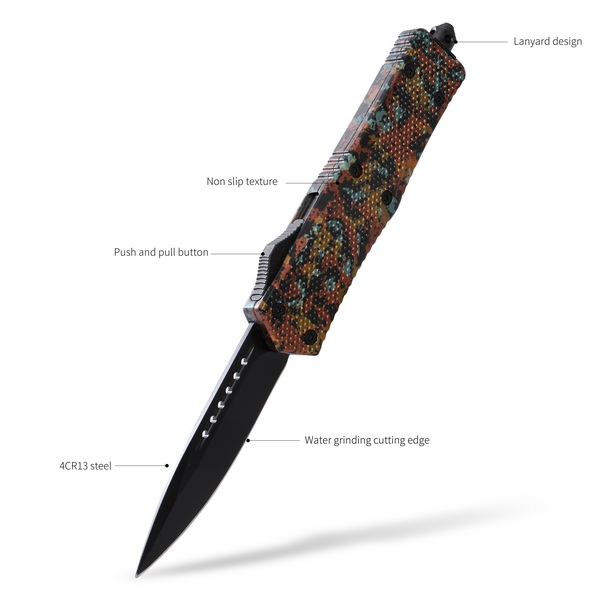
Surface finish is more than cosmetic; it affects corrosion resistance, wear appearance, and maintenance. Stonewashed and satin finishes tend to hide scratches and abrasions, which is useful for Automatic OTF Knives used in harsh field conditions. Coated blades—such as black or non‑reflective finishes—add extra corrosion protection and reduce glare, which can be important in tactical or hunting environments.
A high‑quality Automatic OTF Knife blade finish should appear even, with no bare patches, heavy drips, or cloudy areas. A consistent finish signals that the manufacturer controlled each step of grinding, polishing, and coating, which usually correlates with better overall production discipline.
The handle of an Automatic OTF Knife is both the user's interface and the structural housing for the mechanism. It must provide a comfortable, secure grip while also protecting the internal components from shock, moisture, and contamination. Common high‑end handle materials include:
- Aircraft‑grade aluminum alloys for a strong yet lightweight chassis
- Reinforced polymers or composites for impact resistance and thermal stability
- Textured rubber or inlays to enhance traction and comfort
A quality Automatic OTF Knife handle features precise machining, rounded or chamfered edges to avoid hot spots, and well‑placed texturing or inlays. The handle is usually assembled from two halves that enclose the mechanism; when well made, the seam is tight and even, with no sharp ridges or gaps. Internal structural ribs or steel inserts may be added to strengthen the frame and maintain rigidity under heavy use.
No matter how advanced the mechanism is, an Automatic OTF Knife must feel natural in the user's hand. Good ergonomics ensure that the knife remains controllable during rapid deployment, powerful cuts, and awkward grip angles. Key ergonomic signs of quality include:
- A thumb slide or button positioned where it can be actuated without shifting grip dramatically
- A handle contour that fits the natural curve of the hand, avoiding pressure points
- Adequate jimping or texturing in high‑pressure areas for non‑slip control
A high‑quality Automatic OTF Knife should allow confident opening and closing even when the user is wearing gloves or has wet, cold hands. Carefully tuned switch resistance—firm but not excessively stiff—is a subtle but important sign of refined design.
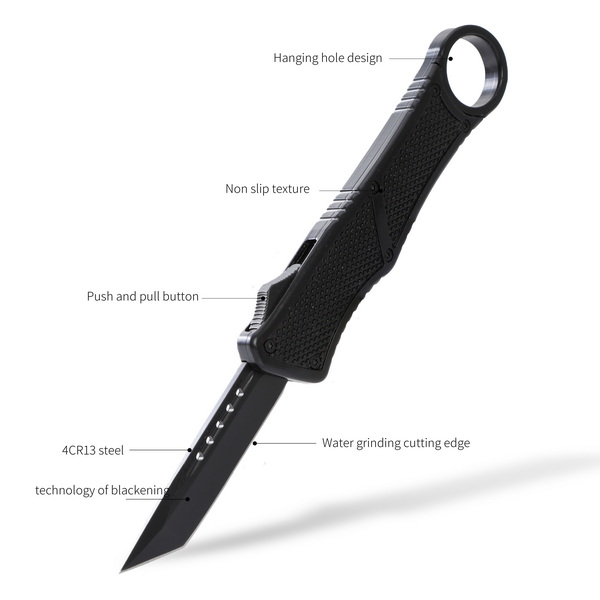
The hallmark of a premium Automatic OTF Knife is crisp, confident double‑action performance. When the switch is pressed, the blade should launch smoothly, without grinding or hesitating, and should lock firmly with an audible, consistent “click.” Retraction should feel just as positive and controlled.
Some minor movement of the blade in the open position is typical for OTF mechanisms, since the blade rides on internal rails rather than a single pivot. However, excessive rattle or visible wobble indicates poor tolerances or worn internal parts. A high‑quality Automatic OTF Knife finds the right compromise: enough clearance for reliable cycling under dust and grit, but tight enough to feel solid and trustworthy in actual cutting tasks.
Safety is a major concern for any Automatic OTF Knife, especially in professional and tactical environments. Quality designs integrate multiple safety layers:
- Internal geometry that prevents the blade from fully locking if it hits an obstruction during firing, reducing the risk of penetrating soft targets like hands or clothing
- Switch resistance or detents that require deliberate pressure before the mechanism engages
- In some models, an external safety switch that can lock the firing control in the “off” position
In a well‑designed double‑action Automatic OTF Knife, the spring typically “slings” the blade with momentum. If something blocks the path, the loss of momentum stops the blade before lockup, and the user can reset it by pulling the blade fully to its locked position. This behavior is a built‑in functional safety aspect that separates serious designs from low‑end gimmicks.
Fit and finish tell an experienced buyer almost everything about the real quality level of an Automatic OTF Knife. Points to examine include:
- Evenness and quality of anodizing, coating, or polishing on the handle and blade
- The way screws sit (flush or appropriately recessed, not crooked or over‑driven)
- Alignment of the blade within the handle channel when closed
- Sound and feel of the switch sliding along its track
A high‑quality Automatic OTF Knife feels like a single, solid object rather than a loose assembly of parts. When shaken gently, it should not rattle excessively. When the blade is extended, the transition between handle and tang should look precise and stable, with no obvious gaps that could collect dirt or compromise strength.
Durability is where advanced engineering and strict quality control really show their value. A serious manufacturer will design Automatic OTF Knife mechanisms to cycle thousands of times without significant loss of power, lockup strength, or switch integrity. This involves:
- Selecting springs that maintain tension over long periods of compression and repeated firing
- Using robust internal components, often CNC‑machined, to withstand wear and impact
- Testing finished knives through extensive deployment cycles and real‑world cutting tasks
In actual field use, a high‑quality Automatic OTF Knife remains reliable even when exposed to dust, pocket lint, sweat, rain, and temperature swings. Robust design and proper material selection help prevent corrosion, spring fatigue, and handle distortion that might otherwise lead to misfires or mechanical failure.
Even the best Automatic OTF Knife will benefit from simple maintenance. Owners should periodically:
- Wipe the blade clean after use, especially after cutting corrosive materials
- Lightly lubricate moving parts with suitable oil or dry‑film lubricant
- Avoid heavy over‑lubrication, which can attract dust and grit into the mechanism
Many users are tempted to disassemble their Automatic OTF Knife; however, unnecessary disassembly can damage small internal parts or void warranties. A factory that focuses on professional‑grade OTF knives will often provide clear maintenance instructions, and may offer factory service or refurbishment for heavily used or abused knives.
For overseas brands, wholesalers, and manufacturers, choosing the right OEM partner is essential to building a competitive Automatic OTF Knife portfolio. An experienced Chinese outdoor knife factory can provide:
- Engineering input on blade profiles, steels, and heat treatment for different market levels
- Custom handle designs, textures, color schemes, and branding (logos, laser engraving, packaging)
- Mechanism tuning for different user groups (e.g., lighter switch for EDC, firmer for tactical)
A professional OEM supplier of Automatic OTF Knives will run structured quality control at each stage: incoming material inspection, in‑process checks during machining and assembly, and 100% functional testing of deployment and retraction. This ensures that every knife leaving the factory meets the target brand's reliability and safety expectations in real‑world use.
Different users value different aspects of an Automatic OTF Knife, and high‑quality designs are tailored accordingly:
- EDC and urban users focus on moderate blade length, low weight, discreet profiles, and smooth, clean double‑action for frequent light cutting tasks.
- Outdoor and hunting users need stronger tips, corrosion‑resistant steels, and grippy handles that remain secure in mud, blood, or rain.
- Tactical and duty users prioritize maximum reliability, secure lockup, glove‑friendly controls, and non‑reflective finishes.
By aligning blade shape, steel, handle material, and mechanism tuning with the target application, an OEM factory can create Automatic OTF Knife models that feel “purpose built,” rather than generic. This fine matching of design and use is a defining trait of high‑quality OTF manufacturing.
A genuine high‑quality Automatic OTF Knife is far more than a flashy automatic blade. It is a carefully engineered tool where blade steel, geometry, handle design, internal mechanism, and safety systems all work together to deliver fast, consistent, and secure performance. When supported by strict quality control, rigorous mechanical testing, and clear maintenance guidance, the Automatic OTF Knife becomes a trusted companion for everyday carry, demanding outdoor work, and professional tactical use. For brands and wholesalers, partnering with an experienced OEM factory that understands every technical detail of Automatic OTF Knife design is the most effective way to build a strong, reliable product line in this competitive segment.
The main advantage is speed and convenience: an Automatic OTF Knife deploys and retracts the blade in a straight line using a single switch, allowing true one‑hand operation in confined spaces or under stress. Traditional folders can be very strong, but they usually require more hand movement and may not be as fast or intuitive in tactical or rescue situations.
Yes. Because the blade rides along a channel instead of pivoting around a single hinge, a slight amount of movement in the open position is normal and even helpful in preventing binding. However, a high‑quality Automatic OTF Knife will keep this movement minimal and controlled so that the knife still feels solid and secure during cutting.
Cleaning frequency depends on use conditions, but regular users should at least wipe and lightly lubricate an Automatic OTF Knife every few weeks, or after exposure to dirt, sand, moisture, or sticky materials. The goal is to remove debris from the blade and handle openings while applying just enough lubricant to keep the spring and sliding parts running smoothly without attracting excessive grit.
High‑quality Automatic OTF Knives with robust steels, strong tips, and well‑tested mechanisms can handle many demanding outdoor cutting tasks. However, they are still precision mechanical tools, so extremely abusive prying or hammering is better left to fixed blades or dedicated tools. When used as intended—for cutting, slicing, and controlled piercing—a well‑designed Automatic OTF Knife is very effective in outdoor and survival kits.
A brand should evaluate the factory's engineering experience with Automatic OTF Knife mechanisms, its blade steel sourcing and heat‑treatment capabilities, the precision of its machining, and the structure of its quality‑control process. Sample testing, clear communication, and the ability to customize designs for different price levels and markets are also key signs that the OEM partner can support a long‑term Automatic OTF Knife program.
[1](https://www.sogknives.com/pentagon-otf-black/)
[2](https://www.benchmade.com/products/5370fe-shootout-otf)
[3](https://tacknivesusa.com/product/tacknives-automatic-otf-knife-mlt7-series/)
[4](https://cobratecknives.com/product/special-purpose/utility-knives/otf-utility-knife/)
[5](https://uppercuttactical.com/blogs/news/how-does-an-otf-knife-work)
[6](https://www.trueswords.com/Armed-Force-Tactical-Non-Reflective-Automatic-OTF--51801/51801.html)
[7](https://eknives.com/blog/5-characteristics-to-consider-automatic-knives/)
[8](https://www.budk.com/Bushmaster-Mamba-Automatic-OTF-Knife-Stainless-Ste-50276/50276.html)
[9](https://swordsswords.com/blog/essential-facts-to-know-before-purchasing-an-otf-automatic-knife/)


