
Views: 222 Author: Loretta Publish Time: 2025-10-09 Origin: Site


Content Menu
● Understanding OTF Knives: Definition and Functionality
● Single-Action vs Double-Action OTF Knives
● Market Demand and Ideal Customer Profiles
● Key Legal Considerations Retailers Must Understand
● Quality and Manufacturing: What to Look for in OTF Knives
>> Blade Steel
● Inventory and Stocking Strategies for Retailers
● Effective Marketing Approaches for OTF Knives
● FAQ about OTF Knives for Retailers
>> 1. What makes OTF knives different from regular folding knives?
>> 2. Are there legal restrictions I should be aware of before selling OTF knives?
>> 3. Should I stock single-action or double-action OTF knives?
>> 4. How important is the quality of the blade steel?
>> 5. How can I ensure I am sourcing the best OTF knives for my store?
In recent years, OTF knives have surged in popularity among collectors, outdoor enthusiasts, tactical professionals, and everyday users worldwide. As a retailer aiming to expand or diversify your product offerings, understanding the unique characteristics, legal considerations, quality factors, and market demands associated with OTF knives is essential before adding them to your inventory. This comprehensive guide will equip you with the knowledge necessary to make well-informed decisions, help you choose the right products, and optimize your sales potential in this niche market.
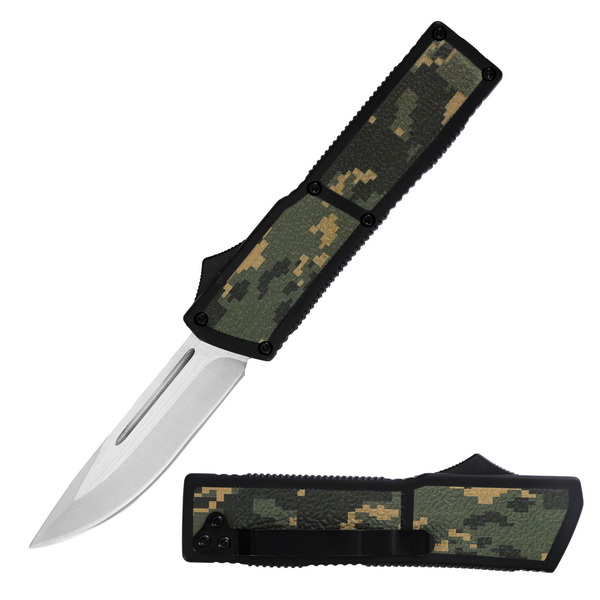
An OTF Knife (Out-The-Front knife) is a specialized type of folding knife distinguished by its blade deployment method. Instead of folding out from the side of the handle like a traditional folding knife, an OTF knife's blade slides straight out of the front end of the handle through a dedicated slot. This mechanism allows for rapid, one-handed opening and often quick retraction, enhancing usability in dynamic or tactical situations.
The blade is typically spring-assisted or spring-loaded, activated by a switch or slider on the handle.
OTF knives generally come in two varieties based on their blade operation:
- Single-Action OTF Knives: These models deploy the blade automatically with a flip of the switch but require the user to manually retract the blade back into the handle. They are simpler mechanically and often preferred by those who need quick deployment but don't require instant blade retraction.
- Double-Action OTF Knives: Featuring a more complex mechanism, double-action models allow both deployment and retraction of the blade via a single switch or slider. This provides faster, more fluid operation and added convenience for tactical or everyday uses.
Retailers should consider stocking both types to address different customer preferences and use cases.
The growing interest in OTF knives reflects their versatile appeal. Retailers should target several key customer segments:
- Collectors and Knife Enthusiasts: OTF knives' innovative mechanisms and sleek designs attract collectors who value craftsmanship and uniqueness within their collections.
- Outdoor Enthusiasts: Campers, hikers, fishermen, and hunters appreciate the immediate accessibility and reliability of OTF knives for tasks ranging from food preparation to emergency situations.
- Tactical and Law Enforcement Users: Because of the need for rapid blade deployment in critical moments, police officers, security personnel, and military operators often prefer OTF knives for their ergonomic efficiency and one-handed operation.
- Everyday Users: Many users seek an easy-to-deploy knife for daily tasks such as opening packages, minor repairs, and self-defense.
Understanding exactly who your customers are will help you tailor your inventory in terms of blade length, design aesthetics, price point, and mechanism type.
One of the most critical factors impacting the sale of OTF knives is their legal status, which varies widely from one jurisdiction to another. Retailers must be diligent in learning and complying with local laws before stocking or selling OTF knives.
- United States: While federal law places some restrictions on automatic knives, many states have unique and sometimes more restrictive regulations specifically targeting OTF knives. For example, California and New York heavily restrict or outright prohibit sales, possession, or carrying of OTF knives. Retailers must consult state-specific laws and ensure they are not violating any regulations when shipping or selling to customers.
- Europe: European countries have a patchwork of knife laws. Some allow OTF knives with specific blade length restrictions and usage conditions, while others enforce complete bans on automatic knives, including OTF styles.
- Other Regions: In Asia, Australia, and other parts of the world, regulations tend to be more restrictive. Many countries classify automatic knives as controlled items requiring licenses or permits for sale and import.
For retailers, staying informed is paramount. Ignorance of laws can lead to fines, criminal charges, and damage to your business reputation.
The performance and durability of OTF knives depend heavily on the materials used and the precision of the manufacturing process. Partnering with manufacturers like Yangjiang Ruizhen Industry and Trade Co., Ltd., a China-based leader in producing high-quality OEM OTF knives, can ensure you provide superior products that meet customer expectations.
The blade's steel composition is fundamental to an OTF knife's sharpness, edge retention, corrosion resistance, and overall longevity. Popular high-performance steels include:
- VG-10: Known for excellent edge retention and corrosion resistance.
- 154CM: High-carbon stainless steel offering toughness and durability.
- D2: Tool steel prized for wear resistance.
- S35VN: Premium stainless steel for top-end knives.
Retailers should prioritize blades made from reputable steel types.
Handles not only influence the knife's durability but also its grip, weight, and aesthetics. Common premium materials include:
- Titanium: Lightweight, corrosion-resistant, and strong.
- Aluminum: Durable and often anodized for color and corrosion protection.
- G10: Composite fiber material known for excellent grip and toughness.
- Carbon Fiber: Lightweight with a high-tech look.
A smoothly operating spring mechanism built for thousands of deployment cycles is crucial. Look for knives with strong locking features to prevent accidental blade release. Also, ease of maintenance, such as simple disassembly for cleaning, can be a selling point.

For retailers wishing to add OTF knives to their inventory with successful turnover, consider these tips:
- Diversify product types: Stock multiple blade lengths (e.g., 2.5 inches to 4 inches), handle materials, and action types (single vs double action).
- Price range variety: Include budget-friendly options for casual users alongside premium knives for collectors and professionals.
- Partner with reliable OEM suppliers like Yangjiang Ruizhen for consistent quality and customized branding options.
- Seasonal planning: Demand may spike around holidays, hunting seasons, and outdoor event periods.
- Educate your sales team on operational features, safety, and legal issues around OTF knives to improve customer confidence.
Because OTF knives are a niche product, marketing them requires focused strategies:
- In-store demonstrations and videos: Show customers how quick and smooth OTF knife deployment can be, emphasizing safety and robustness.
- Feature highlights: Push benefits such as rapid blade deployment, reliability, high-quality materials, and legal compliance.
- Influencer partnerships: Collaborate with outdoor, tactical, or knife influencers on social media to reach specialized audiences.
- Content marketing: Blog articles, educational videos, and FAQ pages addressing common questions strengthen customer trust.
- Warranty and robust after-sales service: This encourages positive reviews and repeat business.
Introducing OTF knives to your retail inventory can be a rewarding move, given their rising popularity and appeal across multiple consumer segments. However, it is vital to understand the intricate legal landscape, market preferences, and quality standards to avoid operational risks and ensure customer satisfaction. Working with experienced manufacturers such as Yangjiang Ruizhen Industry and Trade Co., Ltd., known for delivering reliable OEM OTF knives, lets you offer a diverse, high-quality product range that stands out in the competitive market. With the right knowledge and strategies, retailers can capitalize on this sophisticated product category while maintaining compliance and catering effectively to specialized customer needs.

An OTF knife deploys its blade straight out of the handle front via a sliding mechanism, enabling rapid one-handed use, unlike regular folding knives which open by pivoting the blade out from the side.
Yes. The legality of OTF knives varies widely by country, state, and local laws. Retailers must research and adhere to these regulations to avoid legal penalties and business risks.
Both have dedicated user bases: single-action knives are simpler and often more affordable, while double-action knives offer faster, fully automatic deployment and retraction.
Extremely important. High-quality blade steel determines sharpness retention, corrosion resistance, and overall knife longevity, all key factors for customer satisfaction.
Partner with reputable manufacturers with proven OEM experience like Yangjiang Ruizhen Industry and Trade Co., Ltd., request samples, and verify quality control processes before committing to bulk orders.


