
Views: 222 Author: Leah Publish Time: 2025-11-24 Origin: Site


Content Menu
● What Is an OTF Pocket Knife?
● Single-Edge vs Double-Edge: Basic Definitions
● Functional Differences in Real Use
>> Everyday Utility and Work Tasks
>> Tactical and Defensive Applications
● Legal and Regulatory Differences
● Edge Geometry, Grinds, and Blade Shapes
>> Common Single-Edge Profiles
>> Common Double-Edge Profiles
● Market Positioning for OEM and Wholesale
● How to Choose the Right Type
● FAQ
>> 1. Which is better for everyday carry: single-edge or double-edge OTF pocket knives?
>> 2. Are double-edge OTF pocket knives legal to carry?
>> 3. Do double-edge blades wear out faster than single-edge blades?
>> 4. What blade steel is recommended for OEM OTF pocket knife production?
>> 5. Can one handle design support both single-edge and double-edge OTF pocket knife blades?
Choosing between a single-edge and double-edge OTF pocket knife goes far beyond appearance. It affects safety, performance, legality, maintenance difficulty, and how your customers or end users will actually use the knife day after day. For brands, wholesalers, and OEM partners, understanding these differences is essential when planning new product lines or private label projects.
As a Chinese high-end outdoor knife manufacturer providing OEM service, positioning the right OTF Pocket Knife configuration for different regions and user groups can make a big difference in sales, regulations compliance, and brand reputation.
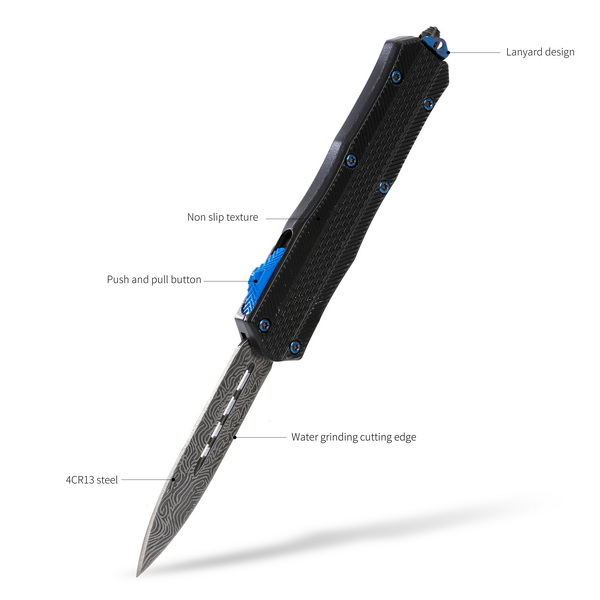
An OTF pocket knife (Out-The-Front knife) is an automatic knife where the blade moves in a straight line out of the front of the handle instead of swinging out from the side like a traditional folder. This linear deployment gives the knife its distinctive profile and fast, one-handed operation.[3][7]
Most OTF pocket knives use a spring-driven mechanism controlled by a button or sliding switch. Dual-action OTF models can both deploy and retract the blade with the same control, which makes them popular for EDC, tactical use, and rescue situations where speed is critical.[7][3]
Before comparing performance, it helps to clarify the blade concepts:
- Single-edge OTF pocket knife:
Only one side of the blade is sharpened. The back (spine) remains unsharpened and is usually thicker, giving additional strength and a safer surface for the thumb during controlled cuts.
- Double-edge OTF pocket knife:
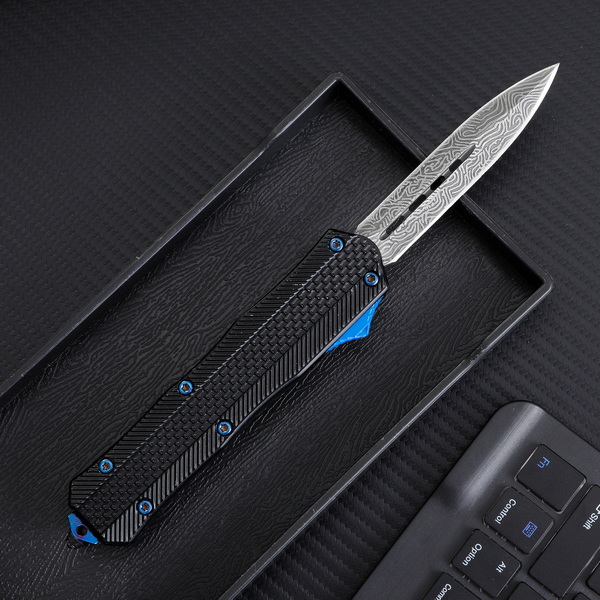
Both sides of the blade are sharpened, often in a symmetrical “dagger” or spear-point profile. This design maximizes piercing and cutting performance in both directions, with a central point designed for thrusting.[5][10]
For OEM designs, blade geometry and grind can be customized, but the key distinction always remains: one edge or two.
For daily cutting tasks—opening boxes, cutting straps, trimming cordage—a single-edge OTF pocket knife is usually more practical. The unsharpened spine gives the user a safe area to apply pressure, improving control for careful cuts.[3]
The single bevel also tends to behave more predictably when slicing, especially through dense materials. Many EDC-focused OTF pocket knife models use drop-point, clip-point, or tanto-style single edges because they balance strength, precision, and safety for non-tactical tasks.[8]
By contrast, a double-edge OTF pocket knife is optimized for penetration and fast cutting from multiple angles rather than delicate utility work. A spear-point double-edge blade excels in thrusting and quick, defensive cuts, which is why many tactical OTF pocket knives use this style.[10][3]
In tactical or law-enforcement environments, the user may value maximum penetration and the ability to cut in any direction without rotating the wrist. A double-edge OTF pocket knife with a symmetrical spear-point provides:[10][3]
- Dual cutting edges for forward and backward slashes
- A strong central point for piercing through thicker materials
- Balanced feel in the hand due to centered grind
Single-edge OTF pocket knives can still perform tactical roles, but they focus more on control, tip strength, and general utility. They are often preferred in mixed-use contexts where the same knife must handle both work tasks and potential emergency needs.
A single-edge OTF pocket knife is inherently safer for inexperienced users because there is a clearly defined “safe” side of the blade. The dull spine can be used to guide the cut, press against materials, or rest under the thumb, lowering the risk of accidental self-cutting during controlled work or cleaning.[3]
With a double-edge OTF pocket knife, any contact with the blade—from either side—can result in injury. When users choke up on the blade for fine work, they must be much more cautious, and maintenance tasks like wiping, oiling, or sharpening also carry more risk.
Modern OTF pocket knives often incorporate built-in safety features, such as:[7][8]
- Internal lock systems that keep the blade retracted in the pocket
- Mechanisms that cause the blade to “jump off track” or stop if it meets resistance during deployment
- Positive detent or safety switches that require deliberate force to operate
These features help prevent accidental deployment, but they do not eliminate the extra risk from a second sharpened edge on double-edge designs.
One of the biggest practical differences between single-edge and double-edge OTF pocket knives is legality. In many markets, double-edge blades, especially dagger-style profiles, fall under stricter regulations. Some regions prohibit civilian carry or import of double-edge automatic knives entirely, while allowing single-edge OTF pocket knives under specific length limits.[5][10]
When designing OEM OTF pocket knife lines for export, single-edge configurations often offer:
- Wider legal acceptance
- Easier customs clearance
- Fewer restrictions in retail distribution
Double-edge OTF pocket knives may still be attractive to specialized segments—collectors, military, or security buyers—but they usually require more careful market research and compliance checking in each destination country.
Single-edge OTF pocket knives frequently use shapes like:[8][3]
- Drop point – good balance of strength and slicing, ideal for EDC
- Clip point – finer tip for precision work while retaining a strong belly
- Tanto – reinforced tip for piercing and prying tasks
- Modified wharncliffe or sheepsfoot – excellent control in straight cuts
Grinds can be flat, hollow, or convex, depending on whether the focus is durability, slicing performance, or ease of sharpening.
Double-edge OTF pocket knives usually adopt:[10][3]
- Spear point / dagger profile – symmetrical taper to a central point
- Double hollow grind – very sharp, aggressive cutting edges on both sides
For OEM buyers, double-edge blades are visually striking and instantly recognizable in tactical marketing, but they require careful communication of legal usage and target audience.

The blade steel and handle materials play a major role in how any OTF pocket knife performs over time. Popular steels include:[9][8][3]
- D2 tool steel – high wear resistance and hardness; good for outdoor and tactical use
- AUS-8 / 8Cr13MoV – easier to sharpen, good balance for mid-range knives
- 440C stainless – corrosion resistance and decent edge retention
- M390 or CPM MagnaCut – premium steels with excellent edge holding and toughness in high-end OTF pocket knives
Handle materials for OTF designs are commonly aluminum alloys (such as 6061-T6) or advanced composites because they are strong yet light, and they can be precisely machined to house the internal rails, springs, and firing assemblies.[1][9]
From a blade-edge perspective:
- Single-edge blades usually keep a slightly thicker spine, improving resistance to lateral stress and prying.
- Double-edge blades, by grinding both sides, may be a bit thinner at the centerline, prioritizing cutting aggression over raw toughness.
Most modern OTF pocket knives used for EDC or tactical applications rely on a double-action mechanism: the same control both deploys and retracts the blade using stored spring energy. This system allows one-handed operation in confined spaces or under stress.[7][8][3]
A smaller number of knives use single-action OTF mechanisms, where the spring deploys the blade, but the user must manually retract it and reset the spring. These can be mechanically simpler and very robust, but less convenient for rapid cycling.[7]
Both single-edge and double-edge blades can be built on either mechanism type. For OEM production, dual-action systems are often the most attractive to customers, especially in higher-end OTF pocket knife lines.
A single-edge OTF pocket knife is straightforward to maintain:
- Only one bevel needs to be sharpened
- The user can clamp or rest the blade spine safely on a guide or stone
- Angles are easier to keep consistent across the length of the edge
For users who maintain their own knives at home, single-edge designs are more approachable.[3]
A double-edge OTF pocket knife requires more skill:
- Both edges must be sharpened to the same angle for symmetry
- There is no safe side to hold, so jigs or protective gloves are recommended
- Mistakes can quickly lead to uneven bevels or accidental cuts
Many owners of premium double-edge OTF pocket knives prefer professional sharpening services, especially when using higher-hardness steels like M390 or CPM MagnaCut.[9][3]
Because OTF designs have moving internal parts, periodic cleaning is essential. Dust, lint, and moisture can get inside the handle and affect the action. Basic maintenance for both types usually includes:[3][7]
- Blowing out debris with compressed air
- Wiping the blade with a soft cloth and light oil
- Occasionally disassembling (where permitted by design) to clean rails and springs
With a single-edge OTF pocket knife, cleaning is easier and safer because the spine provides a non-cutting surface. Double-edge models require more attention to finger placement even during a simple wipe-down.
The edge configuration also influences handle design and ergonomics:
- Single-edge blades let designers orient the edge in one direction, making it easier to add thumb ramps, finger choils, or index grooves aligned with typical cutting motions.
- Double-edge OTF pocket knives are often more symmetrical and neutral in shape to accommodate use from any direction, but this can limit very aggressive ergonomic shaping.
For OEM customers who want strong branding and visual differentiation, single-edge models give more freedom to experiment with handle profiles, surface textures, and grip contours.
When planning a product line as an OEM or manufacturer, it helps to think of the two blade styles as serving distinct segments:
- Single-edge OTF pocket knife
- Target: EDC users, outdoor enthusiasts, work professionals, global retail channels
- Strengths: Broader legality, easier training, practical utility, lower return or incident risk
- Marketing angle: Reliable everyday tool with fast deployment, safe control, and easy care
- Double-edge OTF pocket knife
- Target: Tactical communities, law-enforcement contracts (where allowed), collectors, specialty retailers
- Strengths: Aggressive appearance, dual cutting ability, strong tactical appeal
- Marketing angle: High-performance, combat-inspired OTF pocket knife with maximum cutting potential
A complete OEM range can include both types, but volumes, pricing, and regional distribution should reflect legal frameworks and customer expectations in each market.[5][10][3]
For end users, a simple way to decide:
- Choose a single-edge OTF pocket knife if:
- Most tasks are cutting, slicing, opening packages, or outdoor work
- You want easier sharpening and safer handling
- You are concerned about legal restrictions in your region
- Choose a double-edge OTF pocket knife if:
- You prioritize tactical performance and rapid multi-directional cutting
- The knife is used in specialized roles or kept as a collection or duty piece
- Local laws clearly permit double-edge automatic knives
For brands and wholesalers, analyzing customer profiles, legal environments, and price tiers will indicate how much emphasis to place on each type within your catalog.
Single-edge and double-edge OTF pocket knives share the same core mechanism—fast, linear deployment from the front of the handle—but they are optimized for different priorities. Single-edge designs focus on control, safety, and versatile everyday performance, making them better suited to broad consumer markets and stricter legal environments. Double-edge OTF pocket knives sacrifice some ease of handling and maintenance in exchange for aggressive cutting capability, symmetrical balance, and tactical appeal.
For OEM buyers and international brands, the smartest strategy is to match blade style to target user groups and legal frameworks, then refine blade steel, handle materials, and action type to fit your price segment. Whether the goal is a rugged utility OTF pocket knife for outdoor retailers or a high-end double-edge tactical model for specialized distributors, understanding the differences between these two blade configurations is the key to successful product planning, marketing, and long-term customer satisfaction.
For most people, a single-edge OTF pocket knife is better for everyday carry because it offers safer handling, easier sharpening, and more predictable cutting performance in typical tasks like opening boxes or cutting cord. It is also more likely to comply with regional knife regulations, which makes it ideal for general EDC and retail markets.[8][3]
Legality depends entirely on local laws. Many jurisdictions treat double-edge or dagger-style blades as restricted weapons, especially when combined with automatic deployment, while allowing single-edge OTF pocket knives under certain blade-length limits. Before importing, selling, or carrying a double-edge OTF pocket knife, users and brands should carefully check specific regulations in each state or country.[5][10]
Not necessarily, but double-edge blades have two sharpened sides to maintain. Each edge can last as long as a comparable single edge if made from similar steel and used correctly. However, sharpening a double-edge OTF pocket knife requires more work and precision, and the thinner centerline of a dagger grind may be slightly more vulnerable to lateral stress if the knife is misused for prying.[9][3]
Steel choice depends on price and market positioning. For mid-range utility OTF pocket knives, steels like AUS‑8, 8Cr13MoV, or 440C provide a good balance of cost, corrosion resistance, and ease of sharpening. For higher-end tactical or premium models, D2, M390, or CPM MagnaCut offer superior edge retention and durability but may be more difficult for end users to sharpen. OEM partners typically select steels according to target retail price and brand positioning.[8][9][3]
In many cases, yes. As long as the internal mechanism, blade channel, and lock interface are properly engineered, the same handle platform can accept different blade grinds and profiles. However, ergonomics and legal considerations may encourage using specific handle textures, thumb ramps, or marketing for each blade type. Some OEM programs offer a modular approach, allowing clients to choose between single-edge and double-edge blades on a shared OTF pocket knife chassis.[1][7][3]
[1](https://cobratecknives.com/product/special-purpose/utility-knives/otf-utility-knife/)
[2](https://www.benchmade.com/products/5370fe-shootout-otf)
[3](https://knife-depot.com/blogs/sharpened-values/otf-knives-explained-the-complete-guide)
[4](https://www.sogknives.com/pentagon-otf-black/)
[5](https://www.trueswords.com/Armed-Force-Tactical-Black-Automatic-OTF-Knife-And-51800/51800.html)
[6](https://store.smith-wesson.com/sale/smith-wesson-swotf9b-assist-opening-otf/SWOTF9B.html)
[7](https://nobliecustomknives.com/what-is-an-otf-knife-and-how-does-an-otf-knife-work/)
[8](https://bladeops.com/blog/what-is-an-otf-knife/)
[9](https://kershaw.kaiusa.com/livewire.html)
[10](https://www.budk.com/Smith-Wesson-Bead-Blasted-OTF-Pocket-Knife-AUS-8-S-50950/50950.html)


